AMD Zen 7 Florence now has a date: 2028. Lisa Su, AMD’s chief executive, used the company’s Advancing AI event to sketch a server CPU plan that reaches past the newly shown Zen 6 Venice generation and into Zen 8 Ravenna, giving data center buyers a longer view of AMD’s platform cadence.
The event centered heavily on AMD’s new 256-core EPYC 9996 processor, which uses the Zen 6 architecture. AMD also discussed Venice-X, a related Zen 6 product slated for next year. The longer-range news was that AMD has now named Florence as its Zen 7 platform for 2028 and Ravenna as its Zen 8 EPYC family targeted for 2030.
What did AMD say about Zen 7 Florence?
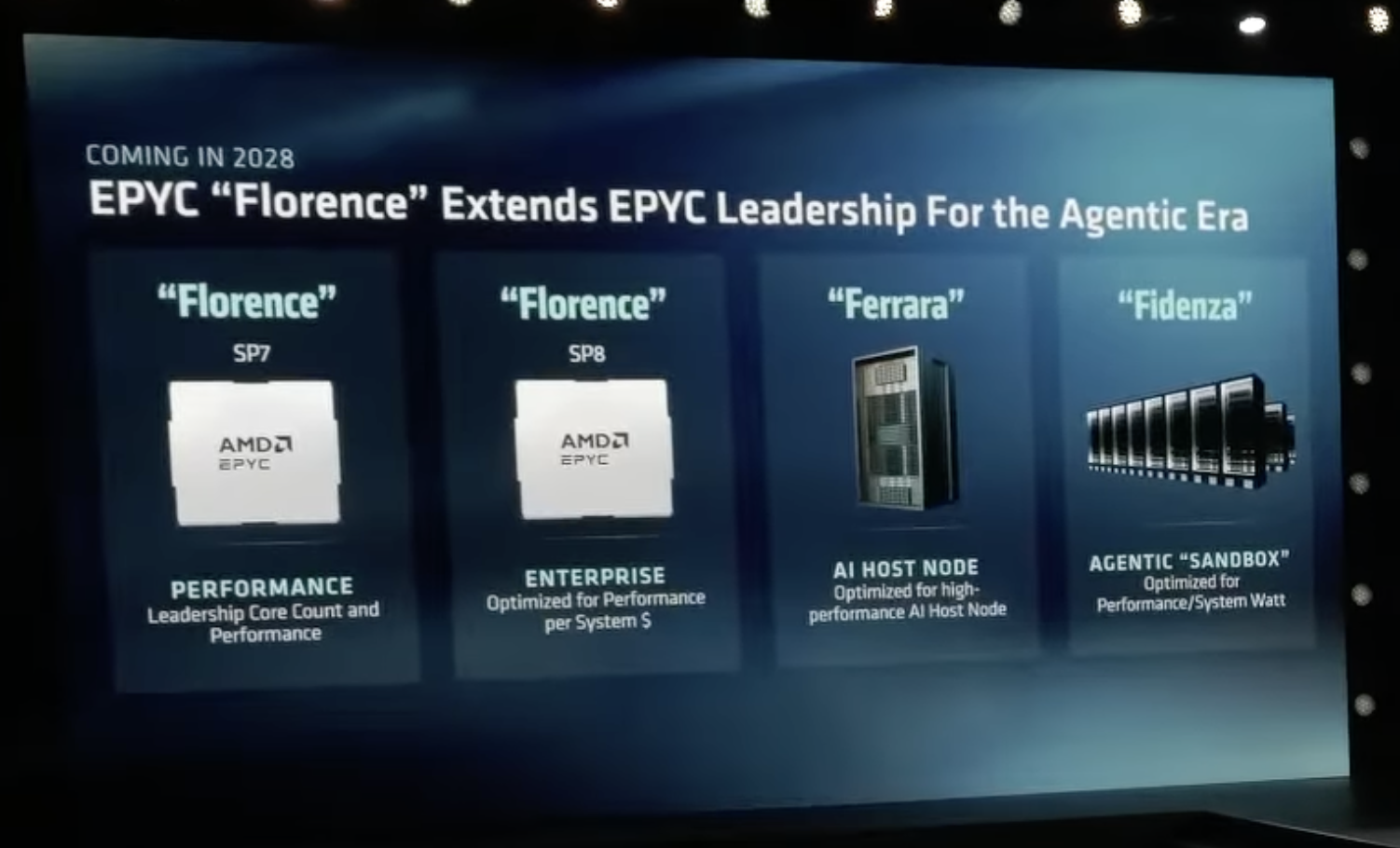
Su said Florence will bring AMD’s next-generation Zen 7 cores, a leading-edge manufacturing process, new AI compute extensions, and support for the latest memory technologies. AMD did not give the useful nerd numbers: no core counts, no process node, no memory layout, and no specifics on what the AI extensions actually do.
Florence is the code name AMD gave to its 2028 Zen 7 EPYC platform. In practical terms, Zen is AMD’s CPU core architecture, and EPYC is the company’s server processor line, so Florence is aimed at the data center rather than consumer desktops.
AMD also said Florence will sit inside a more varied product family. Su named Ferrara, described as an AI host node, and Faenza, described as an Agentic Sandbox, as related parts intended for different AI workloads. AMD’s pitch is that this gives it more specialized CPU options across server use cases rather than forcing one CPU configuration to cover the whole market.
That is the claim. AMD has not yet supplied the architectural detail needed to judge how different those products are, or how much of the differentiation comes from CPU cores, memory, I/O, packaging, firmware, or platform-level integration.
When will Zen 8 Ravenna arrive?
Su said AMD is already developing Ravenna, which she described as the company’s eighth-generation EPYC family built on Zen 8. AMD’s public timing for Ravenna is 2030.
The Ravenna disclosure is thin by design. AMD confirmed the name, the Zen 8 connection, and the development status, but did not announce specifications, process technology, memory support, accelerator links, or product segmentation.
The CPU plan fits AMD’s broader message that it wants a predictable cadence for data center platforms. That matters for cloud providers, AI infrastructure buyers, and enterprise customers that plan server fleets years ahead and would rather not design around vibes.
What did AMD say about Instinct accelerators?
AMD also discussed its Instinct accelerator line. The company said the MI500 series is being built with next-generation HBM, larger scale-up domains, and new copper and optical interconnect technologies.
Su claimed MI500 will deliver the largest generational jump in Instinct history and put AMD on track for more than 2,000 times higher inference throughput over four years. AMD did not provide enough independent benchmark detail in the announcement to verify that claim.
AMD also confirmed that its CDNA Next-based Instinct MI600 family is in development for 2028. At the same event, AMD launched the MI455X GPU and previewed more of its coming MI500X range.
This story draws on original reporting from Tom's Hardware.