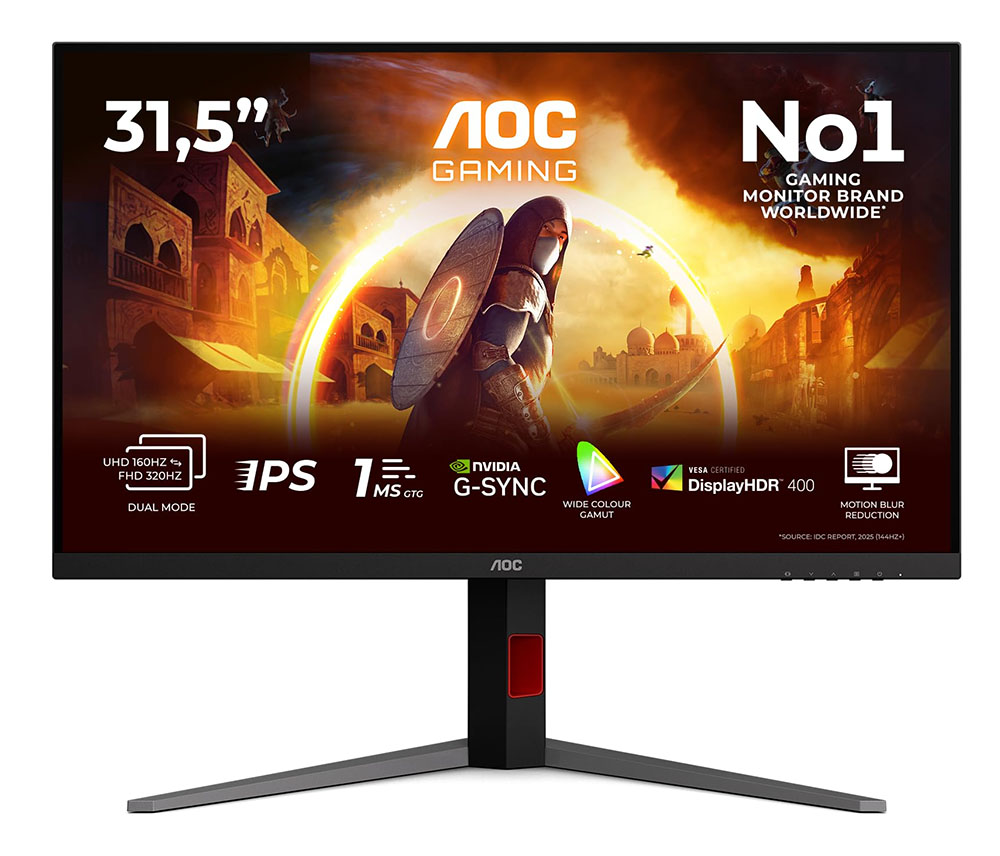
An AOC U32G4 review by Tom's Hardware finds a 32-inch gaming monitor that does the useful trick budget panels keep trying to pull off: 4K at 160 Hz for sharp play, or 1920x1080 at 320 Hz when motion matters more than pixels.
The monitor sells for $320, according to Tom's Hardware, which makes the pitch fairly blunt. AOC is offering a larger 4K screen for less than the 27-inch U27G4XM the reviewer previously tested, though the U32G4 drops that model's Mini LED backlight and uses an edge-lit W-LED array instead. That is the trade, not magic.
The U32G4 uses a 32-inch IPS panel with a 16:9 aspect ratio, DisplayHDR 400 certification, HDR10 support, 10-bit color and DCI-P3 coverage. Tom's Hardware measured about 90% DCI-P3 coverage, roughly 1,100:1 contrast and up to 480 nits for SDR content. AOC's listed specs include 450 nits brightness, 1,000:1 contrast and a 1ms gray-to-gray response time.
Is the AOC U32G4 worth buying?
Tom's Hardware's answer is broadly yes, if the missing creature comforts do not bother you. The review says the monitor delivers low input lag, smooth motion, accurate color after minor adjustment and enough desktop space for productivity, while omitting USB ports, built-in speakers and decorative lighting.
The dual-refresh feature is the main technical hook. At full resolution, the monitor runs 3840x2160 at 160 Hz. Switch modes and it drops to 1920x1080 while doubling the refresh rate to 320 Hz. That makes the image softer on a 32-inch panel, as Tom's Hardware notes, but it also reduces motion blur and can help cheaper gaming PCs reach higher frame rates.
The review also calls out a less common feature: the U32G4's backlight strobing can run alongside Adaptive-Sync. Backlight strobing reduces perceived blur by pulsing the backlight between frames, while Adaptive-Sync matches the monitor's refresh behavior to the GPU's output. Tom's Hardware says the combination worked well when frame rates fell below 120 fps, with some phasing visible.
Connectivity is sparse but adequate for the target use. The monitor includes one DisplayPort 1.4 input, two HDMI 2.1 inputs and a 3.5mm headphone jack. It supports FreeSync and is G-Sync Compatible, according to the listed specifications. The stand provides tilt, swivel, height adjustment and 90-degree portrait rotation, and the chassis includes a 100mm VESA mount.
Tom's Hardware found the Standard picture mode closest to spec and recommended staying there for general use. The review says calibration is possible through RGB sliders for SDR, while HDR modes cannot be calibrated. For HDR10 content, the Display HDR mode was judged the best option because of its grayscale, EOTF and color tracking.
There are caveats. The edge-lit backlight means buyers should not expect OLED-class contrast or Mini LED local dimming. The review also says FHD at 32 inches looks soft, the sRGB mode has some gamma quirks, and the monitor lacks conveniences many desktop setups now expect. For $320, though, Tom's Hardware describes the U32G4 as a strong value for players who want a big 4K screen without paying OLED money.
This story draws on original reporting from Tom's Hardware.