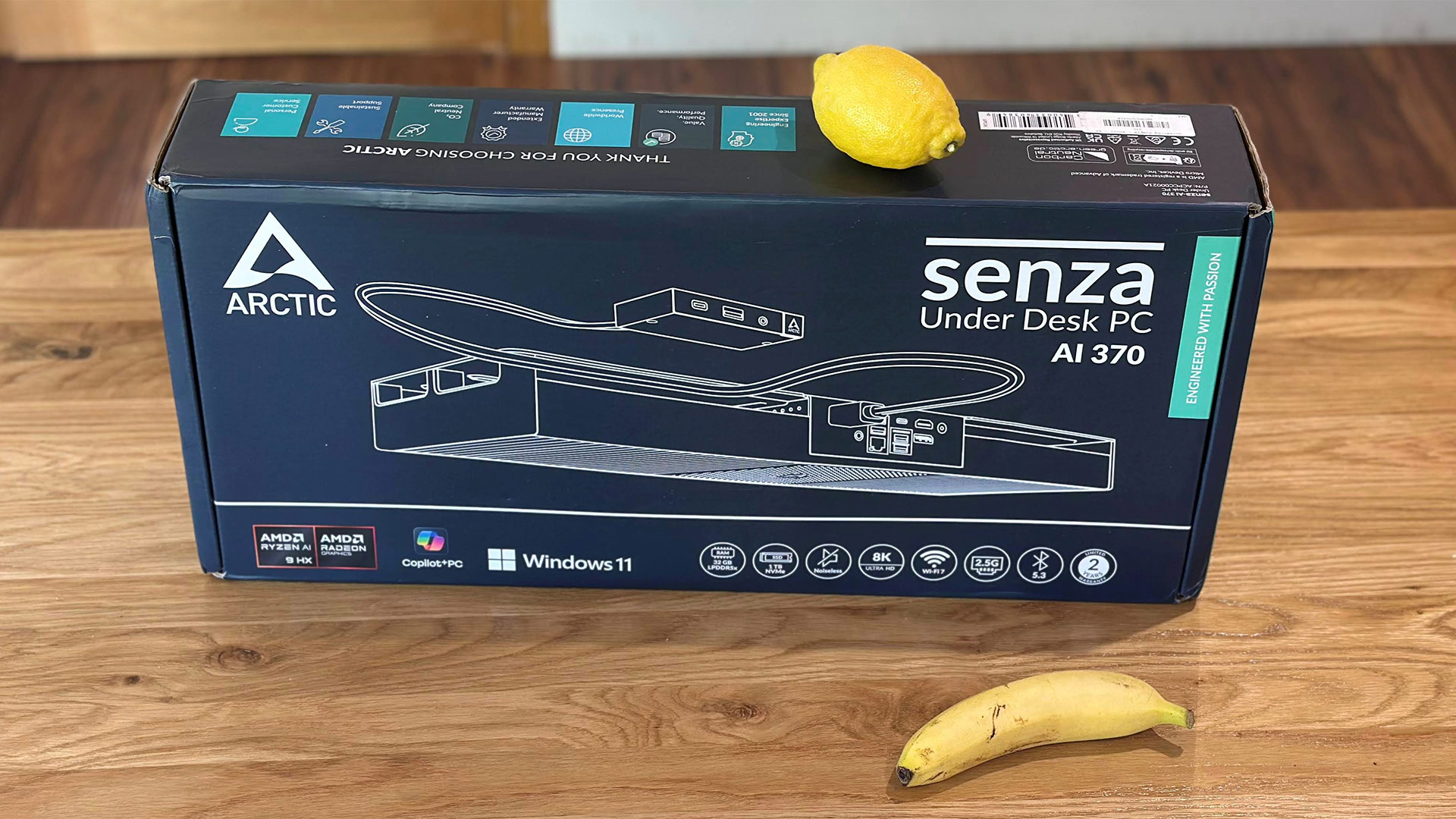
Arctic’s Senza AI 370 is a silent mini PC built to disappear under a desk, and Tom’s Hardware says the design mostly works: it delivers strong performance from AMD’s Ryzen AI 9 HX 370 without a fan whining next to your keyboard.
The “AI” in the name comes from AMD’s mobile chip, which includes a neural processing unit for local AI workloads. The more useful story for most buyers is less glamorous: Arctic built a passively cooled Windows 11 Pro PC with a detachable front-panel button and ports, a 120W external power supply, and mounting hardware meant to keep the actual computer out of sight.
Tom’s Hardware measured the main unit at 21.10 by 7.09 by 1.97 inches, so this is not one of those palm-sized mini PCs that vanish behind a monitor. The size is part of the cooling system. The components sit in the center, while heatpipes spread heat into finned side sections that act as passive radiators.
What Arctic put inside
The tested configuration is the only one Arctic sells, according to Tom’s Hardware. It uses an AMD Ryzen AI 9 HX 370 with 12 cores and 24 threads, integrated Radeon 890M graphics, 32GB of soldered LPDDR5X-8000 memory, and a 1TB PCIe 4.0 NVMe SSD. Arctic lists Linux compatibility, while Windows 11 Pro ships installed.
Connectivity is decent for a machine intended to live under furniture. Tom’s Hardware lists two USB4 Type-C ports, two USB-A 3.2 Gen 2 ports, one USB-A 3.2 Gen 1 port, two USB-A 2.0 ports, HDMI 2.1, DisplayPort 2.0, 3.5mm audio jacks, 2.5Gb Ethernet, Wi-Fi 7, Bluetooth 5.3, TPM 2.0, and DC input for the 120W adapter.
The front-panel dongle carries the power button and some front I/O to a reachable spot. Tom’s Hardware liked the idea, though the reviewer wanted more ports there and ended up using a USB4 dock above the desk for easier peripheral access. That is the price of making the PC pretend it is part of the furniture.
Fast enough, with the usual mini PC catch
In Tom’s Hardware’s productivity tests, the Senza AI 370 handled browsing, office work, and lighter workloads without trouble. More pointedly, it beat or matched newer Ryzen AI 9 HX 470 mini PCs in several tests. In Cinebench 2026 multicore, Tom’s Hardware reported the Arctic machine led the group and was almost 7% ahead of the second-place Beelink SER10 Max.
The review attributes much of that showing to memory bandwidth. Arctic’s soldered dual-channel LPDDR5X-8000 gives the integrated GPU and CPU more room to work than systems using slower memory configurations. The trade-off is familiar and annoying: there are no RAM slots. Buyers need to be comfortable with 32GB for the life of the machine.
Storage is more serviceable. Tom’s Hardware found an M.2 2280 slot with a 1TB YMTC PC411 SSD under an Arctic heatsink, plus an M.2 2230 slot occupied by a MediaTek Wi-Fi 7 and Bluetooth 5.3 card. The review found no other internal expansion options.
Silent does not mean cold
Gaming results were respectable for integrated graphics, with realistic settings doing the heavy lifting. Tom’s Hardware reported 53 frames per second on average in The Division 2 at 1080p using the High preset. In synthetic and game benchmarks, the Senza AI 370 generally beat the tested AMD HX 470 systems, while Intel’s Arc B390 iGPU in the GMKtec EVO-T2 remained faster.
Power draw stayed modest at idle. Tom’s Hardware measured 10W or less from the wall while idle and just under 92W at peak during simultaneous CPU and GPU loads. CPU temperatures sat around 30 degrees Celsius during light use, ranged from 60 C to 70 C during a 30-to-40-minute Division 2 session, and reached 96 C in Cinebench R23 multicore.
Arctic sells the Senza AI 370 in Europe for €1,199.99 with a two-year warranty, according to Tom’s Hardware. The review’s verdict is clear enough: this is a well-built, quiet under-desk PC with real performance, provided buyers accept the size, the fixed memory, and the limited upgrade path.
This story draws on original reporting from Tom's Hardware.