ASRock has started selling all-in-one liquid CPU coolers, adding another category to a catalog better known to PC builders for motherboards, graphics cards, power supplies, and monitors. Tom's Hardware tested two of the first models, the Phantom Gaming 360 LCD and Steel Legend 360 LCD, and the interesting bit is not the little screen. It is that ASRock appears to have built competent high-wattage coolers on the first try.
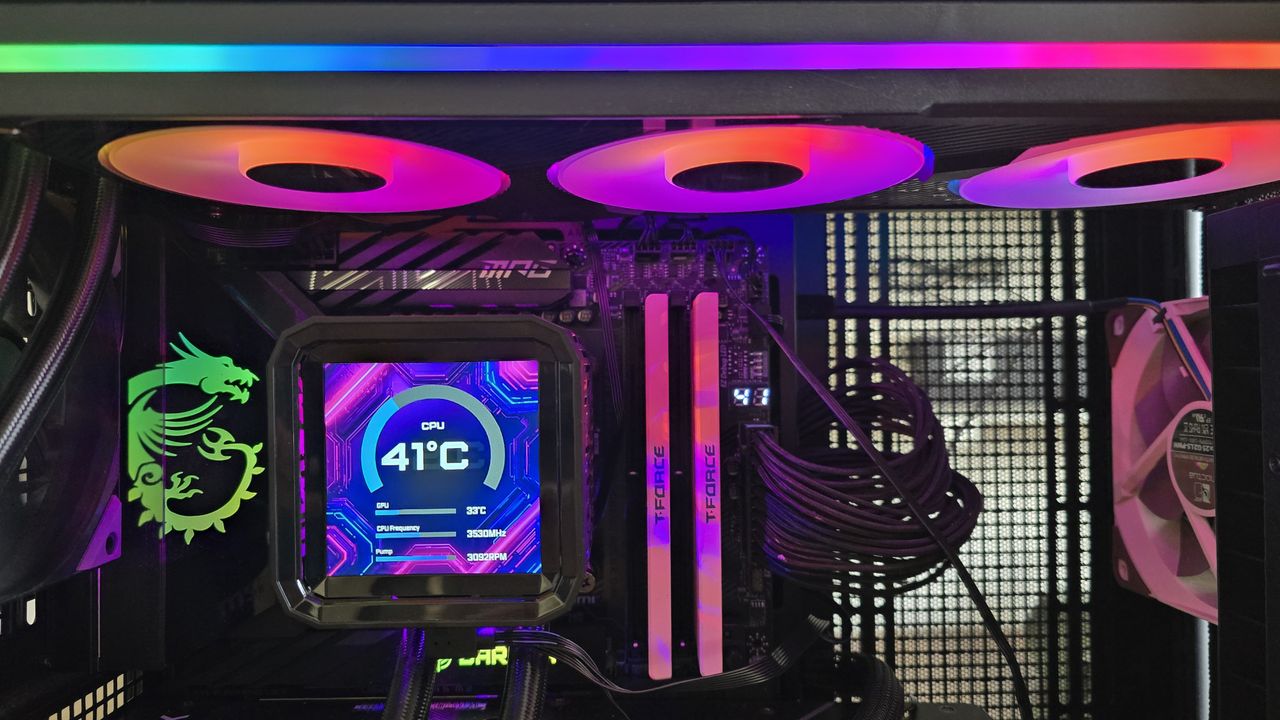
Both units are 360 mm liquid coolers with square 3.4-inch IPS displays mounted on the CPU block. Tom's Hardware lists the panel at 480 by 480 pixels, 60 Hz, and 250 nits. That screen can show animations and system data through ASRock's Polychrome Display software, which offers six preset themes and lets users assemble custom layouts.
The software has limits that will annoy the sort of person who buys a cooler with a display in the first place. Tom's Hardware found that custom background images or videos must be under 20 MB and no higher than 1080p. A 480-pixel pump screen does not need cinema-grade assets, but the restriction is still a very PC-peripheral way to turn decoration into homework.
The two models differ where it counts
The Phantom Gaming 360 LCD is the pricier and flashier model. Tom's Hardware lists it at $189.99, in black, with lighting on the CPU block, radiator, and fans. It uses a 397 mm by 120 mm radiator that is 32 mm thick, deeper than the 27 mm radiator common on many 360 mm AIOs. ASRock gives that model a six-year warranty.
The Steel Legend 360 LCD costs $159.99 and comes in white with gray fan blades. Its radiator has the same 397 mm by 120 mm footprint but a standard 27 mm thickness. Lighting is limited to the CPU block, according to Tom's Hardware, and the warranty is two years.
The fan setups also split the line. Steel Legend uses three separate 120 mm fans, each 28 mm thick, rated for up to 2,500 RPM, 76.7 CFM of airflow, and 4.16 mmH2O of static pressure. Phantom Gaming uses a joined fan block with ARGB lighting, rated for up to 2,400 RPM, 61.28 CFM, and 3.11 mmH2O. The thinner Steel radiator gets stronger fans; the Phantom relies partly on more radiator depth.
Useful hardware under the glass
Both coolers include a 70 mm fan on top of the CPU block, rated at 3,000 RPM, to push air over memory and motherboard voltage-regulator components. Tom's Hardware said its Karhu testing showed that fan cooled those surrounding parts well. That is a practical feature, since liquid coolers often remove the socket-area airflow that tower air coolers provide by accident.
The CPU block does not overhang the DIMM slots, so tall memory modules should fit. Tom's Hardware also noted an unusually thick copper cold plate, more like what it expects on coolers for Threadripper or Xeon-class chips than mainstream desktop CPUs.
The package includes AMD and Intel mounting hardware, tubing clips, thermal paste, the radiator and fans, and the LCD assembly. Tom's Hardware's compatibility list covers AMD AM5 and AM4, plus Intel LGA 1700 and 1851.
Tested on a hot Ryzen chip
Tom's Hardware tested the coolers on an AMD Ryzen 9 9950X3D system with an MSI X870E Carbon WiFi motherboard, MSI Ventus 3X RTX 4070 Ti Super graphics card, TeamGroup DDR5-7200 memory, and a Tryx Flova F50 case. The review emphasizes closed-case testing rather than open benches, which tends to make cooling harder and closer to a normal desktop build.
In Tom's Hardware's specification table, both ASRock coolers handled more than 260 watts with the Ryzen 9 9950X3D. That does not make the LCD useful, or the software elegant, but it does mean ASRock's first liquid-cooling swing is not just motherboard-brand merchandising with tubes attached.
This story draws on original reporting from Tom's Hardware.