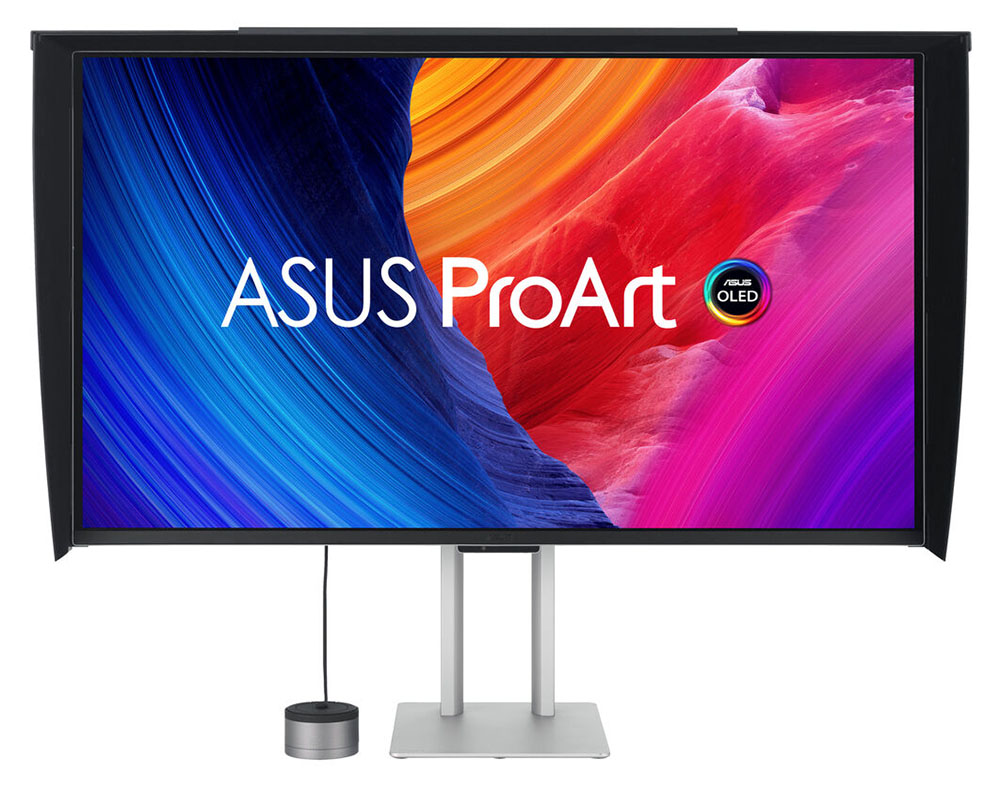
The Asus ProArt PA32UCDMR review case is straightforward: this is a 32-inch-class, 4K QD-OLED monitor built for people who need color-management tools and also want 240Hz motion handling. Tom’s Hardware reported a price of about $1,900 when it reviewed the display. That is a lot for a monitor, and buyers are paying for more than the underlying 3840 by 2160, 240Hz panel.
The PA32UCDMR has a 32-inch, 16:9 QD-OLED panel, true 10-bit color, a listed 0.01ms gray-to-gray response time, and FreeSync and G-Sync compatibility, according to Tom’s Hardware. Asus has paired those gaming-adjacent numbers with selectable color modes spanning sRGB, Adobe RGB and BT.2020. Tom’s Hardware said its testing found the modes accurate out of the box.
That combination makes the monitor a plausible one-screen setup for editing, HDR work and high-refresh use, provided its calibration and connection features are relevant to the job. A buyer interested mainly in 4K gaming should treat those extras, rather than the 4K/240Hz specification alone, as the argument for the premium.
What does the Asus ProArt PA32UCDMR calibration puck do?
Asus bundles a device called CaliContrO, which combines a colorimeter with an on-screen-display controller. Tom’s Hardware says the monitor creates its own test patterns and writes calibration results into its firmware. The puck can control the display menu when connected through USB-C, but performing calibration requires a PC connection.
The review says Asus’s DisplayWidget Center and ProArt Calibration apps are free downloads, and names Calman and ColourSpace as other supported software. This is a practical differentiator for work where regular calibration and defined color modes matter, rather than a vague promise of “pro” pixels.
For HDR, Tom’s Hardware lists HDR10, HLG and Dolby Vision support for the PA32UCDMR. Its tests verified the display’s VESA DisplayHDR 400 rating, measured more than 420 nits using a 25% window, and described peak brightness at roughly 1,000 nits with a 3% window. Those window sizes matter: a small bright patch and a full screen are different workloads. The manufacturer specification is 250 nits full field and 1,000 nits at 3%.
What ports and extras does the PA32UCDMR have?
Connectivity is unusually comprehensive. Tom’s Hardware lists DisplayPort 1.4 with Display Stream Compression, two HDMI 2.1 ports and two Thunderbolt 4 ports, one of which can be used to daisy-chain another display. The main USB-C connection supplies up to 96W of charging power; separate USB-C and USB-A ports can provide up to 15W. There are two 3W speakers, but no headphone jack.
The package also includes a rigid magnetic hood to block surrounding light, a metal chassis, and cables for power, USB-C, DisplayPort and HDMI. The panel, base and upright assemble without tools. Asus provides a three-year warranty, which Tom’s Hardware says can be extended to five years through online registration.
One naming trap is worth avoiding. The reviewed PA32UCDMR is the successor to the PA32UCDM, adding the calibrator while retaining the predecessor’s base specifications, according to Tom’s Hardware. Asus also markets a later PA32UCDMR-K variant. Its official page lists similar core specifications, but says Dolby Vision would arrive through a 2026 first-quarter firmware update. That timing should not be assumed to apply to the non-K PA32UCDMR reviewed here.
Tom’s Hardware found Adaptive-Sync worked with both AMD and Nvidia systems and characterized its response and lag results as among the quickest 4K OLEDs it had tested. The value calculation remains narrow: the PA32UCDMR makes sense for users who will use its supplied measurement hardware, firmware-stored calibration, broad color and HDR modes, hood, Thunderbolt charging and daisy-chaining. The review’s approximately $1,900 figure was time-specific, not a current-price check.
This story draws on original reporting from Tom's Hardware.