A backyard dark matter detection project described by IEEE Spectrum shows that a small homemade radio telescope can reproduce the basic observation behind one of astronomy’s stranger conclusions: material in the Milky Way does not slow down with distance from the galactic center the way visible mass alone would predict.
Dark matter is the name astronomers give to unseen material inferred from its gravity. They do not know what it is, but galaxy motions indicate there is far more of it than the stars, gas and dust telescopes can see.
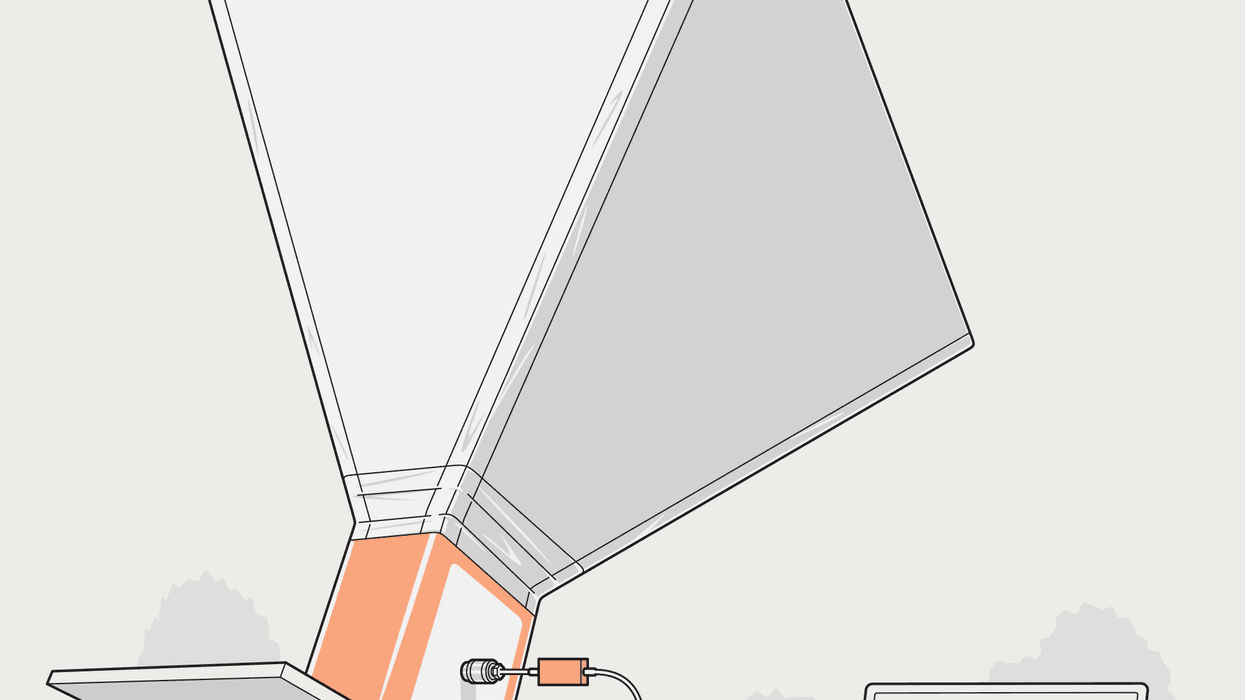
The build used a pyramidal horn antenna made from metal roof flashing, tape and an empty one-gallon paint-thinner can, according to IEEE Spectrum. The design follows the same general idea as the horn antenna used in 1951 to detect the 1,420.4-megahertz radio emission from neutral hydrogen clouds between stars.
That hydrogen line is the useful bit. Neutral hydrogen is spread through the galaxy, and its radio emissions shift slightly in frequency depending on whether a cloud is moving toward or away from Earth. Measure that shift, and you can estimate the cloud’s speed using the Doppler effect.
How can a backyard radio telescope detect dark matter?
The telescope does not see dark matter directly. It measures hydrogen clouds, then uses their orbital speeds around the Milky Way as evidence for how mass is distributed across the galaxy.
If the Milky Way’s mass were concentrated mostly in its bright central region, objects farther from the center should orbit more slowly, the same broad pattern seen in the solar system, where Neptune moves around the sun more slowly than Mercury. If large amounts of unseen mass are spread through the galaxy, orbital speeds should stay high farther out.
IEEE Spectrum’s project used Nooelec’s SAWBird+ H1, a $45 device combining two low-noise amplifiers with a standing-acoustic-wave filter centered on 1,420 MHz, and an RTL-SDR V4 receiver dongle. The larger horn antenna gave better angular resolution than an earlier, smaller 2019 build described by the same publication.
The antenna’s angular resolution was checked against an Inmarsat geostationary satellite and came out to about 20 degrees, IEEE Spectrum reported. The observer then used the Stellarium planetarium program to aim along the Milky Way’s plane at galactic longitudes of roughly 15, 30, 45, 60, 75 and 90 degrees.
The raw radio data came through SDR# software with an IF Average plug-in. By stacking several minutes of measurements, the plug-in made the weak hydrogen signal visible as a spectrum around the 1,420-MHz line. In practice, that line appears as one or more bumps, because the antenna receives emissions from multiple hydrogen clouds at different distances and velocities.
The analysis focused on the cloud with the largest redshift at each pointing direction, meaning the fastest recession from Earth in that field of view. The project modeled the spectra in Microsoft Excel as sums of bell-shaped cloud contributions, then converted six redshift estimates into six orbital speeds and distances from the galactic center.
That conversion used the tangent-point method, which applies trigonometry to observations between galactic longitudes of 0 and 90 degrees. A longitude of 0 degrees points toward the Milky Way’s center, while 180 degrees points away from it.
The resulting points were compared with “The Inner Rotation Curve of the Milky Way,” a recent paper in Publications of the Astronomical Society of Japan. IEEE Spectrum reported that the homemade measurements broadly followed the published rotation curve, though the two innermost points initially showed unusually low orbital speeds and remained somewhat off after another curve-fitting attempt.
The main result was still the one dark-matter hunters care about: the estimated orbital speeds did not drop with distance from the galactic center. A paint can and roof flashing did not solve dark matter, but they did catch its gravitational fingerprint in the Milky Way’s rotation.
This story draws on original reporting from IEEE Spectrum.