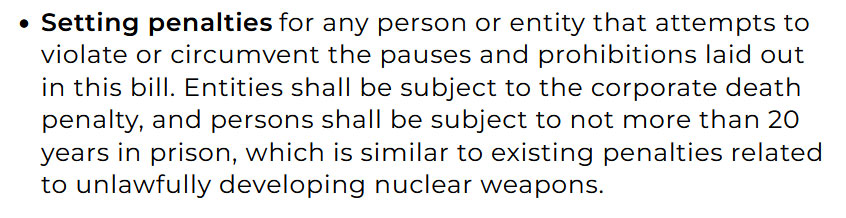
The Bernie Sanders AI prison bill would allow prison terms of no more than 20 years for people who attempt to violate or evade its proposed restrictions on advanced artificial intelligence. Sen. Bernie Sanders, an independent from Vermont, and Rep. Greg Casar, a Texas Democrat, announced the forthcoming Ban Artificial Superintelligence Act on Sept. 3, 2026. It is a proposal, not current law.
According to Sanders’ office, the measure would permanently prohibit the development and deployment of “Artificial Superintelligence” and pause advanced AI development until a new federal regulator is operating with safety rules and model-review processes in place.
The advertised 20-year term is a maximum, not an automatic punishment for people who work on AI. The sponsors’ summary says it would apply to a person who attempts to violate or circumvent the bill’s pauses and prohibitions. It also says entities could face what the sponsors call a “corporate death penalty.”
Sanders’ office compares the proposed individual maximum to existing penalties for unlawfully developing nuclear weapons. That is the sponsors’ characterization; the material does not independently establish the underlying law or an exact equivalence between the penalties.
What would the Bernie Sanders AI prison bill ban?
The proposal’s published summary defines Artificial Superintelligence as an AI system that exhibits, or can readily be modified to exhibit, cognitive performance matching or exceeding humans across a broad range of domains or tasks. It also covers systems with enough capability to plan and carry out humanity’s disempowerment, including by overthrowing or undermining the U.S. government.
Sanders’ announcement separately describes prohibited systems as those that surpass human intelligence or can overthrow human governments, along with systems showing dangerous capabilities such as subverting shutdown commands. The distinction matters: the proposal is framed around a defined class of highly capable systems and a temporary halt on advanced development, rather than a stated ban on every AI product or developer.
Who would enforce the proposed AI restrictions?
Sanders and Casar propose a cabinet-level federal AI agency, advised by an Artificial Intelligence Advisory Board. Their summary says the agency would monitor frontier AI systems throughout their lifecycle, oversee removal of dangerous capabilities, and supervise the destruction of artificial superintelligence.
The measure would also make preventing superintelligence development abroad a U.S. policy goal. The sponsors say it would direct the government to pursue international agreements, coordination with allied countries, and measures including export controls.
The announcement does not show a bill number, committee status, vote, or enactment. It presents the legislation as forthcoming, leaving Congress to decide whether the proposed restrictions, regulator and penalties ever become part of federal law.
Sanders argued that AI companies should not be allowed to advance systems beyond human control. Casar said Congress should ban systems too powerful to control. Those are the sponsors’ stated case for the bill, rather than findings established by legislation or a regulator.
This story draws on original reporting from Tom's Hardware.