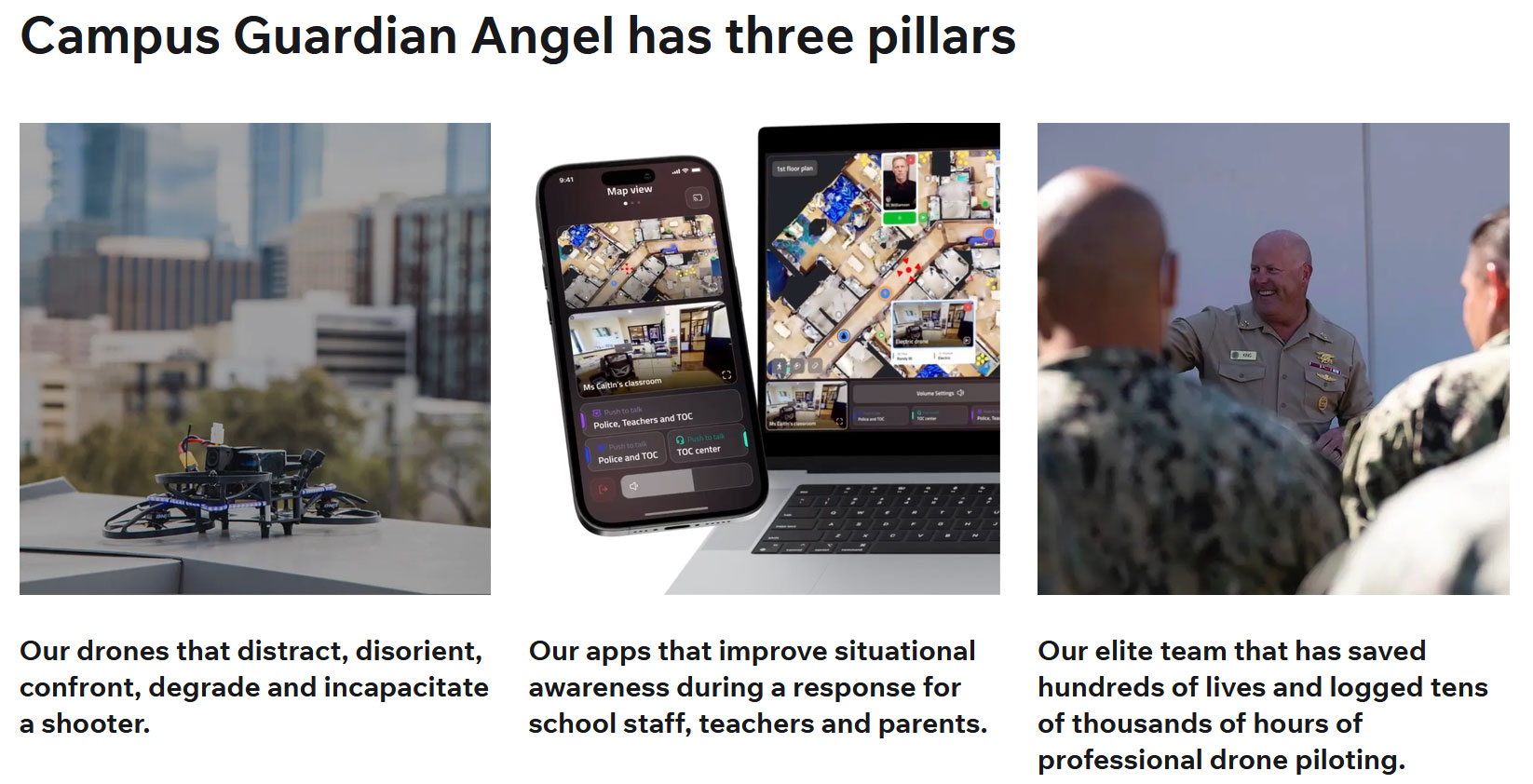
Campus Guardian Angel drones from Mithril Defense are set for pilot deployments in at least nine U.S. schools in Florida, Georgia and Colorado before the end of the year, according to The Washington Post. The system puts remotely piloted drones on campus for active-shooter response, giving schools another security tool that is faster than a human officer in theory and messier in every practical sense.
The Washington Post reported that the trials will include schools with resource officers and schools without them. Mithril Defense describes the drones as staged in secured locations around campus, where teachers can summon them through an app or panic button during an attack.
Once launched, remote pilots would steer the drones toward an attacker and use lights, alarms, pepper gel and physical impact to interrupt the shooting, according to the company’s description cited by The Washington Post. The drones are described as capable of flying at up to 60 mph, ramming attackers and breaking windows.
How do the school pepper-spray drones work?
The system is built around speed: drones are stored around a campus, a teacher triggers an alert, and remote operators take control rather than relying on onboard autonomy to pick a target. Mithril Defense says the drones can reach a shooter in as little as 15 seconds.
- Drones are placed in locked-down locations around school grounds.
- A teacher activates the response through an app or panic button.
- Remote pilots fly the drones toward the threat.
- The drones use strobes, sirens, pepper gel and high-speed impact to distract or disable an attacker.
Justin Marston, Mithril Defense’s founder and chief executive, told The Washington Post that the first 120 seconds are the key window in a school shooting because that is when much of the violence occurs. He also said a drone like Campus Guardian Angel might have saved lives in Uvalde, referring to the 2022 massacre at Robb Elementary School in Texas, where 19 students and two teachers were killed.
That claim is a sales pitch as much as an argument. The Uvalde response was defined by an unusually long delay by law enforcement, with officers waiting more than an hour before entering the classroom. A drone arriving quickly would not by itself answer the harder questions about command decisions, identification under stress or what happens once pepper spray and rotors enter a hallway full of children.
The money is already moving in Georgia. The Washington Post reported that five schools there are expected to receive $500,000 in support for the pilot, and state lawmakers approved the funding without much resistance.
Why are critics worried about drones in schools?
Critics cited by The Washington Post argue that schools may get more safety from prevention work, locked-door routines and lower-tech security steps than from putting armed drones on campus. Others object to bringing drone systems associated with military and police use into schools at all.
There is also the identification problem. A remote pilot under pressure must distinguish an attacker from students, staff or a school resource officer, and the cost of a wrong call could be severe. Mithril Defense’s proposal depends on a fast launch, a fast human assessment and a fast intervention, all inside the same narrow window the company says matters most.
The scale of the problem is not in dispute. The Washington Post reported that nearly 400,000 students have experienced gun violence at school since the 1999 Columbine attack. The question for these pilots is narrower: whether a drone armed with pepper gel and a battering-ram flight profile reduces that danger, or mostly gives frightened districts an expensive machine for a nightmare no gadget can cleanly solve.
This story draws on original reporting from Tom's Hardware.