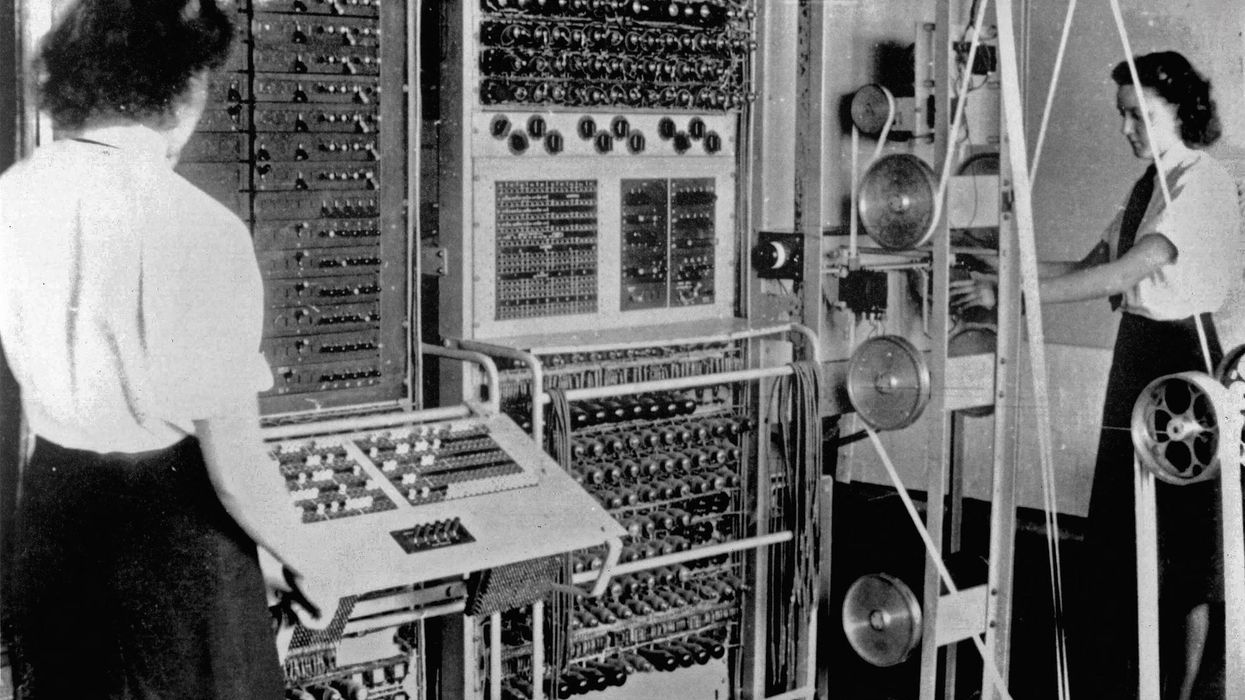
The IEEE will commemorate Colossus, the room-sized British codebreaking computer built during World War II, with a Milestone dedication at Bletchley Park on 29 September. The recognition matters because Colossus was not a museum-friendly prototype waiting for peacetime praise. It was a working electronic system built to crack German high-command traffic while the war was still being fought.
According to IEEE’s Milestone materials, the plaque will be placed outside Block H at Bletchley Park, near Milton Keynes, England, where six Colossus machines operated in 1944 and 1945. The nomination was sponsored by the IEEE United Kingdom and Ireland Section and approved through IEEE’s History Committee and Board of Directors process.
The machine’s target was not Enigma, the better-known German cipher system. In 1941, British intercept operators began hearing high-speed binary teletype transmissions that did not sound like Morse traffic. British codebreakers later identified the system as a Lorenz cipher machine, built by the Berlin engineering firm C. Lorenz and used by Germany’s Armed Forces High Command to communicate with senior commanders.
At Bletchley Park, the British gave the unknown machine the codename Tunny. They did not have the machine in front of them. They had radio intercepts, mistakes by German operators, and a large amount of mathematics.
How Bletchley got from radio noise to a machine
John Tiltman, head of Bletchley Park’s research section, exploited an unusual operator error: two intercepted messages of about 1,200 characters that began with the same sequence of indicators and appeared to be near-duplicates. Tiltman recovered enough plaintext and ciphertext pairings to give the mathematician Bill Tutte the material he needed.
Tutte studied those pairings and worked out, with striking accuracy, the internal logic of the Tunny machine. Alan Turing then developed a method known as Turingery, which used intercepted ciphertext to infer wheel-pin settings. His technique relied on a procedure called delta-ing, or differencing, which compared adjacent characters at the bit level to expose patterns in the cipher.
That was still not enough once German procedures tightened. The helpful message indicators disappeared, and repeated wheel settings became less common. Tutte devised a statistical method that could extract wheel information from ciphertext without depending on those operator mistakes. The catch was computational: the method required enormous amounts of binary counting. Doing it by hand could take months per message.
Flowers builds what the committee would not
Tommy Flowers, an engineer from the British Post Office Research Station, was brought in after Turing recommended him. Flowers had already worked on codebreaking equipment connected to Enigma and had experience with large vacuum-tube switching systems.
Bletchley Park’s advisers initially favored a relay-based machine with some vacuum tubes added for speed. Flowers argued for a fully electronic design using roughly 2,000 tubes. That was a hard sell. Many engineers believed large numbers of tubes would fail too often because of their heated filaments. Flowers’s answer was practical rather than mystical: tubes were more reliable when left on continuously than when repeatedly switched on and off.
After Bletchley rejected the proposal, Flowers and a small team built Colossus in London over 10 months. In January 1944, the machine arrived at Bletchley Park by truck. It was reassembled in about two weeks and produced its first German message result on 5 February 1944.
Colossus read Tunny ciphertext from punched paper tape using photoelectric sensing. It produced wheel information through a printer adapted from a manual typewriter, after which human codebreakers continued the work. A second version, completed in June 1944 just before D-Day, used about 2,400 vacuum tubes and processed 25,000 characters per second, according to the historical account.
By the end of the war, 10 Colossus machines were running at Bletchley Park. The intelligence they helped produce gave Allied commanders access to German strategic and tactical communications. After the war, secrecy won. Most of the machines were dismantled, and operators and engineers were left for years with little public credit.
The IEEE plaque says Colossus “enabled deciphering” of encrypted German radio messages and “anticipated subsequent computer developments.” That phrasing is careful, and rightly so. Colossus did not win the war by itself. People built it, ran it, and interpreted what came out. But it showed that large-scale electronic digital computing could work under wartime pressure, which is a stronger claim than most technology anniversaries get to make.
This story draws on original reporting from IEEE Spectrum.