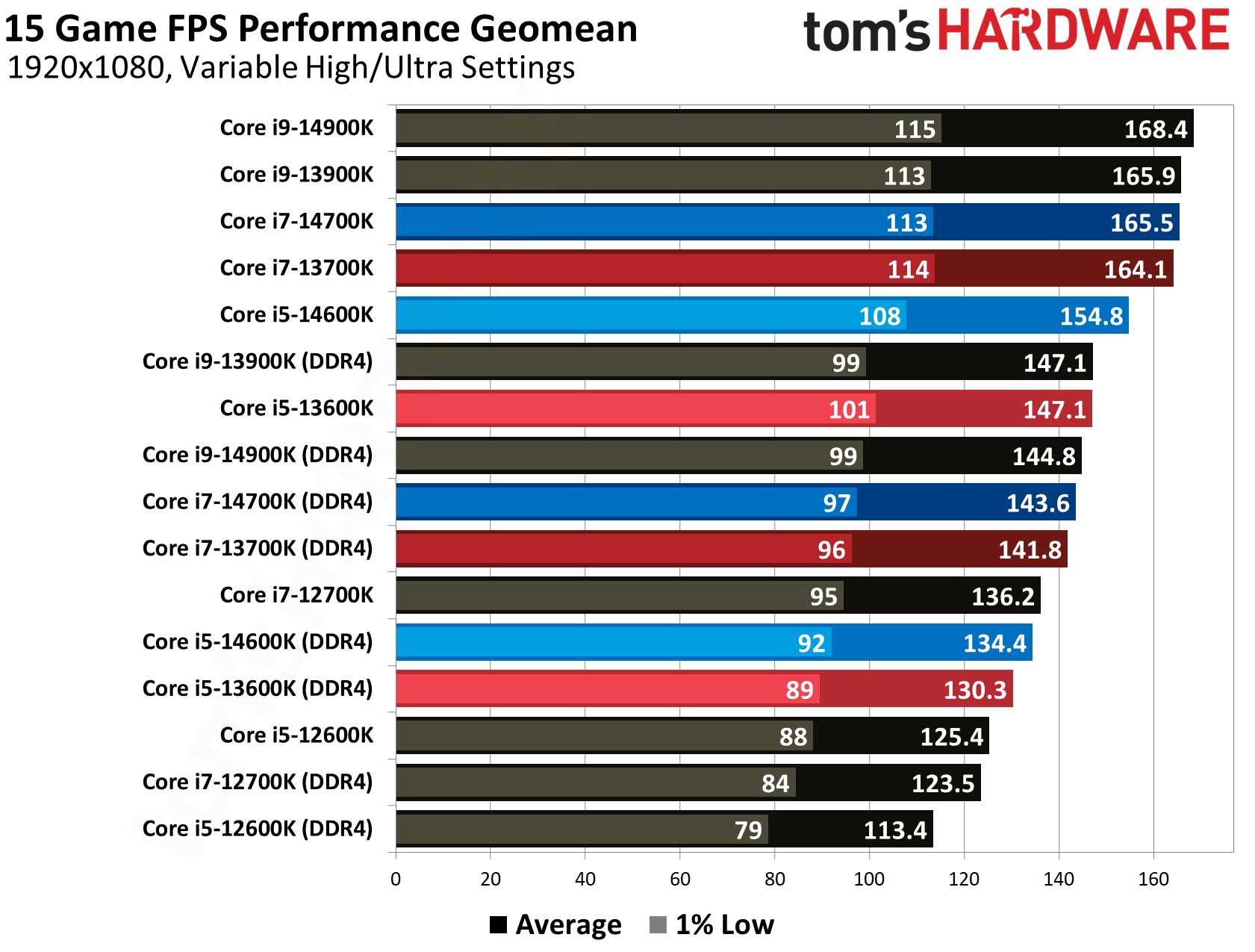
New DDR4 vs DDR5 gaming tests from Tom's Hardware put a number on the compromise behind Intel's LGA 1700 platform: keeping older memory can cost roughly 9% to 14% of average game performance, depending on the CPU, and more than 20% in some titles.
The finding matters because Intel's Alder Lake and Raptor Lake desktop chips are unusual in supporting both DDR4 and DDR5, depending on the motherboard. That makes them a tempting halfway house for people who already own DDR4 or are trying to avoid current DDR5 prices. The catch, according to Tom's Hardware's testing, is that faster CPUs are increasingly held back by the older memory.
How much slower is DDR4 than DDR5 in games?
Across a 15-game test set, Tom's Hardware reported DDR4 performance drops of 14% on the Core i9-14900K, 13.2% on the Core i7-14700K, 13.1% on the Core i5-14600K, 11.3% on the Core i9-13900K, 13.5% on the Core i7-13700K, 11.4% on the Core i5-13600K, 9.3% on the Core i7-12700K and 9.5% on the Core i5-12600K.
DDR4 and DDR5 are system memory standards. DDR5 generally offers higher bandwidth, which can matter when a modern game and a fast CPU are trying to move data quickly enough to keep frame rates high.
The biggest gaps showed up in specific games rather than the average. In Marvel Rivals, Tom's Hardware measured a 25.3% drop for the Core i7-14700K with DDR4, while the Core i5-14600K lost 17.4% and the Core i5-12600K lost 13.9%. In Spider-Man 2, most tested CPUs fell by about 18%, including an 18.7% decline for the Core i9-14900K and a 15% loss for the Core i7-12700K.
Other titles were less severe, but the pattern held. In 007 First Light, the Core i9-14900K was 16.5% slower with DDR4, while the Core i5-13600K dropped 12.7%. Crimson Desert showed losses of 13.7% for the Core i7-13700K and 13.2% for the Core i5-14600K. Counter-Strike 2 was milder: the Core i7-12700K produced the same result with either memory type, while newer, faster chips opened a wider gap approaching 10%.
How Tom's Hardware tested the memory gap
Tom's Hardware said it used Intel LGA 1700 chips because AMD does not offer comparable desktop CPUs that support both DDR4 and DDR5. The Core i9-12900K was left out because the outlet's sample would not boot in DDR5 systems due to a memory-controller problem.
The tests used an Nvidia GeForce RTX 5090 Founder's Edition at 1080p with high and ultra settings. That setup is intentionally CPU-sensitive: higher resolutions tend to push more of the limit onto the graphics card, shrinking CPU and memory differences.
The DDR5 system used an MSI MPG Z790 Carbon Wi-Fi motherboard with 32GB of G.Skill Trident Z Neo RGB DDR5-7200. The DDR4 system used an MSI MPG Z690 Edge Wi-Fi DDR4 board with 32GB of G.Skill Trident Z RGB DDR4-3200. Tom's Hardware said it used a frozen Windows 11 Pro software image, identical drivers, XMP enabled, Resizable BAR enabled and VBS disabled.
Power draw also moved in the wrong direction for DDR4. Tom's Hardware reported that CPU power consumption rose by a few watts in games when using DDR4, although the tested chips stayed well below their thermal limits during gaming workloads.
What does this mean for a PC build?
Tom's Hardware's conclusion is blunt enough: DDR4 still makes economic sense if the memory is already on hand or if DDR5 prices are a hard stop, but it creates a performance ceiling. The outlet also said DDR4 can flatten the gains from buying a faster LGA 1700 CPU, which weakens the case for pairing expensive processors with older memory.
The outlet argued that buyers focused on gaming may be better served by choosing a cheaper modern CPU with DDR5 instead of spending more on a faster DDR4-bound chip. It cited current DDR5 CPU deals from both AMD and Intel, while also noting that DDR5 costs remain elevated and that memory-shortage estimates cited in the report stretch as far as 2030.
This story draws on original reporting from Tom's Hardware.