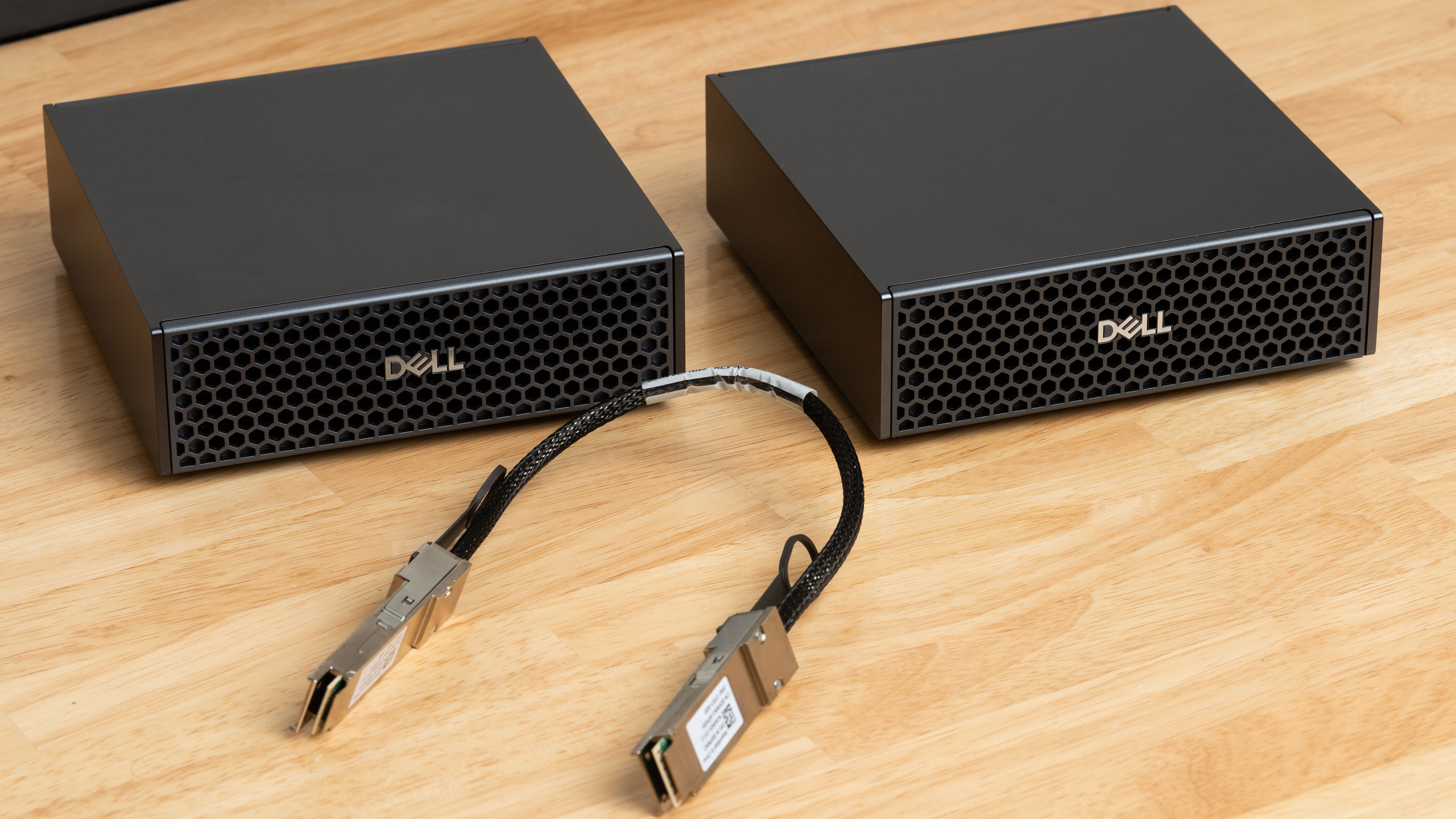
Tom’s Hardware has tested a two-node local AI cluster built from Dell’s Pro Max with GB10, showing how Nvidia’s small Grace Blackwell systems can be linked to run models that do not fit comfortably inside a single 128GB machine.
The setup matters for home labs, research groups, and departments that want a large local memory pool without building a loud, high-wattage GPU server. Each Dell system uses Nvidia’s GB10 platform with 128GB of LPDDR5X unified memory, a Blackwell GPU with 6,144 CUDA cores, 20 Arm CPU cores split between Cortex-X925 and Cortex-A725 designs, a 4TB PCIe Gen 4 NVMe SSD in the tested configuration, and Nvidia DGX OS.
Tom’s Hardware said Dell supplied two Pro Max with GB10 systems and the QSFP cabling needed to connect them. At the time of testing, the reviewed configuration cost $6,332 per box, putting the two-system cluster at $12,664 before roughly $50 for the cable.
The economic argument is narrow but real. Tom’s Hardware compared the pair against a discrete-GPU workstation with more than 128GB of local GPU memory, which can require a Threadripper Pro or Epyc platform, multiple high-memory Nvidia cards, a large power budget, and blower fans that do not belong near people trying to think. The publication estimated that going past 128GB with Nvidia discrete GPUs would start at $20,000 or more for GPUs alone, even using older 48GB Ada cards.
How the cluster works
Nvidia built the DGX Spark platform and similar GB10 systems with ConnectX 7 networking. The Dell Pro Max follows that template with a 200Gbps QSFP interface, 10Gb Ethernet, and Wi-Fi 7. The 200Gbps link supports remote direct memory access over converged Ethernet, or RoCE, which lets the nodes move data across the network with less CPU involvement than ordinary networking.
Tom’s Hardware noted one important trap: Nvidia says GB10 systems support Ethernet for clustering, not InfiniBand, despite ConnectX 7 cards supporting both protocols in other forms. Anyone planning to reuse InfiniBand switching gear for these boxes should read that sentence twice.
The physical networking is also odd. According to the testing, GB10 appears to expose PCIe 5.0 links at x4 width, so the ConnectX 7 connection teams two x4 links behind one QSFP port to reach 200Gbps. The operating system sees two logical interfaces per physical port. Nvidia’s Spark playbook and the community spark-vllm-docker documentation both cover the required configuration.
Setup was not plug-and-play. Tom’s Hardware initially saw only a fraction of expected RDMA bandwidth, even though Dell’s DGX Dashboard reported both systems as current. Command-line apt checks on the second node found a fwupd update held behind Ubuntu-style phasing. Forcing that update exposed additional firmware updates. After applying them and rebooting, NCCL tests approached the expected 25GB/s for a 200Gbps link.
What ran on it
The test used vLLM with tensor parallelism, which distributes model weights across GPUs during inference. Tom’s Hardware also cited SGLang as another possible route, while focusing its testing on spark-vllm-docker.
On DeepSeek v4 Flash, described as a 284-billion-parameter mixture-of-experts model with 18 billion active parameters per token, vLLM capped context at 400,000 tokens on this cluster despite the model’s claimed 1 million-token support. Tom’s Hardware said the recipe used the model’s multi-token prediction feature, keeping decoding throughput roughly steady even as time to first token rose at context lengths above 200,000 tokens.
The testers also ran CyanKiwi’s four-bit quantization of MiniMax M2.7, a 230-billion-parameter mixture-of-experts model with 10 billion active parameters and a 200,000-token context window under vLLM. Without the same multi-token prediction advantage, its throughput dropped as context length approached the limit.
Power and noise were the civilizing details. Tom’s Hardware measured about 375W to 415W at the wall for the two-node cluster during inference tests, with noise around 40 dBA from 18 inches away. That is closer to office hardware than rack gear, though larger clusters would likely need louder 200G or 400G switching equipment.
This story draws on original reporting from Tom's Hardware.