ServeTheHome’s Dell VEP4600 review puts a once-pricey Dell EMC network appliance back in front of homelab and edge-server buyers: the site bought a unit for $495 with a 16-core Intel Xeon D system, 64GB of RAM, a 1TB SSD and ten 10GbE ports.
The configuration reviewed is the Dell EMC VEP4600, though ServeTheHome notes that Dell and VMware versions of the platform exist. The site’s reviewer said he had considered buying one many times over several years before finally purchasing this unit, partly because current memory pricing made the installed 64GB more attractive.
ServeTheHome framed the machine as a template for shoppers looking at similar second-hand network systems, while warning that prices could change after the review and video drew attention to the model. That is the annoying part of surplus enterprise gear: the good deals tend to become less good once people start posting photos of the internals.
What is the Dell VEP4600?
The Dell VEP4600 is a short-depth 1U network appliance aimed at gateway and uCPE-style deployments, the kind of box used where compute and networking need to sit close to traffic. That overlaps with edge computing, where servers are placed nearer to users, devices or branch sites instead of only in centralized data centers.
ServeTheHome measured the chassis at roughly 15 inches, or 38.1 centimeters, deep, with extra rear clearance needed for the fan and power-supply area. The design keeps the front crowded with network and management cabling, while the rear is reserved for cooling and power.
What hardware did ServeTheHome find?
The reviewed VEP4600 has status LEDs, two USB 3.0 ports, a serial port and a management port on the left side of the front panel. ServeTheHome also found an ASPEED baseboard management controller, with its own serial and management connectivity.
The networking is the part that makes the box interesting. ServeTheHome’s unit included two rNDC carriers populated with quad-port Intel X710 cards, adding eight SFP+ 10G ports beyond the base configuration. The site notes that rNDC is Dell’s older proprietary network-card format. The modules may look like standard PCIe cards on risers, but they are not regular PCIe CEM add-in cards.
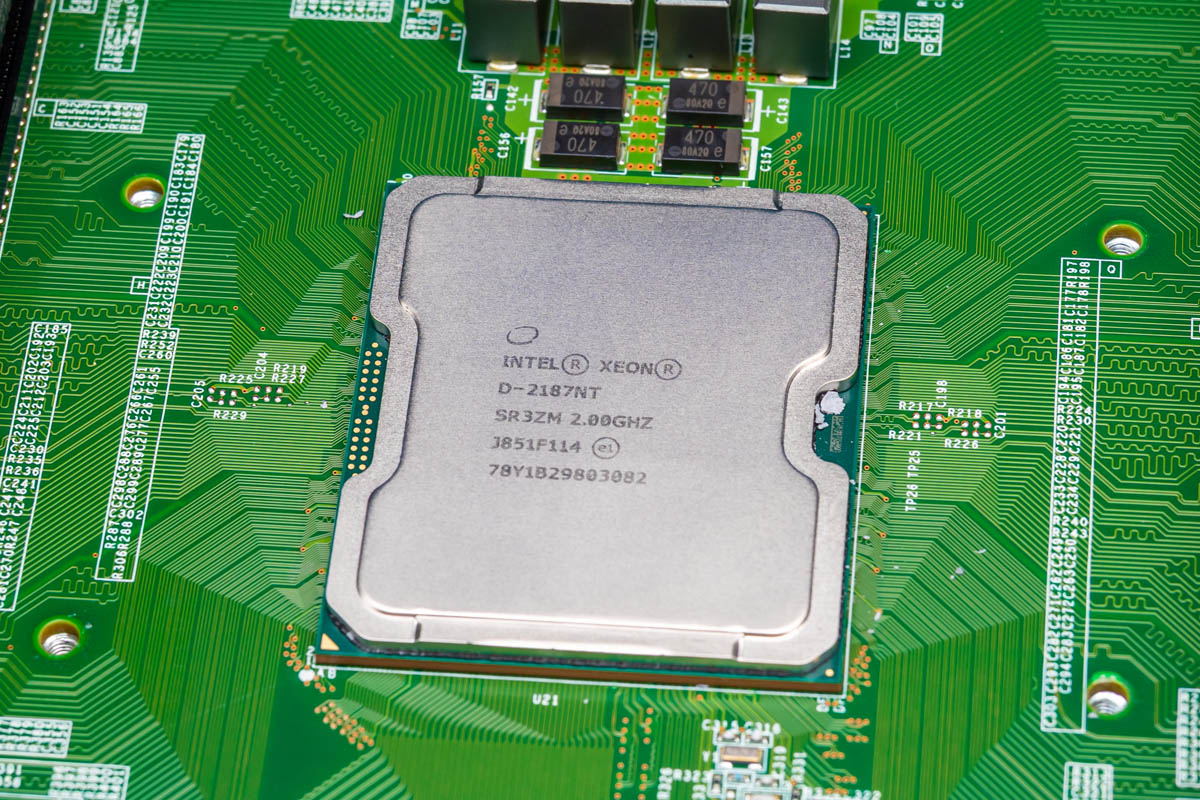
On the right side of the front panel, the Xeon D-2187 SoC provides two Intel X722 10G SFP+ ports. Four additional network ports come from an Intel i350-am4 controller, which ServeTheHome described as a high-quality NIC.
- CPU platform: Intel Xeon D-2187, described by ServeTheHome as a 16-core system.
- Memory and storage in the reviewed unit: 64GB of RAM and a 1TB SSD.
- 10GbE count: ten ports total in the tested configuration, including eight from Intel X710 cards and two from Intel X722.
- Additional networking: four ports from an Intel i350-am4 controller.
Why the rails and power supplies matter
The back of the machine contains hot-swappable fans and redundant power supplies. ServeTheHome’s unit came with two 495W 80Plus Platinum power supplies, which the site said are larger than the system’s actual power needs and better than many 80Plus Gold supplies used in Xeon D-2100-era systems.
The reviewed unit also shipped with rackmount rails. ServeTheHome said those rails are not tool-less, but can be expensive to source separately, and advised used buyers to make sure they are included or at least ask before purchasing.
For buyers chasing a compact x86 network appliance, the review’s draw is clear enough: dense 10GbE, remote management, redundant power and a server-class Xeon D platform in a 1U chassis. The catch is equally plain. This is proprietary enterprise hardware, so the bargain depends on the exact configuration, accessories and replacement parts that come in the box.
This story draws on original reporting from ServeTheHome.