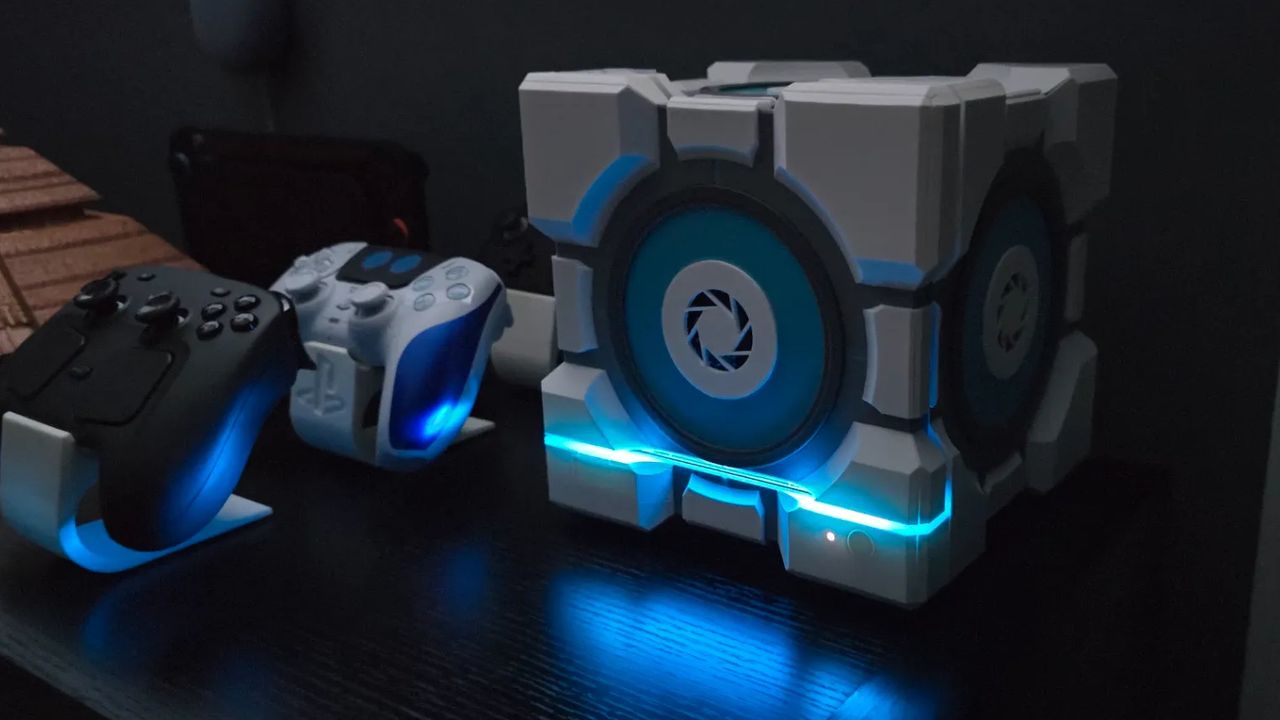
A 3D printing hobbyist has published a make-it-yourself version of the Steam Machine case dbrand abandoned after running into Valve’s intellectual property wall.
The design, posted on Printables by a user named Jaron, turns Valve’s Steam Machine into a Portal-style Companion Cube. Jaron describes the project as an unofficial case for the Steam Machine, with no affiliation to Valve, Steam, or official game assets.
The timing is pointed. dbrand had announced its own Companion Cube accessory for Valve’s small gaming PC, then killed the product after saying Valve told the company the cube design was Valve intellectual property and that dbrand did not have a license. dbrand said last month that it had tried to get permission after the fact, without success.
A home-printable clone, with caveats
An X post about the project says Jaron modeled the case from scratch using images of dbrand’s canceled design as reference. That means the files are not presented as leaked dbrand assets. It also means the legal situation is still awkward, because the whole object is built around a design language Valve has already asserted as its own.
The Printables listing says the case can be made on a single-extruder 3D printer, provided the printer can pause at chosen layers so the user can swap filament colors. Jaron says a slicer is needed to produce the multi-color panel effect.
The build is more involved than printing a phone stand and calling it a weekend. Jaron’s listing includes a bill of materials with screws, threaded inserts, and magnets, along with Amazon links for parts. The instructions also call for a soldering iron, tweezers, and screwdrivers. Jaron lists the specific Sunlu and Overture filaments used for the pictured version.
Jaron has also posted assembly instructions and several YouTube videos showing the process. Based on the parts list and finishing work, this is aimed at users who already know their way around printer settings and small hardware, not someone trying their first Benchy.
Thermals are the unresolved part
A decorative shell around a compact gaming PC raises the obvious cooling question. Jaron says they have not run extensive thermal tests on the printed case. They also say the design avoids blocking the Steam Machine’s airflow paths and vents. According to Jaron, an added opening in the faceplate could even improve cooling, though that remains an unverified claim until someone measures it under load.
dbrand introduced its Companion Cube accessory on November 12, the same day Valve announced the Steam Machine. The company later said it had spent thousands of hours on industrial design, injection molding, and marketing before conceding that it had not secured Valve’s permission. In dbrand’s own statement, Valve said the Companion Cube was its intellectual property and dbrand lacked a license.
Valve’s Steam Machine launched last month as a living-room gaming PC alternative. It costs $1,049, a price the company attributed in part to higher RAM and SSD costs tied to AI-related demand. The hardware includes a semi-custom six-core AMD Zen 4 processor, RDNA3 graphics, 16GB of DDR5 memory, and up to 2TB of SSD storage.
That makes the Steam Machine more expensive than console rivals, while still looking competitive against similarly configured PC hardware. For buyers who already have one, Jaron’s files offer a route to the Companion Cube look dbrand could not sell, assuming they are willing to print, assemble, and accept the thermal unknowns themselves.
This story draws on original reporting from Tom's Hardware.