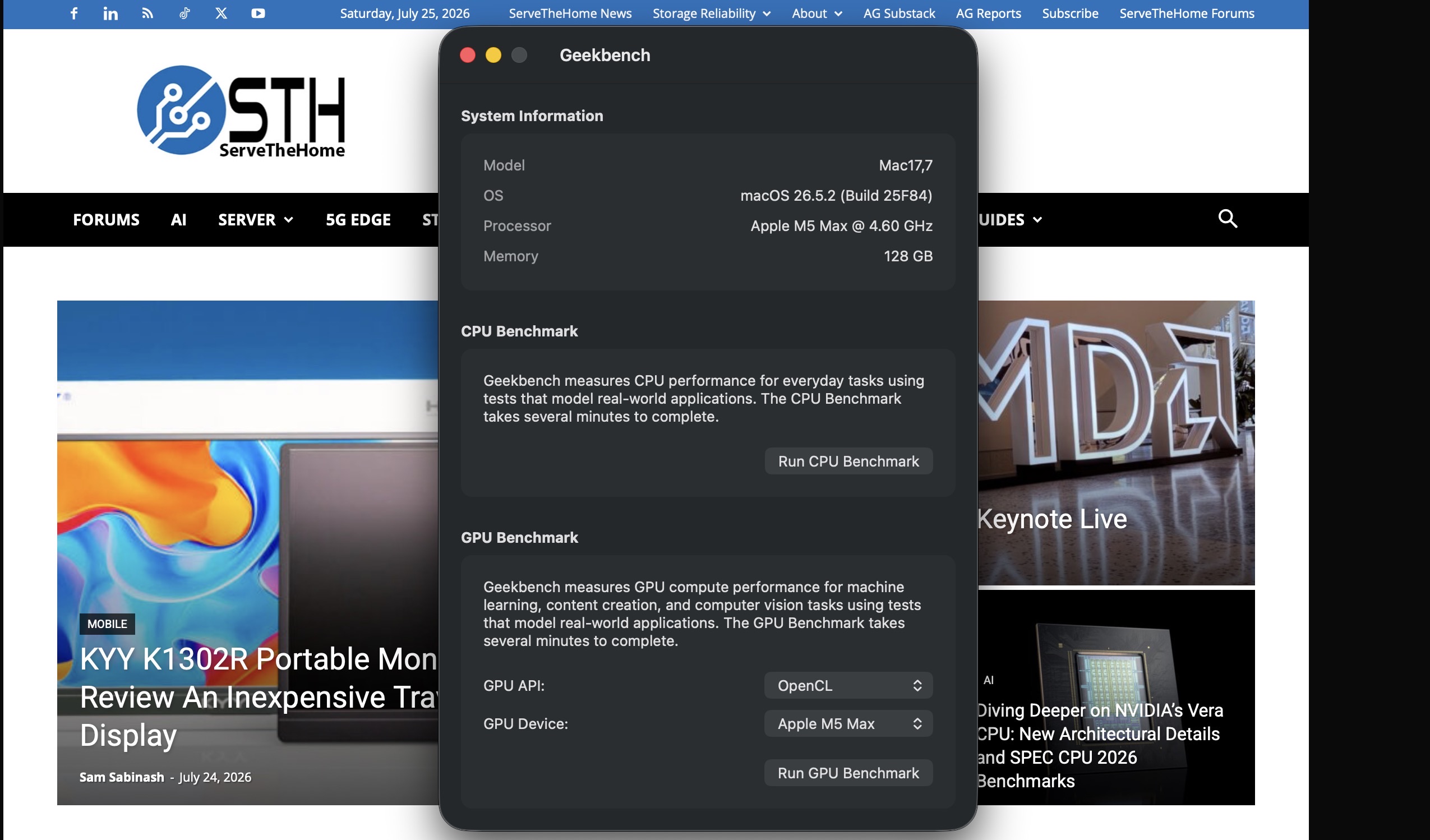
Geekbench 7 is now available, and the practical consequence is immediate: benchmark charts built around Geekbench 6 need a divider line. ServeTheHome reports that the new release changes the CPU and GPU workloads, adds NVIDIA CUDA support, and uses new score anchors, which means its results are not directly comparable with the previous version.
The benchmark remains built for broad reach rather than lab-grade inconvenience. According to ServeTheHome, versions are already available for Windows, Linux, macOS and Android, with Linux preview builds also appearing for Arm and RISC-V systems.
What changed in Geekbench 7?
The score scale has been reset. ServeTheHome says the CPU score now uses a Lenovo Legion laptop with a Ryzen 7 7700 as the 2,500-point reference. The GPU scale uses the same laptop with a GeForce RTX 4060 as the 100,000-point reference.
That reset is not cosmetic. Geekbench 7 uses different assumptions about what modern machines spend time doing, especially on phones, laptops and smaller workstations. A benchmark score is only useful when the workload resembles something a user or developer cares about; otherwise it becomes numerology with a progress bar.
The CPU suite now includes a media group aimed at workloads such as calls, streaming and playback, according to ServeTheHome. The single-core and multi-core suites have also diverged more than before, so the multi-core number should not be read as a clean throughput test in the style of SPEC CPU2026.
Several carried-over CPU tests have grown. File compression now covers three archive types, using LZ4, zlib and Zstandard with SHA1 checks. PDF Viewer renders six documents using PDFium. Photo Library adds JPEG-XL and DNG handling alongside JPEG, labels images with MobileNetV1 SSD, and records results in SQLite. Photo Editor now runs across ten images with a broader set of changes.
Other CPU workloads remain familiar in outline, including OpenStreetMap routing, a headless browser processing eight pages, Clang compiling Lua, Python 3.13 converting 190 Markdown files into HTML, Blender Cycles ray tracing and Jolt physics, ServeTheHome reports.
How do the new media and GPU tests work?
The media tests are more involved than a single encode pass. Video Encoder uses desktop captures with synthetic cursor movement and sends them through the AOM AV1 encoder, modeling a screen-share workload. Audio Encoder processes two minutes of music and speech with Opus. Video Decoder combines multiple steps: handling an AV1 stream, decoding an Opus track, resampling audio and feeding the output into Whisper for captions.
The GPU benchmark has shifted toward machine-learning and creative tasks. ServeTheHome lists DeepLabV3+ for background blur, RetinaFace for face filters, and RFDN upscaling from a 256-by-256 tile to 1024-by-1024. The suite also includes editing work, horizon correction, photo filters, LUT color grading using tetrahedral interpolation, and a RAW pipeline covering noise, color and demosaicing.
Additional GPU work includes feature matching, a path tracer using Blender’s BMW scene, and two simulation tests. The more consequential platform change is CUDA support, which lets NVIDIA GPUs run natively rather than through a translation layer, according to ServeTheHome. That should make NVIDIA comparisons less contorted, though benchmark results still depend on the workload mix.
What should reviewers watch for?
ServeTheHome says Geekbench 7 is better understood as a benchmark for interactive devices and modest workstations than for high-core-count servers. Its multi-core test is not designed as a multi-tenant or pure throughput workload, so large server CPUs may not scale the way they do in tests built for sustained parallel work.
There is also an early results-browser annoyance. ServeTheHome reports that uploaded Geekbench 7 results added to an account did not yet appear on the account page, and recommends saving result URLs for now. The site says it expects to start using Geekbench 7 in its own reviews over the coming weeks.
This story draws on original reporting from ServeTheHome.