Gigabyte CXMT memory support is now public for selected AMD Socket AM5 and Intel LGA 1851 motherboards, with the company claiming speeds up to 8200 MT/s on some boards. That matters because ChangXin Memory Technologies, better known as CXMT, is trying to become a larger fourth supplier in a DRAM market long dominated by SK hynix, Samsung and Micron.
Gigabyte said its boards support DDR5 modules using CXMT chips, also identified by the JEDEC manufacturer ID code CXSH. The company specifically cited support for modules built with 16-gigabit and 24-gigabit ICs. In practice, that covers 16GB and 24GB single-rank DIMMs, plus 32GB and 48GB dual-rank DIMMs.
What did Gigabyte show with CXMT memory?
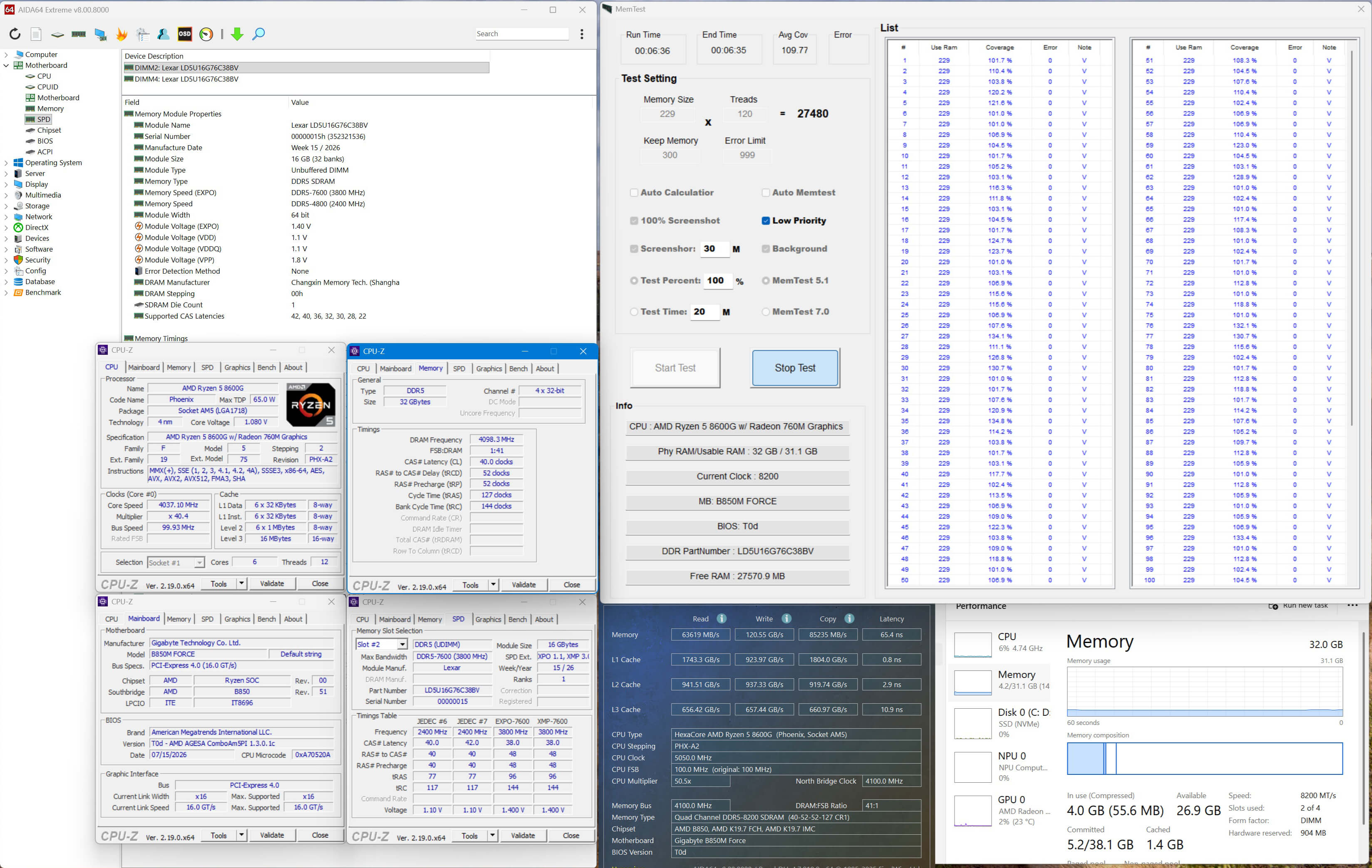
Gigabyte published a CPU-Z validation using two 16GB Lexar DDR5 modules with CXMT chips on a B850M FORCE motherboard. The screenshot showed the pair running at 8200 MT/s with CAS latency set to 40 cycles.
The test system used AMD’s Ryzen 5 8600G, and Gigabyte did not disable the processor’s integrated graphics for the run. The company’s screenshot did not show the voltage used to reach that speed, which is a useful missing number for anyone trying to judge how practical the setting is outside a validation run.
According to Tom’s Hardware, the same setup produced an AIDA64 memory latency result of 65.4 nanoseconds. For comparison, Tom’s Hardware said typical EXPO DDR5 kits tend to sit around 80 ns, JEDEC settings are closer to 100 ns, and LPDDR-based systems often land around 110 ns to 120 ns.
Why CXMT DDR5 support is showing up now
CXMT is expanding production as China works to reduce reliance on foreign DRAM suppliers, and Tom’s Hardware has reported that the company is increasing capacity quickly. Gigabyte framed CXMT-based memory as another supply source for consumers, which is a practical point in a market where DRAM availability and pricing have become more painful for PC builders.
MSI appears to have moved first among major motherboard vendors in publicly promoting BIOS work for CXMT DDR5, according to Tom’s Hardware. MSI initially aimed those optimizations at China-market BIOS releases, then followed with broader announcements. Gigabyte’s announcement is broader in platform language, covering both AMD AM5 and Intel LGA 1851 boards, while also pointing to the 8200 MT/s result on AM5.
Will PC builders outside China see CXMT RAM?
Availability outside China remains unclear. Tom’s Hardware reported that CXMT chips have appeared in products from vendors including Corsair, HP and Dell, and that Apple has shown interest in access to Chinese memory chips. A Corsair Vengeance DDR5-6000 module using CXMT chips has also been identified, though that product was described as China-exclusive.
CXMT is not on the U.S. Commerce Department’s Entity List, so its memory is not banned under that program. The company is, however, again listed by the U.S. Department of Defense as a Chinese military company under the 1260H list after a brief removal in February, according to Tom’s Hardware. Some U.S. lawmakers have called for restrictions on Chinese memory chips, citing supply-chain and national security concerns.
For most DIY buyers, the brand on the DIMM matters more than the DRAM die maker. People usually buy memory from module vendors such as Corsair, G.Skill, Patriot or Silicon Power, rather than directly from SK hynix, Samsung, Micron or CXMT. Gigabyte’s announcement means at least some CXMT-based DDR5 modules now have named motherboard support instead of relying on hope, BIOS luck and forum archaeology.
This story draws on original reporting from Tom's Hardware.