GPU prices 2026 remain stubbornly high in the latest U.S. retail snapshot from Tom’s Hardware, with every listed current-generation Nvidia and AMD card priced above its launch MSRP. That is a retailer-price finding, not evidence that Nvidia or AMD changed their official MSRPs, but it leaves PC builders paying more than the launch-price stickers suggested.
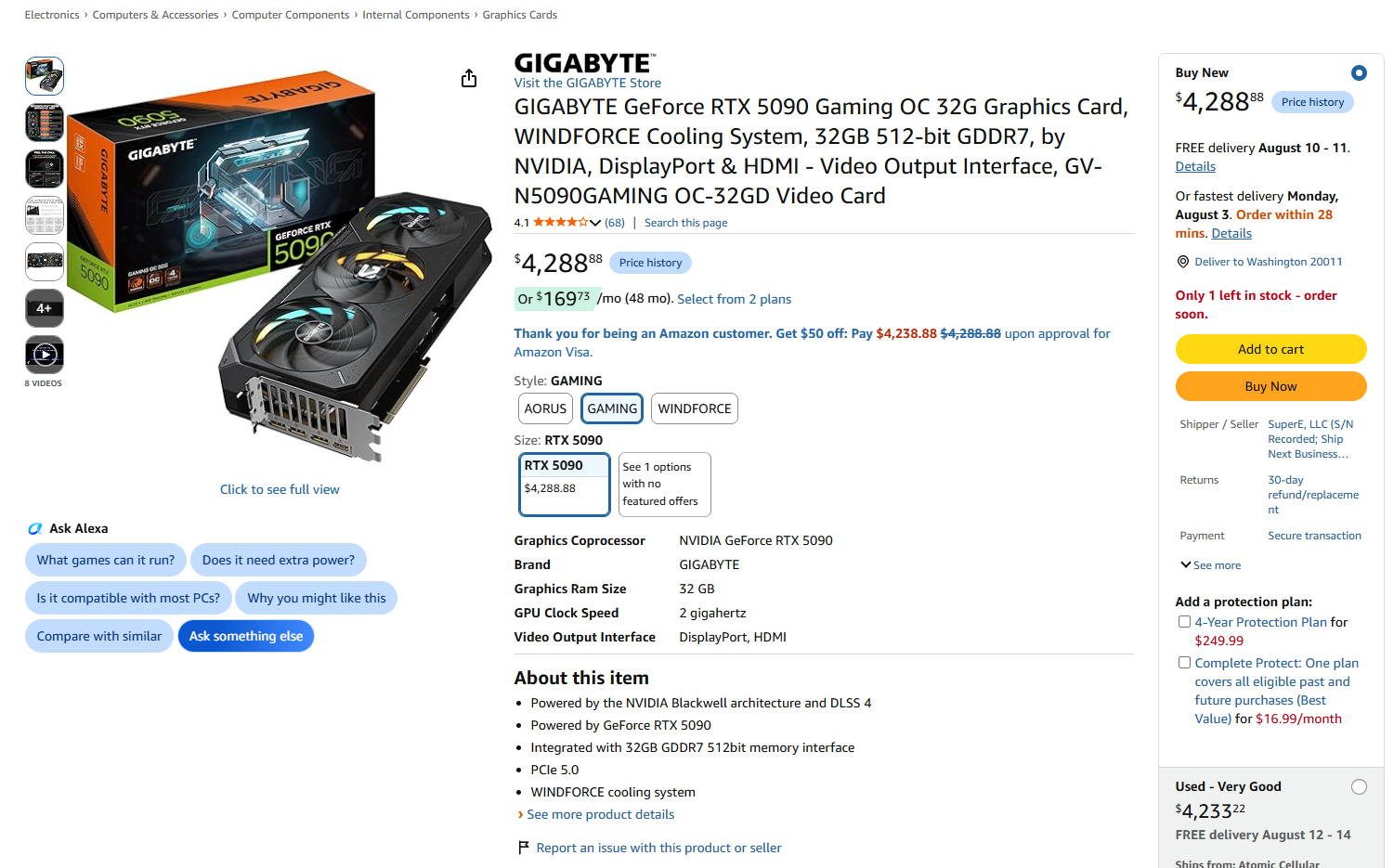
The most extreme entry is Nvidia’s GeForce RTX 5090. Tom’s Hardware listed its best available U.S. price at $4,288, against a $1,999 launch MSRP, a difference of $2,289, or 114.5%. The tracker’s lowest recorded price for that model was also $1,999.
Other cards are less absurdly marked up, though still above their launch baselines in that snapshot. The RTX 5080 was listed at $1,256 versus $999; the RTX 5070 Ti at $949 versus $749; and the 16GB RTX 5060 Ti at $569 versus $429. On AMD’s side, the Radeon RX 9070 XT was listed at $719, up from its $599 launch MSRP, while the RX 9060 XT 16GB was at $449 against $349.
Why are GPU prices still high in 2026?
Tom’s Hardware attributes the pressure in part to more expensive high-speed graphics memory, or VRAM, amid AI-related demand for memory. Wccftech separately reported that constrained DRAM availability and higher DRAM prices were affecting graphics-card prices. Those are industry-publication explanations, not a demonstrated accounting of Nvidia’s, AMD’s, or board partners’ component costs. Neither report supplies memory-contract pricing or GPU bill-of-materials data.
The broader direction is not confined to one day’s U.S. listings. Wccftech, reporting on TechSpot’s comparison of lowest prices in 10 countries from November 2025 to February 2026, said U.S. prices rose 43% for the RTX 5080, 40% for the RTX 5090 and 37% for the RTX 5070 Ti. It also reported a 25% increase for the RTX 5060 Ti 16GB over that period. The comparison measures lowest prices in distinct months, so it is not a manufacturer price list or a universal checkout price.
Did current-generation GPUs get discounts?
Tom’s Hardware said major sales events such as Black Friday and Prime Day did not bring notable below-MSRP discounts overall. Its own tracking also shows that bargains did exist for some models at earlier points: the RTX 5070 reached $479 versus a $549 MSRP, the RTX 5060 Ti 16GB reached $379 versus $429, and AMD’s RX 9060 XT 8GB reached $259 versus $299.
The useful distinction is between launch MSRP, a model’s lowest observed price, and the live retailer listings visible at a particular moment. Prices vary by card variant, memory capacity, seller, country and stock, so a $4,288 RTX 5090 listing is evidence of a painful market snapshot, not a claim that every buyer faces that exact price.
This story draws on original reporting from Tom's Hardware.