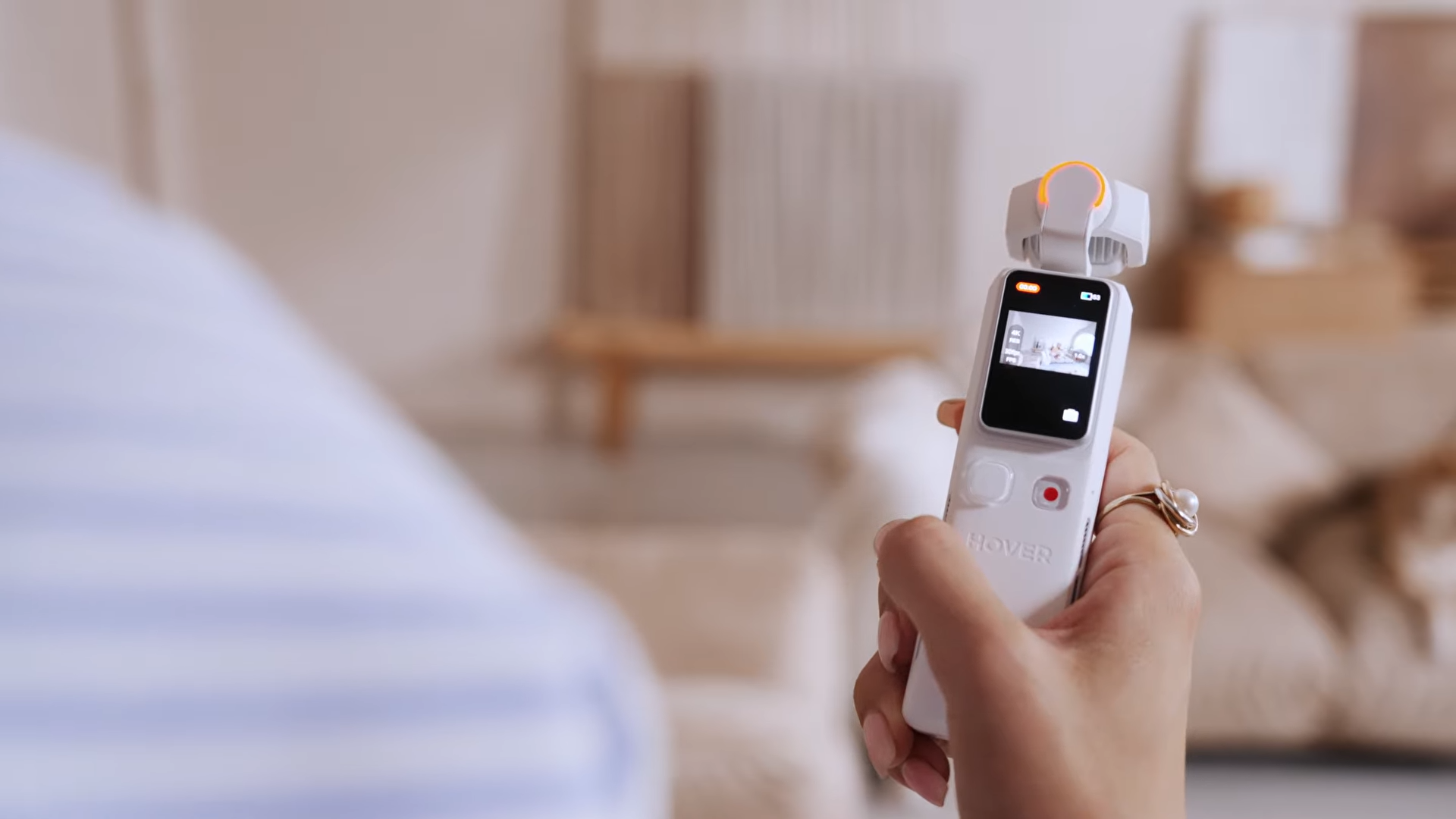
HoverAir has announced the HoverAir Versa flying camera, a modular device intended to serve as both a handheld pocket camera and an autonomous aerial camera. The pitch is straightforward: carry one camera module for stabilized footage on the ground, then connect it to a flight frame when the shot needs to leave the ground. Whether it can do both jobs well remains an open question, because HoverAir has not released the specifications that would let buyers judge it.
In its handheld setup, Versa has a built-in display, physical controls and a three-axis mechanical gimbal for stabilized handheld footage, according to New Atlas and Newsshooter. HoverAir’s own product page currently offers little beyond the product name, the line “This Pocket camera can fly,” and an email sign-up form.
How does the HoverAir Versa flying camera work?
Reports from New Atlas, Tom’s Hardware and PetaPixel describe Versa as two pieces: the pocket camera and a detachable propeller-wing module. With the flight module attached and its arms unfolded, the combined unit is intended to take off from a user’s palm without a conventional controller.
HoverAir says the flight mode uses AI-based subject tracking and framing assistance, and includes more than 10 automated shooting modes. Those are company capability claims, not results from independent testing. The launch material also promises no piloting skills are needed, but it does not spell out the tracking system’s limits, the conditions it needs to work, or how it responds when it loses a subject.
One advertised mode, called 3D Worlds, is designed to send the camera through an automated 360-degree flight path, capture images from multiple angles and turn them into an explorable, shareable 3D scene. PetaPixel and Newsshooter both reported the feature based on HoverAir’s announcements. It is conceptually different from recording 360-degree video: HoverAir is describing an image-capture and reconstruction workflow.
What is known, and what is still missing?
The known part is the modular arrangement and the company’s stated controller-free, tracking-focused workflow. The missing part is most of the purchase-critical data. HoverAir has not announced a price, release date, battery life, camera resolution, lens details or a full specification sheet, according to Newsshooter, PetaPixel and Tom’s Hardware.
HoverAir also claims an industry-leading image processor, strong dynamic range and low-light performance. Until the company publishes sensor and lens specifications and reviewers can test shipping hardware, those remain marketing statements rather than established performance.
The potential appeal is reducing a handheld gimbal camera and a selfie drone to one shared camera module. It also concentrates the usual trade-offs into one unreleased product: flight time, weight, image quality, stabilization, durability and the reliability of the detachable connection are all still unanswered. For now, Versa is an announcement with a plausible workflow, not a camera buyers can compare on a spec sheet.
This story draws on original reporting from Tom's Hardware.