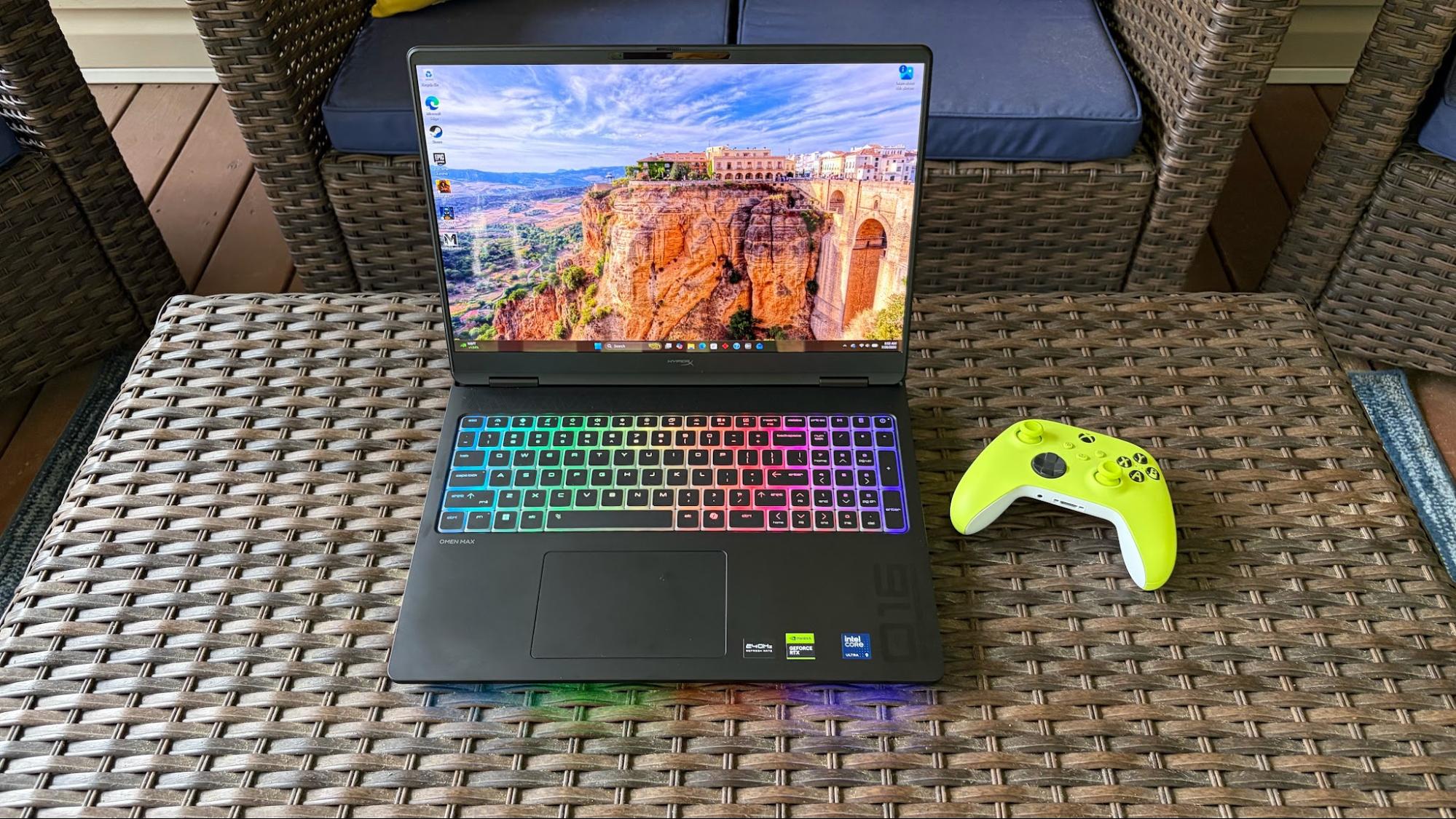
The HyperX Omen Max 16 review from Tom’s Hardware lands on an awkward result for HP: its $4,699.99 flagship configuration brings the weight, power brick and component list of a desktop replacement, but sat near the back of the publication’s stated gaming comparison group except in Far Cry 6. That does not make the machine slow. It makes the value proposition hard to swallow at this price.
The tested unit pairs Intel’s Core Ultra 9 290HX Plus with Nvidia’s RTX 5090 Laptop GPU, configured at up to 175W, alongside 32GB of DDR5-6400 memory and a 2TB PCIe 5.0 SSD. Its 16-inch OLED runs at 2560 by 1600 with a 240Hz refresh rate. Those are the numbers buyers expect to see before someone asks them for nearly $4,700.
Is the HyperX Omen Max 16 worth buying?
Tom’s Hardware’s results suggest prospective buyers should compare it closely with alternatives rather than assume its thicker body will deliver the best results. The review expected stronger performance from a system with a large chassis and 300W total system power, yet found it behind much of a group including the Razer Blade 16 and MSI Raider 16 Max HX, both of which also used RTX 5090 laptop GPUs at 175W. The Alienware 16 Area-51 in that group used an RTX 5080.
That is not a controlled one-component shootout. The Blade used a different CPU and faster LPDDR5X-9600 memory, while the MSI and Alienware had their own platform and cooling designs. Tom’s Hardware noted the Omen’s DDR5-6400 memory but did not identify it as the cause of the benchmark result.
In one real-game check, the reviewer reported 100 to 110 frames per second in Battlefield 6 at the laptop’s native resolution and Overkill detail, with DLSS Quality and frame generation enabled. Nvidia describes frame generation as an AI feature that infers frames from rendered game frames, so that result is a useful indication of the configured experience, not a conventional native-rendering measurement.
A desk machine wearing a laptop badge
HP’s RTX 5090 configuration weighs 6.56 pounds and measures 14.04 by 10.59 by 1.03 inches. It includes a 460W GaN adapter. The Razer Blade 16 in Tom’s Hardware’s comparison weighed 4.71 pounds, while the MSI Raider measured 5.73 pounds; the Alienware was heavier at 7.49 pounds. Component and memory differences mean the figures are context, not like-for-like performance proof.
The hardware is otherwise sensibly equipped: an aluminum, matte-black chassis; per-key RGB lighting; a configurable front light strip; two Thunderbolt 4 ports; two USB-A ports; HDMI 2.1; 2.5GbE; and a 3.5mm audio jack. It is an expansive port selection for a machine likely to spend most of its time attached to a desk.
One useful feature, tested on another configuration
Gizmodo reviewed a different Omen Max 16, a $3,300 model with a Core Ultra 9 275HX and RTX 5080, and found a genuinely useful idea in its built-in 2.4GHz HyperX receiver. The Instant Pair system can connect a HyperX Pulsefire Saga Pro mouse and Cloud III S headset without their USB dongles.
Gizmodo also reported pairing and software failures during testing: the headset required repeated attempts, while the mouse developed scroll-input problems and later stopped working after installation of HP’s Ngenuity software until firmware troubleshooting. HP told the outlet a subsequent Ngenuity firmware update should address the mouse issue. Those findings belong to Gizmodo’s RTX 5080 unit, not the RTX 5090 system tested by Tom’s Hardware, but they put a sensible asterisk beside HP’s most distinctive peripheral feature.
For buyers, the central problem is not whether HP can fit expensive silicon into a 16-inch chassis. It plainly can. Tom’s Hardware’s test indicates that this particular configuration did not convert that bulk and bill of materials into a class-leading result against its selected rivals.
This story draws on original reporting from Tom's Hardware.