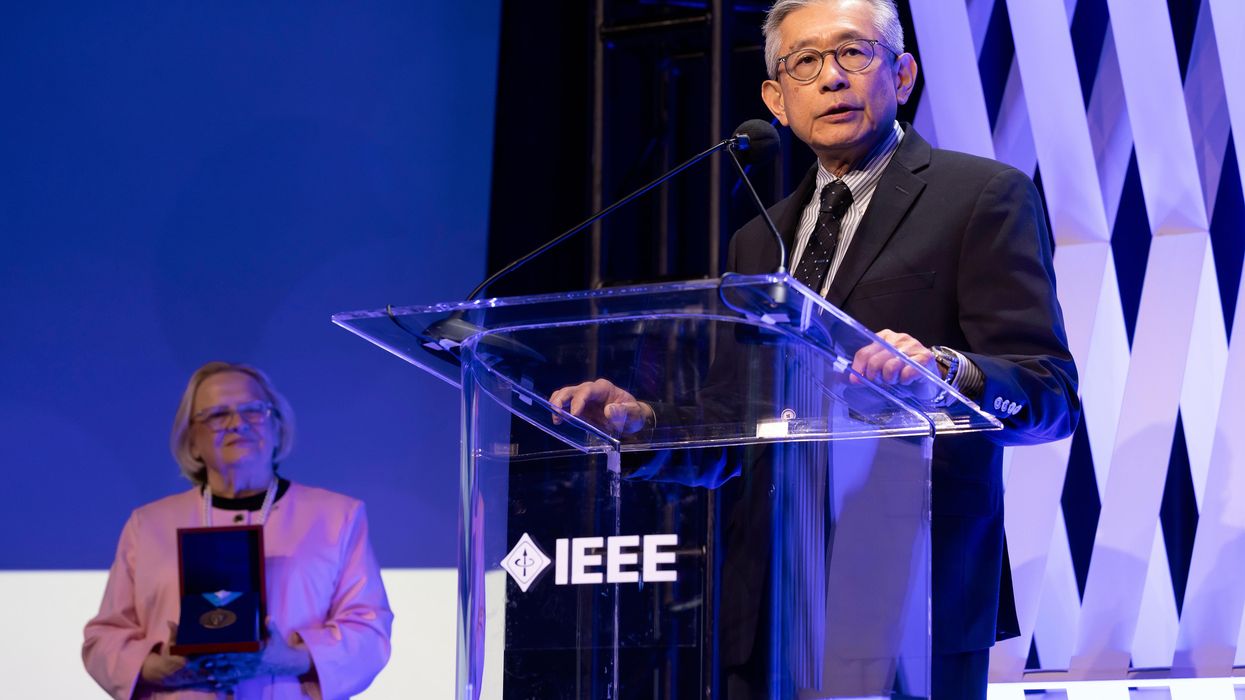
IEEE has given its IEEE Haraden Pratt Award to K.J. Ray Liu, the organization’s 2022 president and a longtime signal processing researcher, for leadership the organization says changed how it represents and recognizes members.
Liu received the Board-level award on April 24 at a ceremony in New York City, according to IEEE. The IEEE Foundation sponsored the honor. IEEE cited Liu for “transformative and impactful leadership,” including work to broaden the nominee pool for IEEE Fellow, the organization’s top membership grade, and to adjust IEEE’s geographic regions for more balanced representation on its Board of Directors.
Liu is an IEEE Fellow, a retired University of Maryland professor, and the founder of Origin Wireless, a Rockville, Maryland, company focused on wireless sensing and indoor tracking. ADT acquired Origin Wireless in February.
Why did IEEE honor K.J. Ray Liu?
IEEE credited Liu with pushing changes in three awkward but consequential parts of professional-society plumbing: awards, governance and money tracking. During his presidency, Liu said his priorities included increasing the IEEE Medal of Honor prize, realigning regional representation, and improving financial reporting.
The regional change addressed a mismatch inside IEEE’s structure. Region 10, covering Asia and the Pacific, had grown to nearly 40 percent of total membership, Liu said, while each region still had one Board representative. IEEE’s Board approved a reorganization in 2022 that keeps the total number of regions at 10 while shifting the map.
Under the plan, effective Jan. 1, 2028, six U.S.-based regions will become five. Region 10 will be split, with Region 10 covering North Asia and a new Region 11 covering South Asia and the Pacific. IEEE will stop using the Region 1 designation, and the new Region 2 will cover the Northeastern and Eastern United States.
Liu also backed a new financial reporting system for IEEE, intended to give the organization a clearer view of banking transactions, contracts, expenses and other spending.
From Taiwan’s chip push to signal processing
Liu grew up in Taichung, Taiwan, at a time when the government was steering strong math and science students toward electrical engineering as part of a semiconductor strategy. Taiwan’s electronics push included RCA’s 1976 agreement to transfer licensed semiconductor processes to the Industrial Technology Research Institute, which later spun off companies including Taiwan Semiconductor Manufacturing Co.
Liu earned a bachelor’s degree in electrical engineering from National Taiwan University in 1983. Semiconductor plants were still being built, he said, so he went to the United States after two years of mandatory service in the Republic of China Armed Forces.
His academic path then ran through:
- University of Michigan, where he earned a master’s degree in electrical engineering in 1987.
- UCLA, where he earned a Ph.D. in electrical, electronics and communications engineering in 1990.
- University of Maryland, where he spent 31 years as a professor and digital signal processing researcher before retiring in 2021.
At UCLA, Liu moved into VLSI signal processing, a field linking chip design with digital signal processing. At Maryland, he is credited with establishing the university’s signal processing research program. His work has covered bioinformatics, game theory, signal processing architectures, wireless sensing and communications. IEEE lists him as the author of more than 10 books and 900 papers, with 250 patents.
What is time-reversal signal processing?
Time-reversal signal processing captures a wave, such as sound or an electromagnetic signal, and sends it back through the same medium in reverse order. In practical terms, it can make a messy wireless environment act less like a soup of interference and more like a focusing system.
Liu said he applied the concept during a 2009 U.S. Navy project involving wireless systems inside metal submarines, where radio waves bounced around compartments rather than passing cleanly through them. He later extended the idea to ambient sensing, using ordinary Wi-Fi signals to infer motion, breathing, heartbeat and falls without cameras or wearables.
That work fed into Origin Wireless, which Liu launched in 2013 through the University of Maryland’s incubator. The company’s Wi-Fi and AI sensing products won three CES innovation awards in 2020 and 2021, according to IEEE.
This story draws on original reporting from IEEE Spectrum.