An IEEE-backed program at the Indian Institute of Technology Bombay has spent three years trying to solve a stubborn STEM problem at the point where it often starts: teenage girls in rural India being pushed away from school before college is even an option.
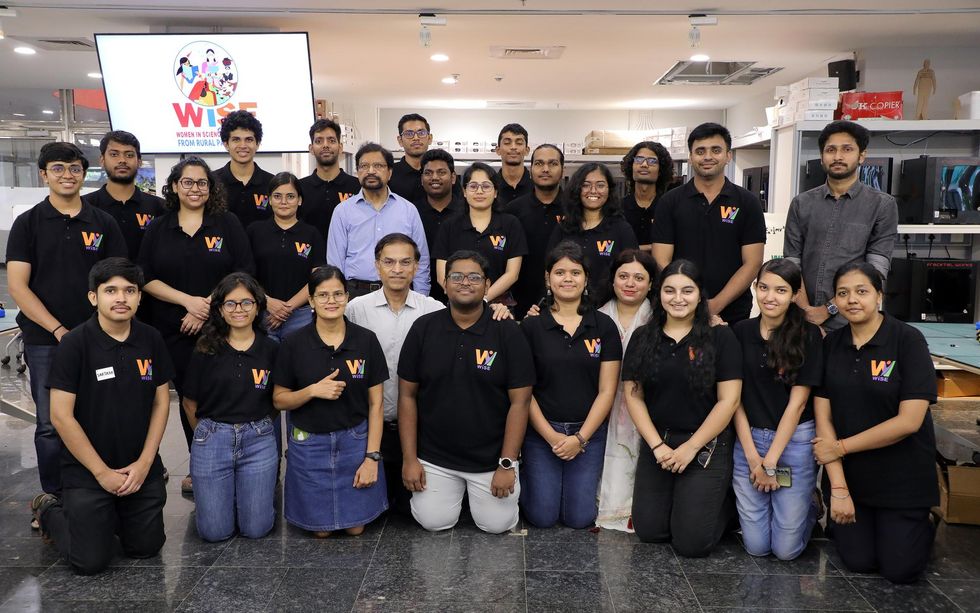
The Women in Science, Engineering project, known as WiSE, brought cohorts of 160 to 200 girls from rural and tribal areas in Maharashtra and Karnataka to IIT Bombay for five-day residential sessions from 2023 through 2025. IEEE Fellow Rajiv Joshi and IEEE Senior Member Rajesh Zele created the project after winning an $80,000 grant from the IEEE Circuits and Systems Society board of governors in 2022.
Joshi is vice president of industry for the IEEE Circuits and Systems Society and a principal scientist and master inventor at IBM’s Watson Research Center in Yorktown Heights, New York. Zele is an electrical engineering professor at IIT Bombay. Their target was not a vague “pipeline” problem, but a set of practical barriers: limited STEM access, family pressure, early marriage and expectations that girls help support households.
The need is not hard to find. UNESCO’s 2024 Global Education Monitoring Report said women made up about 35 percent of STEM college graduates worldwide. The World Economic Forum put women at about 28 percent of the global STEM workforce in 2024. In rural India, the Mahadev Maitri Foundation says girls’ dropout rates rise sharply between ages 11 and 14, with early marriage and traditional gender roles among the pressures.
How the program worked
WiSE was built around two mechanisms: making things and meeting women who had already beaten long odds. Each March, the girls lived in IIT Bombay dormitories and spent the week in sessions run by Zele, project manager Arti Auti, IIT Bombay faculty and about 70 student volunteers.
The technical track used what the organizers called Break-Make-Program exercises. Participants worked in teams on projects involving bioluminescent bacteria, autonomous underwater vehicles and a remote-controlled robot. The robot served as a capstone because it pulled together mechanical and electronics work from the week.
Students in Zele’s Advanced Integrated Circuits and Systems Lab designed the build kits. Participants and their teachers took the kits home, which gave the program a life outside the campus visit. Joshi said some girls later used the kits in demonstrations. One participant, Sushi Pawar, said she presented a drone project in 2024 to Prime Minister Narendra Modi during Pariksha Pe Charcha, an annual student event backed by India’s Ministry of Education.
The selection process also pulled in adults. Zele’s team contacted administrators at 68 schools in Maharashtra and Karnataka. Teachers nominated girls with strong math and science scores, while community leaders recommended students likely to benefit. Parents had to do more than approve attendance: they agreed to join quarterly online meetings with teachers, IIT Bombay mentors and volunteers for at least four years after the campus week.
Role models, then replication
WiSE also brought in daily speakers the program called “Winspirers,” including scientists, doctors, military officers, professors and women outside formal STEM careers. One was Savita Dakle, a Maharashtra farmer who left school after 10th grade and later built online communities for women farmers that now have more than 1 million members, according to YourStory.
The organizers do not yet have empirical data proving WiSE’s effect. They point instead to participant feedback and continued school enrollment among many girls from the 2023 cohort. Tejswini Manoj Patil said the hands-on projects changed her STEM interest from “passive curiosity to active confidence.” Ritu Ravindra Patil said meeting women role models pushed her toward higher education. Pallavi Bharti said the IIT Bombay experience shifted her from wanting to become a doctor to choosing math classes and engineering.
The original three-year initiative has ended, but Joshi says IEEE Circuits and Systems Society chapters in Kerala and Bangalore are adapting pieces of it. He said Alex James at Digital University Kerala has implemented WiSE concepts in that region, while Jayesh Tanwani of Intel and Suman Dwivedi of Synopsys are bringing STEM outreach to remote schools in Karnataka through the Bangalore chapter.
Joshi said he has received requests for information about WiSE from countries in Asia, Africa and Europe. Zele described the goal as giving young women enough skills and information to make their own decisions. That is a modest claim by technology-program standards, and probably the right one.
This story draws on original reporting from IEEE Spectrum.