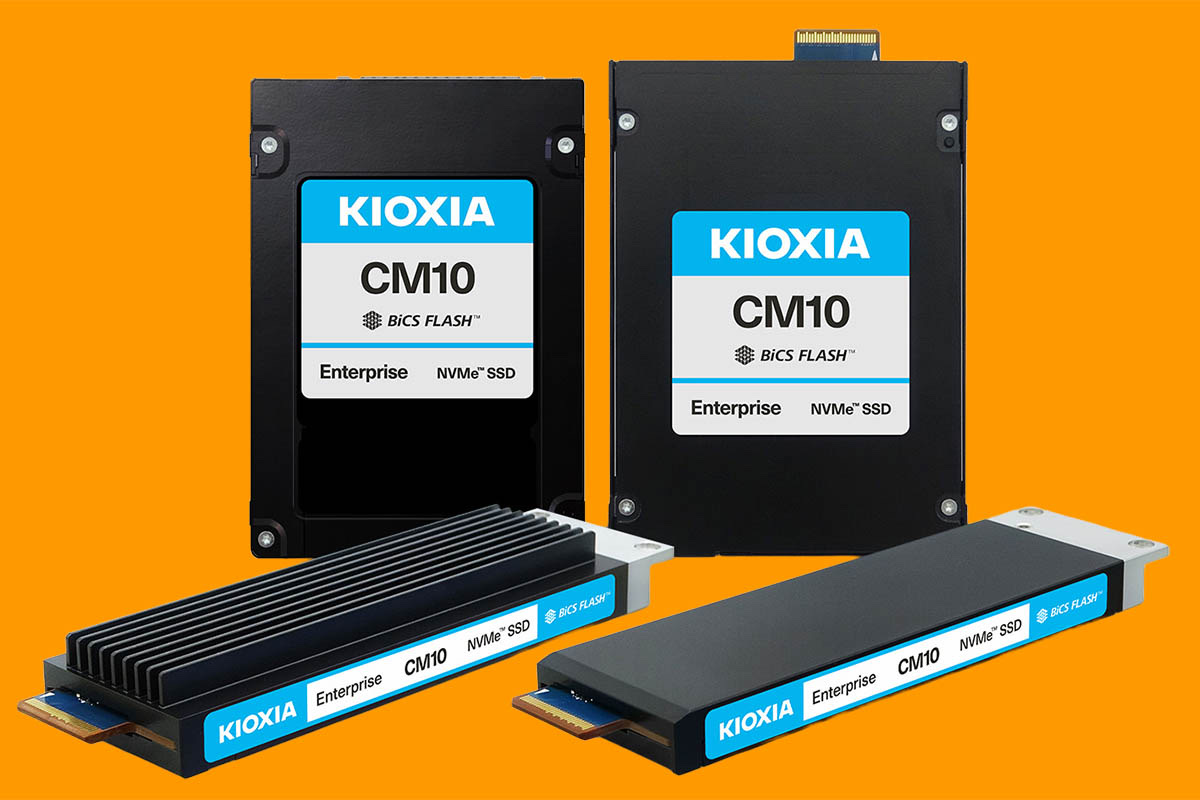
Kioxia has launched the CM10 PCIe 6 enterprise SSD family ahead of FMS 2026, pushing its fastest new drives toward AI infrastructure where storage has to sit closer to accelerators and tolerate denser cooling setups. According to Kioxia materials reported by ServeTheHome, the CM10 line is aimed at high-performance KV cache workloads and Nvidia CMX context memory deployments.
Kioxia says the CM10 family uses its BiCS Flash generation 10 memory technology in the EDSFF models and marks the company’s move into PCIe 6.0 enterprise storage. The company claims the new drives can deliver up to about 92% higher sequential read performance and up to about 85% higher random read performance than its previous CM9 generation.
Those claims are vendor numbers, so treat them as launch-positioning until independent testing exists. The direction is still clear: Kioxia is tuning this family for systems where large AI models and longer context windows put more pressure on fast storage tiers. If you need the background on why context size matters, Kernel’s explainer on how LLMs work covers the mechanics without the brochure fog.
What is different about the Kioxia CM10 PCIe 6 SSDs?
The headline change is that Kioxia is not treating every form factor equally. The EDSFF versions get PCIe 6.0 and generation 10 BiCS Flash, while the 2.5-inch model listed in the materials uses PCIe 5.0 and generation 8 TLC flash, according to ServeTheHome’s reading of Kioxia’s slide deck.
That split says a lot about where enterprise SSDs are going. EDSFF designs, including E3.S and E1.S, are built for modern server layouts that need better density, thermals and signal integrity than legacy 2.5-inch U.2 and U.3 bays can comfortably provide at the top end. Kioxia is still keeping a 2.5-inch option for existing enterprise chassis, but the newest interface and NAND sit with the newer connector family.
The EDSFF lineup includes E3.S at 7.5 mm thickness and E1.S versions at 9.5 mm and 15 mm. Kioxia’s materials say 9.5 mm variants in both E3.S and E1.S support direct liquid cooling, while the full range remains usable in air-cooled systems. Direct liquid cooling here means a cold plate can move heat away from the SSD more aggressively than airflow alone, a practical concern in cramped GPU-heavy racks.
Kioxia also lists a dual-port E3.S design for high-availability storage arrays. Dual-port drives let two hosts access the same SSD pathing for redundancy, which is still boring in exactly the way storage admins prefer.
Where does the 2.5-inch CM10 fit?
The 2.5-inch version gives customers with conventional enterprise chassis a way to use the CM10 family without moving to EDSFF slots. ServeTheHome reports that this drive is 15 mm thick and keeps a dual-port design for high-availability applications.
The tradeoff is that the 2.5-inch model is not the PCIe 6.0, generation 10 NAND version described for EDSFF. Based on Kioxia’s materials, it is PCIe 5.0 compliant and uses BiCS Flash generation 8 TLC memory. That makes the CM10 brand cover two different technical tiers rather than one uniform platform.
ServeTheHome frames the launch as another sign that 2.5-inch U.2 and U.3 drives are starting to lose their lead role at the high end of NVMe. Kioxia’s approach lets it serve existing air-cooled infrastructure while reserving the newest interface, newer NAND and liquid-cooling path for EDSFF deployments.
The intended use case is narrow but important: AI storage tiers where temporary KV cache data benefits from flash latency between GPU HBM and networked storage, according to ServeTheHome. Kioxia has not made independent benchmark results part of this launch, so the performance story remains a claim until drives show up in real systems.
This story draws on original reporting from ServeTheHome.