New laptop battery performance benchmarks from Tom’s Hardware suggest the old unplugged slowdown is no longer guaranteed, at least on some high-end machines. In its latest tests, Apple’s M5 Max MacBook Pro and an Intel Core Ultra X9 388H system delivered nearly identical results on battery and wall power, while one AMD Ryzen AI laptop fell sharply when disconnected.
Tom’s Hardware said it tested recent laptops using processors from Intel, Qualcomm, Apple and AMD. The Windows laptops ran on the balanced power profile, which the publication said was already the default on most of the machines. The MacBook Pro used Apple’s default “automatic” power management setting.
The test set was deliberately narrow: Cinebench 2026 in single-core and multi-core runs, plus Handbrake transcoding of a 4K video down to 1080p. Tom’s Hardware said it was not comparing one laptop’s raw score against another’s. The point was to compare each system with itself, plugged in versus unplugged.
Which laptops lose performance on battery?
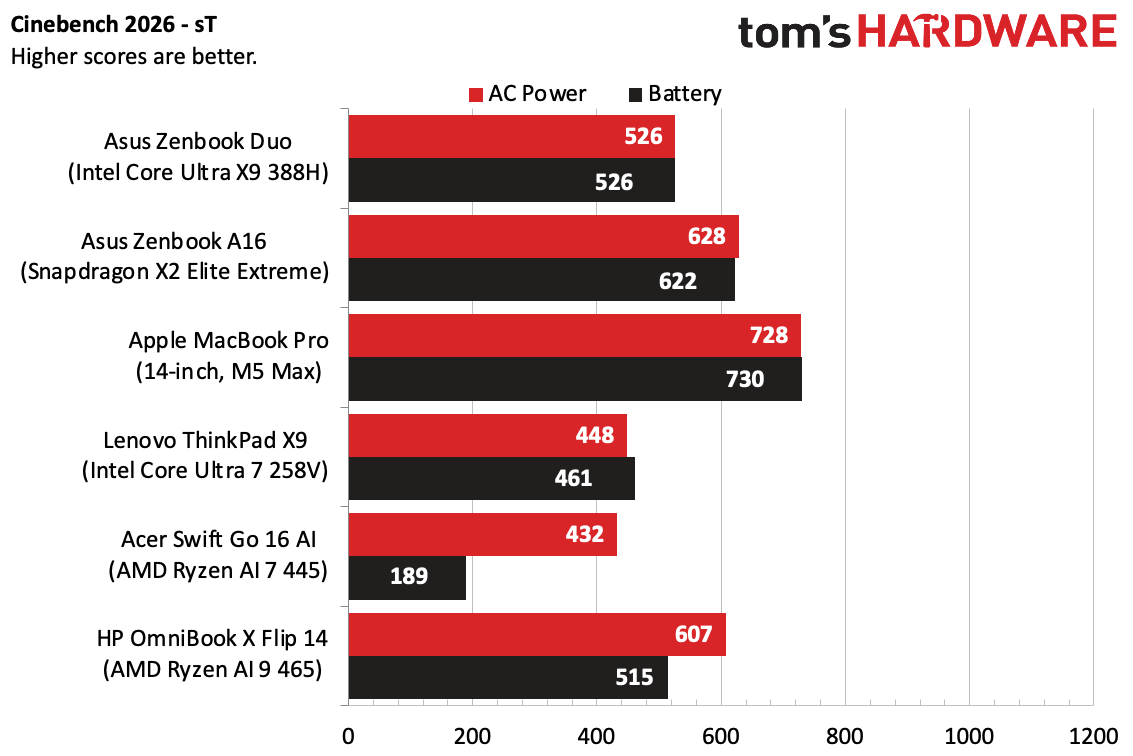
The biggest drop came from the Acer Swift Go 16 AI with AMD’s Ryzen AI 7 445. Tom’s Hardware reported an average decline of 50.06% on battery across the three tests, including a 56.25% fall in Cinebench single-threaded performance and a 51.64% drop in Handbrake.
Another AMD machine, HP’s OmniBook X Flip 14 with a Ryzen AI 9 465, also slowed down on battery, but by far less. Tom’s Hardware said that system lost an average of 5.45% in the same kind of plugged-versus-unplugged comparison.
Apple’s 14-inch MacBook Pro with the M5 Max was the steadiest of the tested systems. Its average changed by only +0.08% on battery, according to Tom’s Hardware, and none of its three benchmark results moved by a full percentage point. The Intel-based Asus Zenbook Duo with a Core Ultra X9 388H was nearly flat on average at +0.01%, though individual tests moved by a few points: down 3.41% in Cinebench multi-core and up 3.43% in Handbrake.
Qualcomm’s Snapdragon X2 Elite Extreme, tested in an Asus Zenbook A16, was less predictable. Tom’s Hardware measured an average change of -0.41%, which looks tidy until the individual results show the mess: a 13.06% gain on battery in Cinebench multi-core and a 13.33% drop in Handbrake.
Why can plugged-in and battery performance differ?
Laptops can use different power management behavior depending on whether they are connected to AC power. The chip matters, but Tom’s Hardware also pointed to the surrounding system design and optimization as part of whether a machine can keep performance consistent away from the wall.
The publication noted that Intel and Apple’s newest tested systems gave very similar experiences on AC power and battery in these workloads. Qualcomm’s result showed that parity is possible, though not necessarily stable across tasks. AMD’s tested laptops were split: the Ryzen AI 7 445 system performed much worse unplugged, while the Ryzen AI 9 465 system gave up a much smaller amount.
Tom’s Hardware also cited Valve’s 2022 Steam Deck as evidence that AMD-based hardware can be designed for similar plugged and unplugged performance. The broader lesson from these tests is less flattering to spec-sheet shopping: a processor name alone does not tell buyers how a laptop will behave when the charger stays in the bag.
This story draws on original reporting from Tom's Hardware.