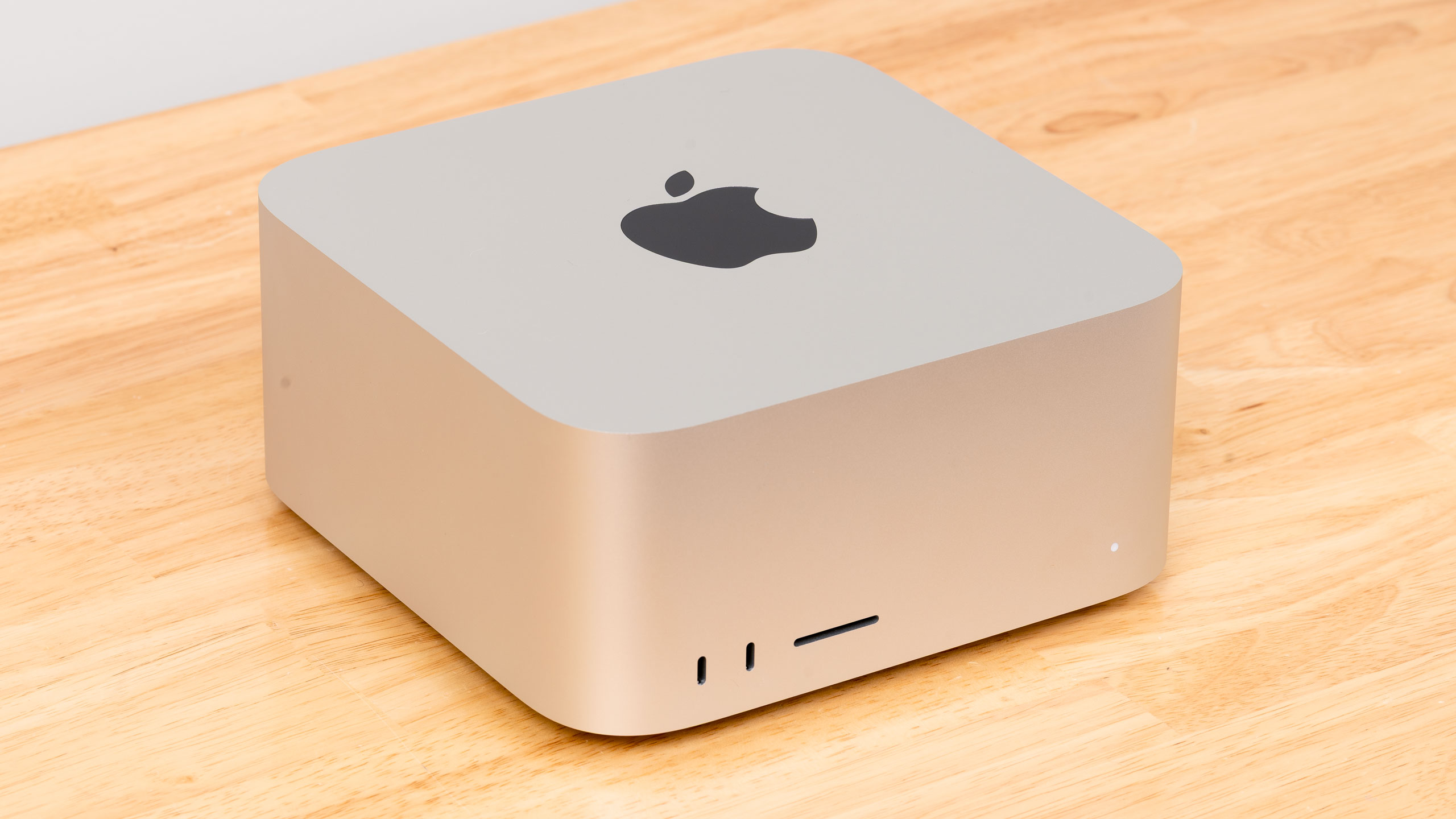
Tom’s Hardware put the M4 Max local AI pitch under a microscope with a 128GB Mac Studio, and the result is annoyingly nuanced: Apple’s chip generated more LLM output tokens per second than Nvidia’s GB10 and AMD’s Ryzen AI Max+ 395, but it did not turn its memory-bandwidth lead into a clean sweep.
The tested Mac Studio used Apple’s M4 Max with a 16-core CPU, 40-core GPU and 128GB of unified memory. Tom’s Hardware said Apple lent the system for LLM-specific testing. That configuration was about $3,699 at the time, close to Nvidia’s DGX Spark list price of $3,999, though the publication noted that the M4 Max Mac Studio it tested is now harder to buy and currently tops out at 64GB of RAM.
The headline advantage is bandwidth. Apple rates this M4 Max at 546GB/s of memory bandwidth, compared with 273GB/s for Nvidia GB10 and 256GB/s for Ryzen AI Max+ 395 systems in Tom’s Hardware’s comparison. The publication inferred that Apple likely gets there with LPDDR5X-8533 on a 512-bit memory bus, twice the width of the Nvidia and AMD platforms, though Apple does not publish the full GPU architecture details needed for a tidy chip-to-chip comparison.
Is the M4 Max good for local AI?
For LLM decode, yes, according to Tom’s Hardware’s tests. Decode is the stage where a model produces output tokens one after another, and it tends to lean hard on memory bandwidth because model weights must be streamed through the GPU as each token is generated.
Using llama.cpp with Apple Metal and MLX support, plus the llama-benchy harness, Tom’s Hardware tested three four-bit quantized models from Unsloth: Qwen 3.6-35B-A3B, Gemma 4 12B and OpenAI’s gpt-oss-120b. The Mac Studio led both GB10 and Strix Halo in tokens per second across those tests, but the size of the lead depended heavily on the model.
- On Qwen 3.6-35B-A3B, the M4 Max’s decode throughput was about 25% higher despite having twice the listed bandwidth of GB10 and Strix Halo.
- On Gemma 4 12B, the Mac Studio scaled much closer to its bandwidth advantage, reaching 1.8 times GB10 throughput and 2.26 times Strix Halo throughput.
- On gpt-oss-120b, the M4 Max averaged 1.5 times GB10 throughput and 1.6 times Strix Halo throughput.
Prompt processing was less flattering. Tom’s Hardware found that GB10 stayed ahead in several prefill or prompt-processing cases, especially with longer contexts. That affects latency, because an inference turn is not just output speed. The system has to ingest the prompt first, then generate the answer.
The energy test made the same point. In a fixed gpt-oss-120b run with a 2,048-token prompt, a 32,768-token context and 1,024 generated tokens, the M4 Max used less total energy than Strix Halo. GB10 finished faster because of its prompt-processing speed and consumed less total power than the Mac Studio, even while producing fewer output tokens per second during decode.
Where Apple’s chip looked worse
Image generation was a rougher story. Tom’s Hardware said its Flux.2 Klein test initially failed on the Mac Studio because the ComfyUI workflow used FP8 by default, apparently hitting a GPU support gap. After changing the workflow to use the base FP16 version, the M4 Max still took longer than AMD’s already slow Radeon 8060S in that test. The publication said Nvidia’s DGX Spark pairing with Macs for image and video generation makes more sense in that light.
CPU performance was the Mac Studio’s cleaner win. In Geekbench 7, Tom’s Hardware reported that the M4 Max beat the Ryzen AI Max+ 395 by 27% in single-core performance and 21% in multi-threaded performance. Against Nvidia GB10, it led by 39% in single-threaded performance and 22% in multi-threaded work. In a Clang 21 build of the CPU-only version of llama.cpp, the M4 Max finished in about 37 seconds, 33% to 37% faster than the Nvidia and AMD systems.
The practical read: Apple’s M4 Max Mac Studio is a strong local LLM box when decode throughput and quiet operation matter. Tom’s Hardware’s results also show why memory bandwidth is a useful clue, not a benchmark. Model architecture, prompt processing, software support and energy per task all get a vote.
This story draws on original reporting from Tom's Hardware.