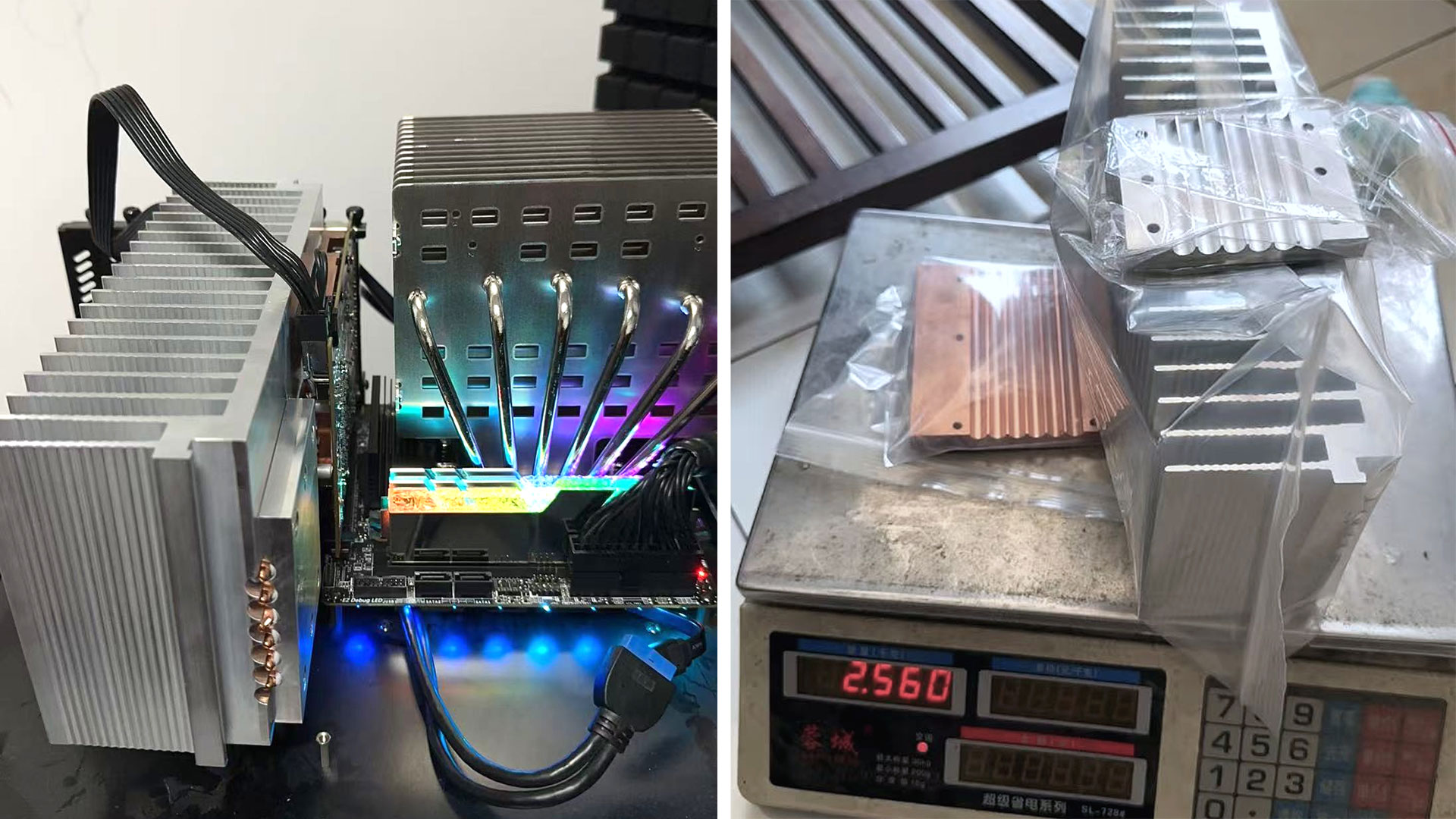
A Bilibili hardware modder has shown an Nvidia GeForce RTX 4060 running without a graphics-card fan, using a 5.5-pound aluminum heatsink bolted onto the GPU instead. The build, posted by NexFrame and flagged by Fanless Tech, is aimed at the old enthusiast dream of a gaming PC that does not sound like a desk fan with a login screen.
The cooling idea is blunt: replace the usual shroud, heatpipes, small fin stack and spinning fans with a much larger finned aluminum mass. Heat leaves the GPU die, spreads into the heatsink, and then dissipates into the surrounding air by natural convection. No fan is shown doing the work for the graphics card, and a monitor readout in the video appears to report the GPU fan at 0 RPM.
That is the clean version. The less clean version is that the public information leaves several useful questions unanswered. NexFrame’s post does not make clear whether the RTX 4060 was undervolted, power-limited, or otherwise tuned for passive operation. Those settings matter because a fanless card has far less margin once heat builds up, especially outside an open testbench-style setup.
In the gaming footage, a monitoring window near the end of NexFrame’s video appears to show the GPU at 58 degrees Celsius, with a hotspot temperature of 71 degrees Celsius. For a passive installation, those numbers look entirely workable in that specific setup.
One displayed figure is harder to trust. The same system information view appears to show the GPU drawing 198 watts. That does not square with a standard RTX 4060, which is normally far closer to roughly 115 to 120 watts under load. Either the monitoring software is reading the wrong value, the data is being displayed incorrectly, or the card is not behaving like a normal retail RTX 4060. The video alone does not settle that.
NexFrame’s machine also appears to cool the CPU without a fan. Images from the build show what looks like a six-core Intel processor paired with Noctua’s NH-P1 passive CPU cooler. In Tom’s Hardware testing cited in the report, that cooler handled a CPU consuming up to 75 watts over extended use. NexFrame’s overlay shows the CPU drawing between 35 and 50 watts during the shown game session.
The appeal is obvious to anyone who has built a gaming PC and then listened to it. A typical system can have fans on the CPU cooler, the graphics card, the power supply and the case. Liquid cooling usually moves the noise to radiator fans rather than eliminating it. NexFrame’s build attacks that problem with metal surface area instead of moving air.
The catch is also obvious: a video clip is not a validation suite. Passive cooling depends heavily on room temperature, case layout, orientation, workload duration and power limits. NexFrame’s RTX 4060 mod shows that a big enough heatsink can make a modern low-end Ada GPU behave, at least on camera. It does not yet show whether this is a practical enclosed-PC design or a very tidy physics demo.
This story draws on original reporting from Tom's Hardware.