Motherboard M.2 heatsink contact is much less reliable than the metal slabs on modern boards suggest, according to testing by Tom's Hardware. In a 20-motherboard spot check across recent Intel and AMD platforms, the site found that only six boards made what it considered good contact across the SSD components, while nine failed to make proper contact and five landed in a questionable middle.
The problem matters most for fast PCIe 5.0 SSDs, which can shed enough heat under sustained transfers to throttle performance. M.2 SSDs have spent the past decade replacing bulkier storage in many PCs, including SSDs and hard drives in older form factors. The drives got smaller, faster and hotter. Physics, as usual, did not read the marketing deck.
Do motherboard M.2 heatsinks make good contact?
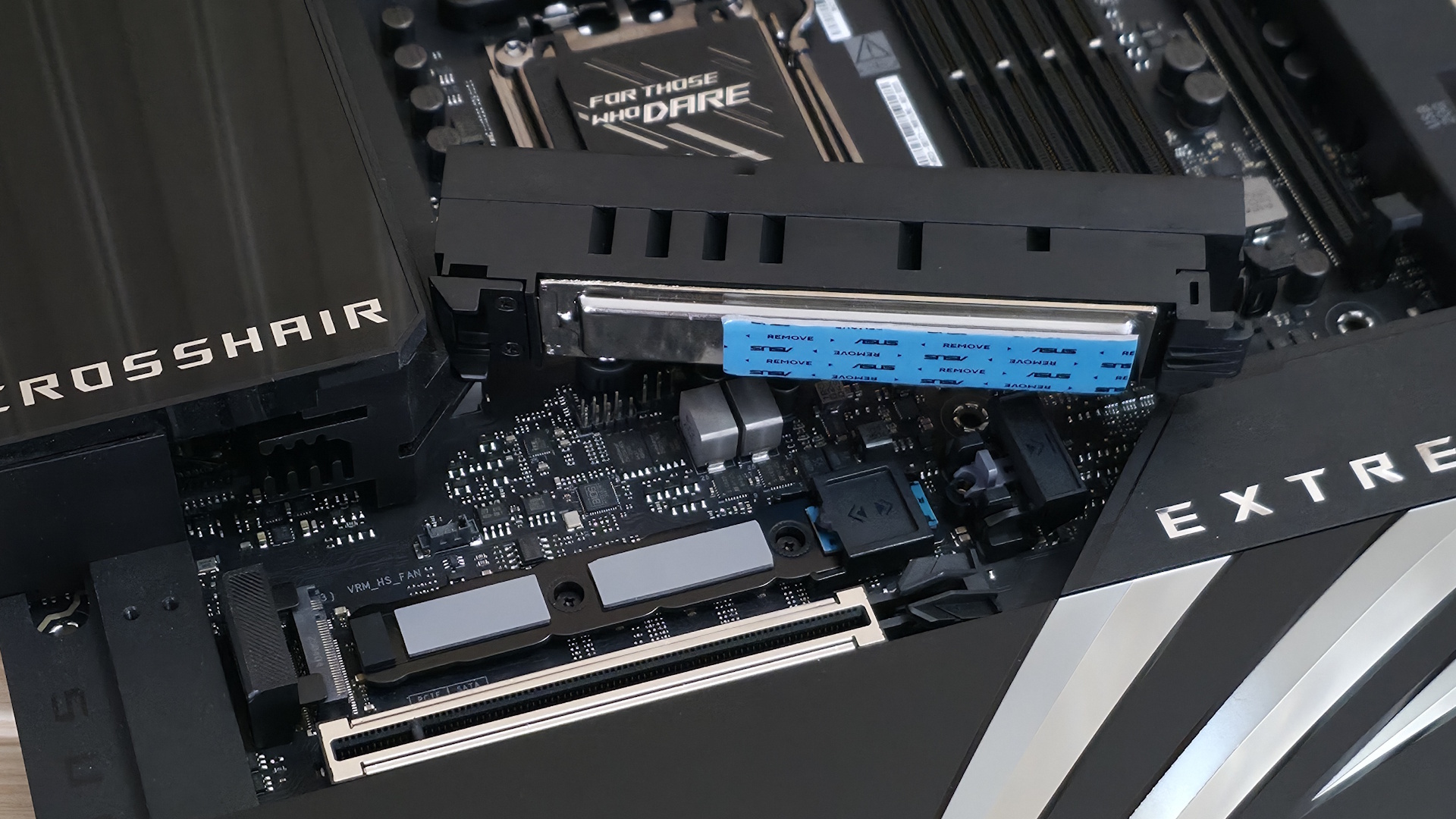
Tom's Hardware found that many do not, at least with the double-sided drive it used for the contact test. The publication tested the primary M.2 heatsink on the top PCIe 5.0 M.2 slot of 20 boards using AMD B850 and X870/X870E chipsets and Intel B760, B860 and Z890 boards.
The test drive was a double-sided 2TB Crucial T705 measuring 3.8 mm thick. Tom's Hardware removed each motherboard heatsink, took off the protective film, installed the SSD with the board's stock latch, reattached the heatsink and checked how the thermal pads compressed against the SSD's chips.
The results were uneven. Six boards showed good contact across the integrated circuits on the drive. Five showed light but complete contact, which the publication treated as questionable. Nine contacted only part of the SSD, often just the controller, which is an important hot spot but not the whole thermal problem.
Why the fit is hard to get right
The M.2 standard sets maximum component heights rather than one exact height for every SSD. Tom's Hardware noted that single-sided drives can have top-side components from 1.2 mm to 2.0 mm high, while double-sided drives vary on both the top and bottom.
That leaves motherboard makers choosing thermal pad thicknesses for a moving target. Pads need compression to move heat well, but too much pressure can hurt performance. Too little contact leaves air gaps, which are a lousy heat conductor and a fine way to turn an expensive heatsink into decoration.
Tom's Hardware illustrated the performance risk with a separate heatsink-free Transcend 260S 2TB PCIe 5.0 SSD. In its test, the drive throttled after about 50 seconds, falling from just under 4,000 MB/s to roughly 1,700 MB/s. After recovering briefly around 90 seconds into the transfer, it dropped again, eventually falling to about 600 MB/s during a longer run.
Thermal throttling is the drive protecting itself. Once sensors report temperatures near critical limits, often around 70 to 85 degrees Celsius according to Tom's Hardware, the SSD reduces work, caps bandwidth or otherwise slows transfers until it cools.
Which boards did better in the test
- ASRock had the strongest showing in this sample, with four of seven boards judged to have adequate contact, including the X870E Taichi White, X870 LiveMixer, X870 Taichi Creator and Z890 Taichi Lite.
- Asus had three of four boards rated as good or at least complete, though Tom's Hardware said compression was light on the tested models. The B850 Creator Wifi was the exception.
- Gigabyte had one of three boards, the Z890 Aorus Elite Duo X, make complete contact on both sides. Tom's Hardware credited its flexible M.2 EZ-Flex base as part of the reason.
- MSI performed worst in this limited set, with Tom's Hardware saying only two of six boards made good contact, while the others had incomplete coverage.
Price did not cleanly predict the outcome. Tom's Hardware found expensive boards with incomplete M.2 contact and cheaper boards that did better. The sample is too small to condemn an entire brand or chipset, but it is large enough to make a practical point: a motherboard heatsink is not proof your SSD is being cooled well.
This story draws on original reporting from Tom's Hardware.