Motherboard VRM thermal testing by Tom’s Hardware found that most current mainstream and enthusiast boards kept voltage-regulator temperatures well under danger levels with high-end CPUs, while some budget and business-class boards from prior platforms showed performance losses in heavy multi-threaded work.
The takeaway is useful for PC builders trying to decide whether a more expensive board buys real performance. Tom’s Hardware said its recent AMD X870, X870E and B850 data, along with a smaller Intel Z890 and B860 sample, showed VRM temperatures grouped within about 15 degrees Celsius. Even the warmest board in that current set remained more than 30 degrees below the range where throttling becomes a concern, according to the testing.
Do motherboard VRMs matter for performance?
They can, but mainly when the board is too cheap for the CPU and workload. Tom’s Hardware reported no throttling across boards priced from $179.99 to more than $1,000 when tested with Intel’s Core Ultra 285K, and no throttling with AMD’s Ryzen 9 9900X.
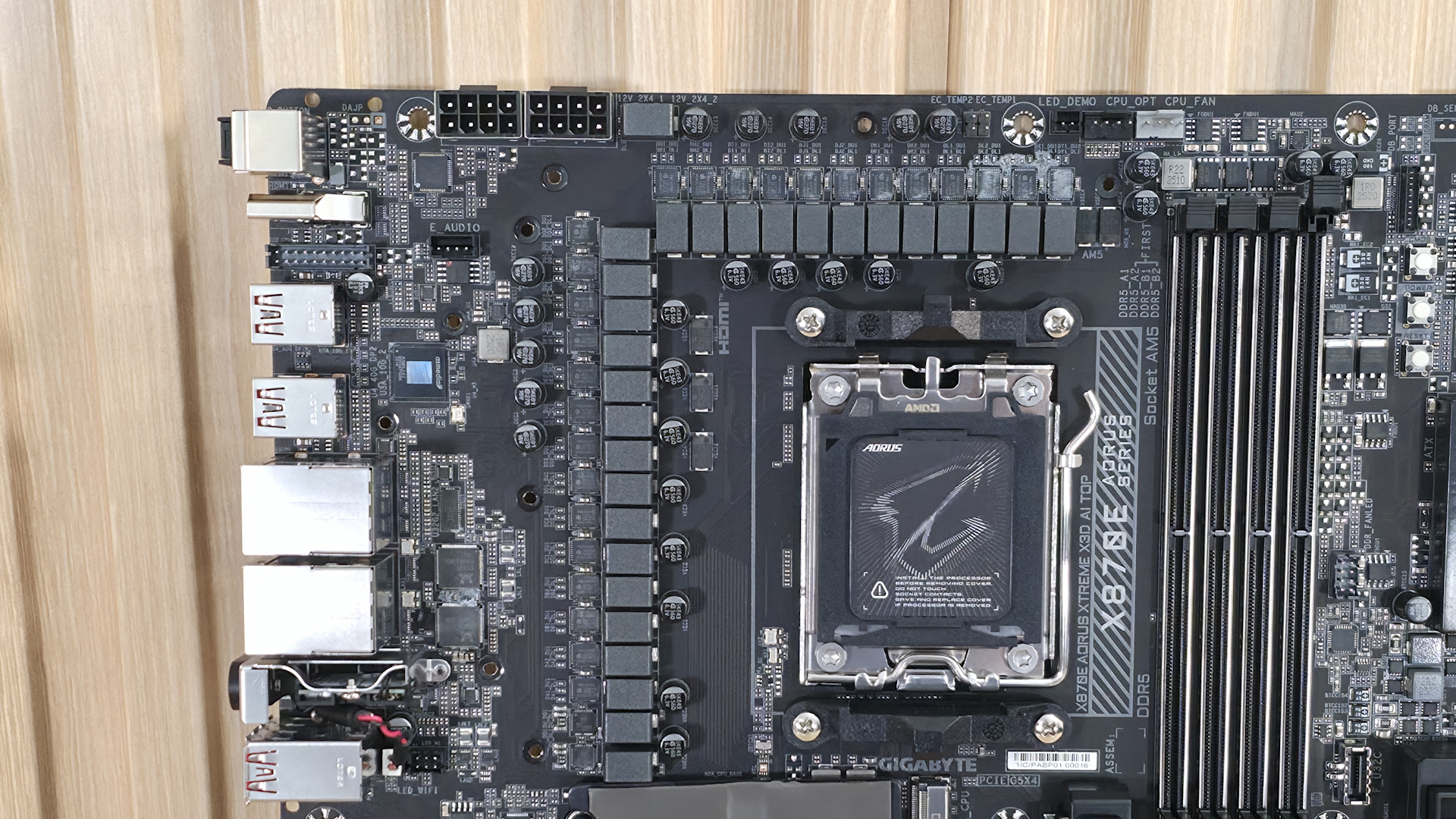
VRMs, short for voltage regulation modules, convert 12-volt power from a PC power supply into the much lower, stable voltage a CPU uses. A motherboard VRM is a collection of parts: a PWM controller decides voltage behavior, MOSFETs switch power rapidly, chokes smooth the current, and capacitors help hold voltage steady. When that system works hard, it produces heat. If it gets too hot, the CPU can reduce performance to protect the hardware.
Tom’s Hardware said board class still matters. Enthusiast boards such as Z890 and X870E models often use more power phases, stronger 80A to 110A MOSFETs, and larger heatsinks. Mainstream boards tend to sit below that, while budget AMD A620 and Intel H-series boards may have fewer phases, lower current capacity, and smaller heatsinks or none at all.
The numbers explain the gap. Tom’s Hardware gave the example of a 12-phase VRM using 80A MOSFETs, which can provide up to 960A, compared with a 20-phase setup using 110A MOSFETs, which can reach 2,200A. The publication said it prefers at least 900A of available capacity for flagship-class processors to avoid putting too much stress on the power delivery hardware.
Where budget boards still fall behind
The current-generation results do not mean every cheap motherboard is safe for every build. Tom’s Hardware said its older Intel Z790, B760 and H770 results, plus AMD X670E and B650 testing, showed clear performance differences between budget-class boards and mainstream or enthusiast boards in multi-threaded workloads.
Intel budget boards tended to lose more performance because the tested Intel CPUs used more power than AMD’s Ryzen 9 7950X, according to Tom’s Hardware. On AMD systems, the differences were present but less severe in the reviewed data. The publication said those gaps could come from VRM throttling or from BIOS behavior, since some budget and business boards enforce baseline CPU limits while others use looser settings, especially on Intel platforms.
For ordinary gaming or office systems using budget or midrange CPUs, Tom’s Hardware’s results suggest a basic board may be fine if it has adequate airflow and suitable VRM cooling. For sustained CPU-heavy work, high-TDP processors, or overclocking, the testing supports buying a board with stronger power stages, proper heatsinks, and enough headroom. A flagship motherboard is not required for most users, but the cheapest board on the shelf can still be the part that makes an expensive CPU act ordinary.
This story draws on original reporting from Tom's Hardware.