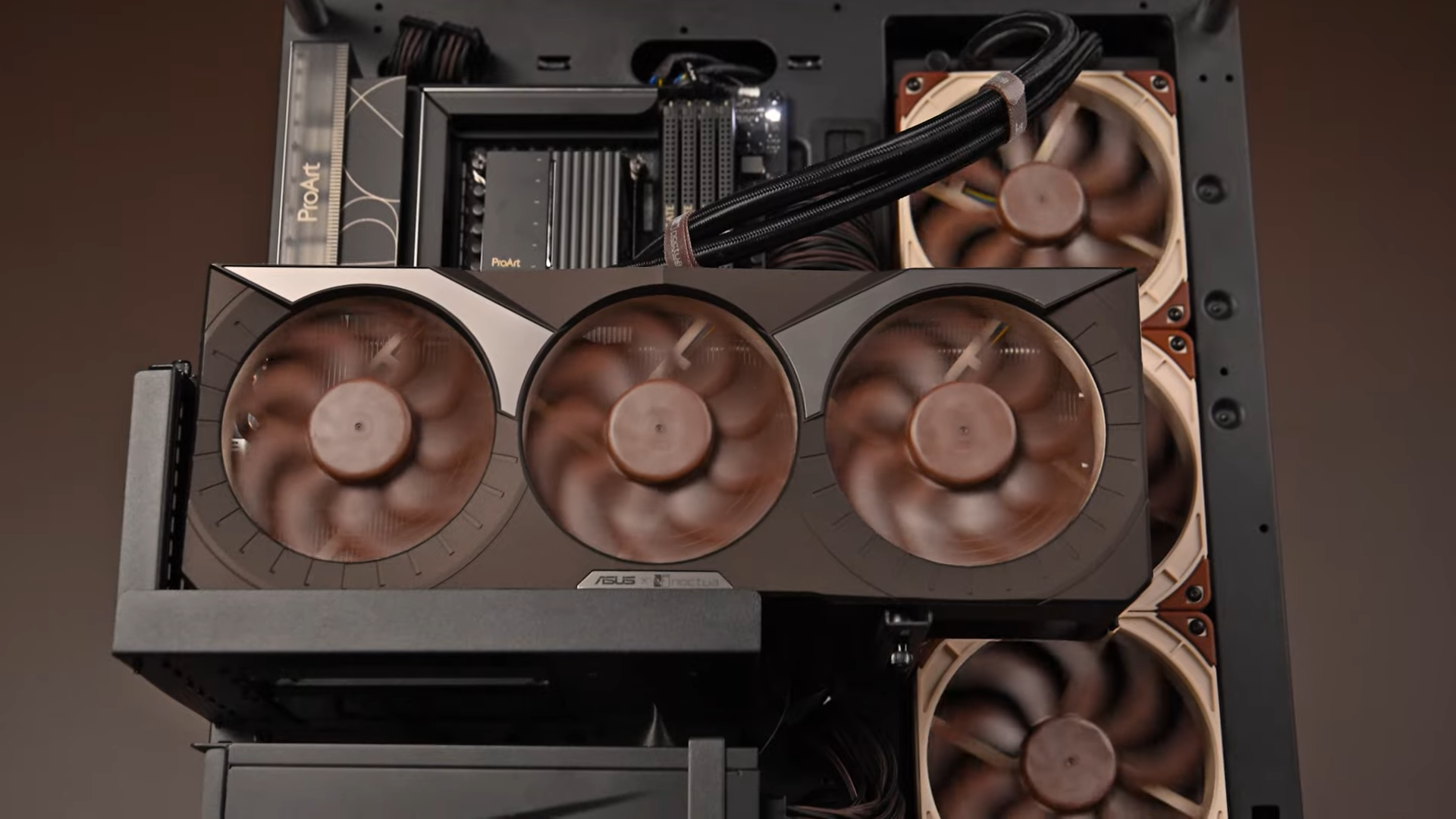
Nvidia RTX 50-series owners now have a way to see temperatures for individual memory chips, not just the broader GPU readings Nvidia exposes through its official developer interface. The access comes from Hotspot.dll, a new MSI Afterburner plugin developed by Overclock.net member asder00 with help from several hardware monitoring developers and modders.
The change matters for anyone trying to diagnose a hot graphics card without guessing which part is misbehaving. A single aggregate memory temperature can hide an uneven thermal pad, poor cooler contact, or one GDDR7 package running out of line with the rest. Per-module telemetry gives overclockers and repair-minded users a much sharper instrument than the usual “it is hot somewhere” dashboard.
Nvidia exposes some GPU data through NVAPI, the company’s application programming interface for graphics cards and drivers. Game developers and utility makers use NVAPI for advanced features, including live sensor reporting. According to Tom’s Hardware, Nvidia has kept some thermal readings outside the public NVAPI surface, including the hotspot data that enthusiasts recently learned to access and the per-memory-module readings now exposed by the new plugin.
MSI Afterburner sits in an awkward position here. It is made by MSI, an Nvidia board partner, so it cannot directly poll data Nvidia has not officially made available through NVAPI, according to Tom’s Hardware. Hotspot.dll works as a plugin for Afterburner rather than a native Afterburner feature, which is the kind of workaround PC hardware people tend to produce when a vendor leaves useful sensors behind a curtain.
The plugin reports several values: GPU hotspot temperature, die thermal channel readings, average die temperature, GPU memory junction temperature, and thermal data for each DRAM chip. Tom’s Hardware said HWiNFO beta version 8.51-6304 already includes the per-module memory reporting function and successfully displayed temperatures for all 16 GDDR7 memory modules on a GeForce RTX 5090.
Who built it
Asder00 is credited with developing Hotspot.dll, but the work was not a solo stunt. Tom’s Hardware named several contributors: Alexey “Unwinder” Nicolaychuk, the developer of MSI Afterburner; olealgoritme, known for an open-source Linux GDDR6 and GDDR6X temperature reader; Brazilian hardware modder Paulo Gomes; and Martin “Mumak” Malík, creator of HWiNFO.
The plugin supports GDDR6, GDDR6X, and GDDR7 memory, according to Tom’s Hardware. That makes it applicable across Nvidia’s Blackwell lineup, from the GeForce RTX 5050 through the RTX 5090. Although the effort focused on RTX 50-series cards, Tom’s Hardware said it should also work with earlier GeForce RTX generations, including RTX 40-series Ada Lovelace and RTX 30-series Ampere cards.
Third-party monitoring tools may move faster than partner-branded utilities. Tom’s Hardware said AIDA64 and HWiNFO are not constrained by the same Nvidia partner agreements that apply to MSI Afterburner, and are likely to add or expose similar functionality. HWiNFO’s beta already has it, which means the feature has crossed from forum breakthrough to usable monitoring software faster than Nvidia’s official interfaces did.
Nvidia has not made these readings generally available through NVAPI, based on Tom’s Hardware’s reporting. For users, the practical result is still straightforward: more of the card’s own telemetry is now visible, and the extra detail may help with cooling checks, thermal pad work, overclocking, and troubleshooting. The sensors were already there. The dashboard finally caught up.
This story draws on original reporting from Tom's Hardware.