A new MSI Cubi NUC AI+ 3MG review from Tom’s Hardware puts Intel’s Panther Lake silicon into a very small desktop box and finds the usual mini PC trade: quiet office performance, limited graphics headroom, and pricing that asks buyers to love the badge.
The Cubi NUC AI+ 3MG is MSI’s compact business-leaning mini PC built around Intel’s Core Ultra Series 3 mobile chips. Tom’s Hardware tested a configuration with a Core Ultra 9 386H, 32GB of DDR5-5600 memory, a 1TB PCIe 4.0 NVMe SSD and Windows 11 Pro. MSI told the publication that this tested 32GB model is sold business-to-business with a $1,999 MSRP, depending on order size.
The machine itself is small: Tom’s Hardware listed it at 4.71 by 4.54 by 1.48 inches, with a 0.8-liter chassis weighing 1.21 pounds. The shell uses matte black recycled plastic, and the review described the internal board as mounted inside a folded aluminum frame. That is NUC orthodoxy: small, plain, hard to offend.
Is the MSI Cubi NUC AI+ 3MG worth buying?
Tom’s Hardware’s answer is conditional. The Cubi makes sense for offices that value quiet operation, vPro remote management, multiple displays and a compact chassis. Buyers chasing the most CPU or GPU performance per dollar can find stronger configurations from brands including Arctic, Beelink, GMKtec and Geekom, according to the review.
The Core Ultra 9 386H tested by Tom’s Hardware has 16 cores and 16 threads and can boost up to 4.9GHz. MSI also sells Cubi NUC AI+ 3MG versions with Core Ultra 7 355 and Core Ultra 5 322 processors.
Performance landed where the power budget said it would. In CPU-heavy tests including Cinebench 2026, Blender and Handbrake, Tom’s Hardware said the MSI trailed the recent mini PCs it compared against. The publication attributed that gap to MSI’s default behavior, which topped out around 55W in testing, while a GMKtec Panther Lake system was observed drawing more than 70W at the wall. Less power means less heat and noise, but also less sustained compute.
That quieter behavior was one of the Cubi’s better showings. Tom’s Hardware measured about 17W at idle and roughly 40 degrees Celsius on the CPU. Under prolonged stress, the system settled near 55W and about 75 degrees Celsius. Noise measured 30.8dB at idle or light load, with a maximum fan reading of 37.3dB.
What ports and upgrade options does it have?
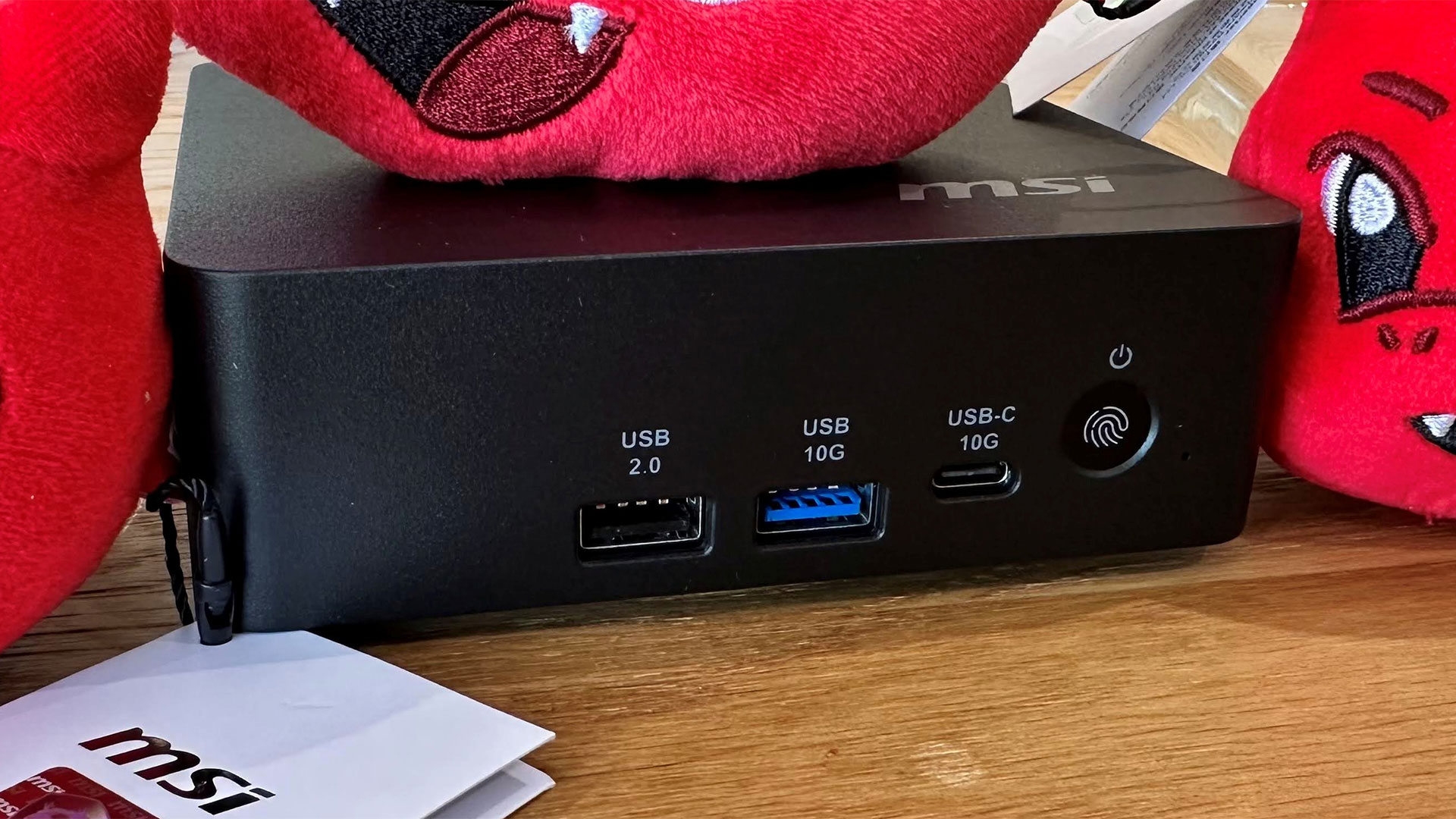
The front includes USB-A 3.2 Gen 2, USB 2.0 and 10Gbps USB-C. The rear has two Thunderbolt 4 ports, two HDMI 2.1 ports, two 2.5G Ethernet jacks and power. One HDMI port supports MSI PowerLink, which can start the PC with a monitor. Wireless support includes Wi-Fi 7 and Bluetooth 5.4.
Tom’s Hardware dinged the port layout because there is no rear USB-A port and no 3.5mm audio jack. The system can drive up to four displays through two HDMI outputs and two USB-C DisplayPort Alt Mode outputs, which is the sort of boring feature that matters a lot in desk fleets.
Inside, the tested unit used two Samsung 16GB DDR5-5600 SO-DIMMs and a removable 1TB Phison M.2 2280 SSD. The system supports up to 128GB of memory across two slots, according to the review, and the Wi-Fi card sits in a removable M.2 2230 slot. Tom’s Hardware said MSI’s advertised tool-less access still required a screwdriver for the first slotted screw.
Gaming was possible, but clearly secondary. Tom’s Hardware reported playable results in some titles, including a 37 fps average in Shadow of the Tomb Raider at 1080p High and a playable Cyberpunk 2077 result using the Steam Deck preset at 1080p. Higher Cyberpunk settings fell below 30 fps. The integrated Intel graphics has four Xe3 cores, so nobody should confuse this for a gaming box with office clothes.
MSI Center comes preinstalled and offers system monitoring plus an AI-labeled mode that MSI says can adjust settings based on user scenarios. Tom’s Hardware said the system was otherwise light on third-party clutter. MSI sells the Cubi NUC AI+ 3MG with a one-year standard warranty, while an Amazon Windows 11 Pro configuration comes with three years of advanced tier coverage, according to the review.
This story draws on original reporting from Tom's Hardware.