MSI has put a server design for AMD’s next EPYC generation on public display before the processors themselves are out, according to ServeTheHome, which photographed the system at Computex. The hardware matters because it shows the platform problem server buyers are about to inherit: more CPU, more memory, more PCIe, and much less patience for air cooling.
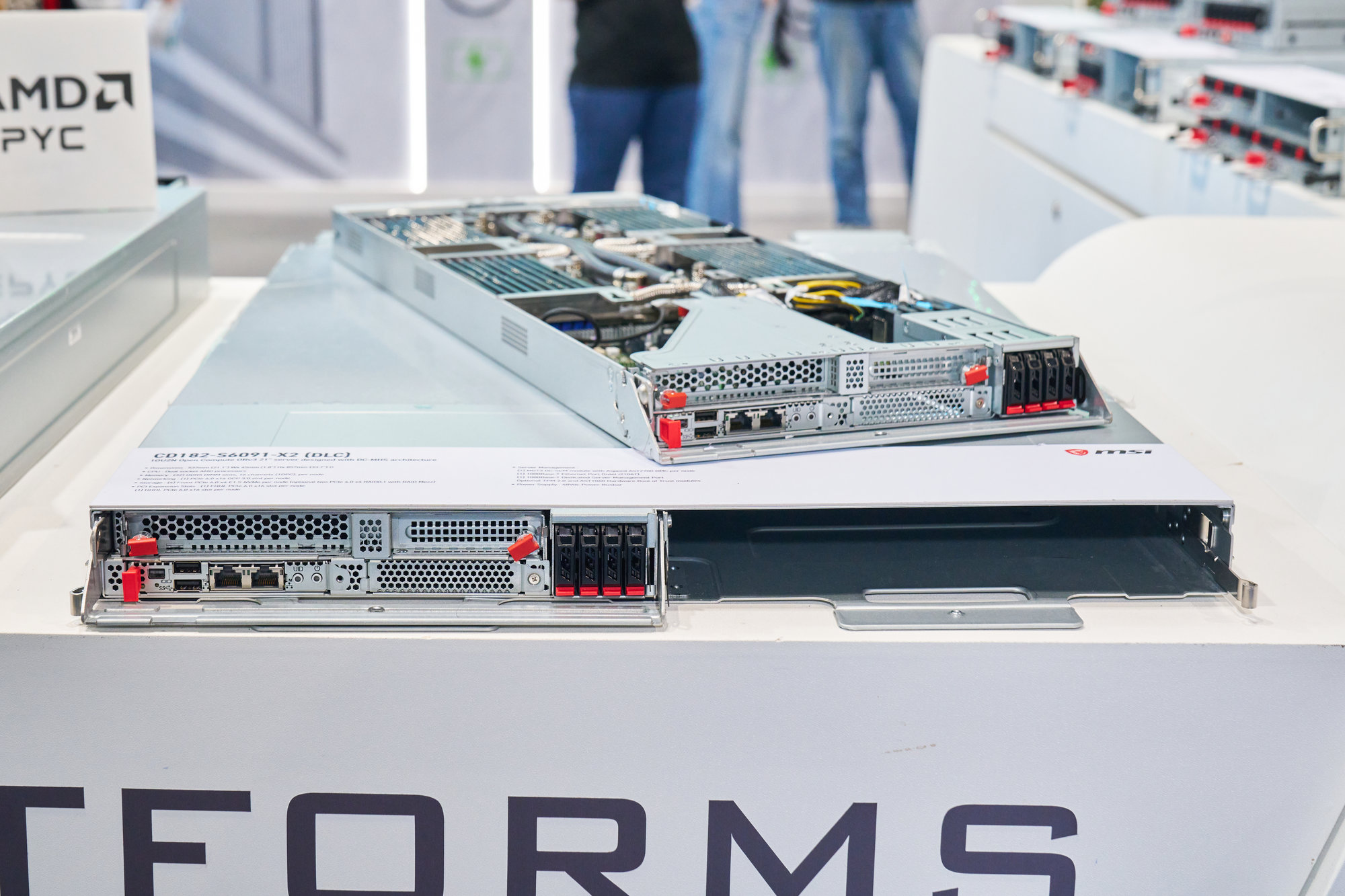
The system is MSI’s CD182-S6091-X2 (DLC), a dual-socket server node built for an undisclosed AMD processor. ServeTheHome identified it as a platform aimed at AMD’s sixth-generation EPYC “Venice” chips, which AMD is expected to launch later this year.
MSI’s design uses a 1OU2N layout, meaning two server nodes fit into one OCP v3 rack unit. With two sockets per node, one chassis can carry four AMD processors plus their memory loadout. That is dense even before anyone starts arguing about what “AI infrastructure” means this week.
Liquid cooling is doing the mechanical work
The “DLC” in the model name refers to direct liquid cooling. ServeTheHome reported that each dual-socket node uses large cold plates over the CPUs, with the processors on their own serial liquid loop. The memory has a separate liquid loop.
That memory cooling is not decorative. Each node has 32 RDIMMs, arranged as 16 channels of DDR5 in a one-DIMM-per-channel configuration. ServeTheHome said the DIMMs are split across both sides of the CPUs. AMD has not disclosed Venice thermal design power figures, but ServeTheHome noted that current fifth-generation EPYC parts already reach up to 500 watts per chip.
The cold plates also conveniently hide the processors from show-floor cameras. ServeTheHome said there appeared to be leak-detection circuitry around the CPU cooling hardware, though MSI did not disclose the full implementation.
MSI still leaves room for I/O. Each node has an OCP 3.0 slot for a customer-selected network card, connected through PCIe Gen6 lanes. ServeTheHome also reported one full-height half-length PCIe slot and one half-height half-length PCIe slot per node, both running at PCIe Gen6 x16. Local storage comes from four E1.S drive bays, also tied to PCIe Gen6.
For management, each CD182-S6091-X2 node includes an ASPEED AST2700 baseboard management controller and two 1GbE ports, according to ServeTheHome.
The rack is built around 48 volts and water
The chassis omits onboard power supplies. MSI instead feeds the CD182-S6091-X2 through a 48VDC busbar, a choice that saves internal space and fits the OCP rack model.
MSI also showed the rack intended to house these servers: an ORv3 liquid-cooled rack. ServeTheHome reported that the 44OU rack can hold 28 of the CD182-S6091-X2 systems, which works out to 112 Venice processors and 1,792 RDIMMs if fully populated.
The demonstrated rack included two 55kW Chicony power shelves and a 100kW Auras coolant distribution unit for liquid-to-liquid cooling. MSI’s demo networking stack included one 32-port 100GbE switch for node traffic and two 48-port 1GbE switches for out-of-band management.
The processors are still pre-launch, so performance claims can wait. The physical design already says plenty: MSI expects Venice systems to need rack-level power delivery, liquid cooling, and a lot of memory plumbing from day one.
This story draws on original reporting from ServeTheHome.