Near-packaged optics, or NPO, is gaining attention as an interim design between familiar pluggable transceivers and fully co-packaged optics, or CPO. SemiAnalysis made that case in an August 10 post, arguing that NPO can retain replaceable optical modules while moving the optics close enough to the switch chip to avoid some of CPO's still awkward manufacturing and repair questions.
The distinction matters for AI clusters and data-center switches pushing more data through each port. The electrical trip across a circuit board to a front-panel optical module gets harder as signaling speeds rise. SemiAnalysis says those front-panel cages commonly sit 15 to 30 centimeters from a switch ASIC or accelerator, requiring signal conditioning in the transceiver before conversion to light.
What is near-packaged optics?
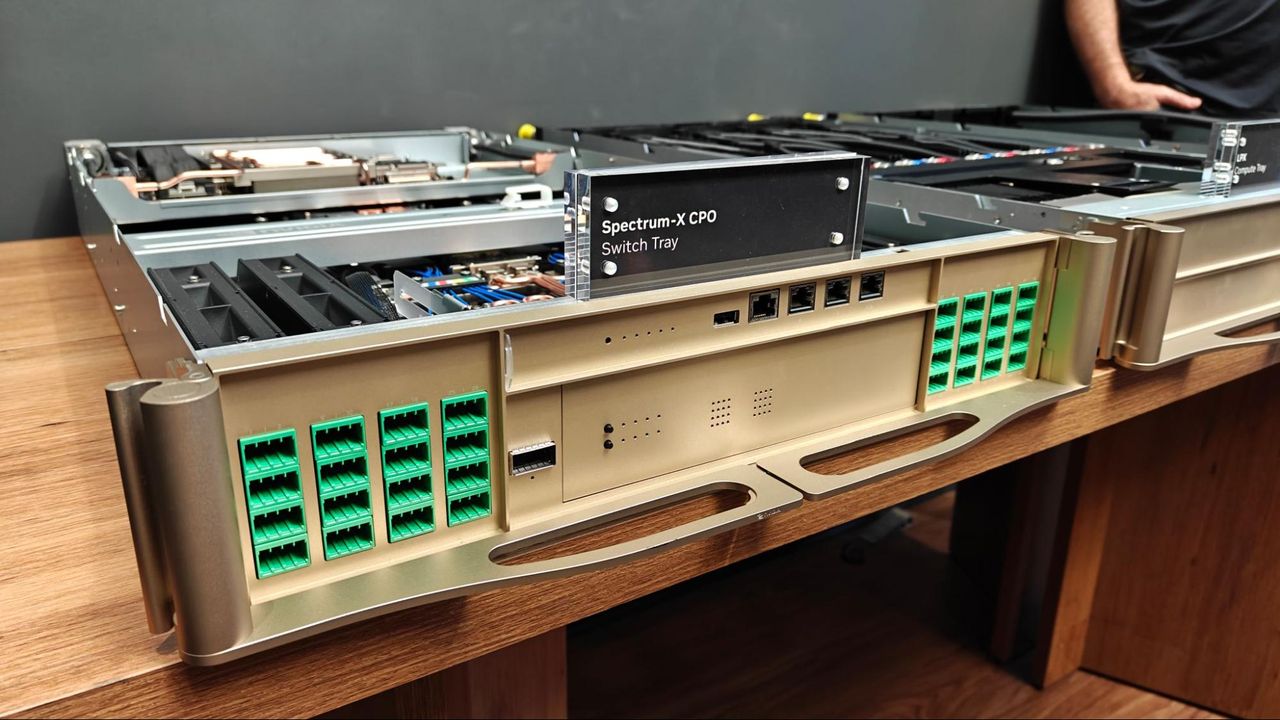
NPO places the optical engine near the ASIC but outside the ASIC's package, generally on its own substrate and connected through a socket. That short electrical path can allow designers to remove the digital signal processor used to clean up a signal after its board-level journey, while the socket lets a technician replace a faulty engine.
CPO takes integration further: the optical engines sit on the same package or substrate as the switch ASIC. Credo describes that arrangement as minimizing electrical distance, but says it also raises packaging complexity and makes service more difficult. In ordinary pluggable optics, the transceiver remains at the front panel, farther from the chip but easy to swap and supported by established form factors and supply chains.
NPO is designed to combine the shorter electrical path with replaceable optical engines. SemiAnalysis also argues that keeping the engine package separate from the ASIC package limits a hardware failure's effect to one socketed unit rather than an entire assembled switch.
Why is the CPO timetable disputed?
The engineering appeal of CPO is clear, at least on paper: shorter electrical connections can reduce power and raise bandwidth density. But its route to broad deployment still runs through yield, thermal management, fiber attachment, testing and field-service questions, according to Wevolver and APNIC. A soldered optical engine is substantially harder to remove without exposing nearby components to another high-temperature assembly cycle, SemiAnalysis said.
The reliability debate is not settled. SemiAnalysis modeled a hypothetical package with 32 optical engines and a 95% attach yield for each engine, producing a compound yield of about 19%. GlobalSemiResearch disputed that example, saying it treated yield as static and omitted screening, binning and redundant engines. Separately, Tom's Hardware reported that Meta presented OFC 2026 results indicating CPO could beat pluggables on failure rates, while Broadcom said Meta testing had accumulated more than 1 million 400G-equivalent port-hours without a link flap. Those are conference and vendor-reported results, not a final verdict on production reliability.
NPO could be a bridge, not a replacement
There is tangible vendor activity. Tom's Hardware reported that Broadcom showed a 3.2T VCSEL-based NPO line at OFC 2026. The same report said Ciena, Coherent, Marvell, Molex, Samtec and TeraHop launched the Open CPX MSA to define a socketed optical-engine interface covering NPO and CPO.
Whether NPO handles meaningful volume through 2030 depends on which CPO schedule proves closer to reality. SemiAnalysis reportedly moved its CPO volume expectation to 2027 for scale-out networks and 2028 or 2029 for full-scale production. Cignal AI has said material CPO volume remains several years away and declined to publish a quantitative forecast it considered defensible. By contrast, Tom's Hardware reported TSMC's target of about 2027 for a second-generation CPO product, a timetable under which NPO's interim role would last only two to three years.
So the end-of-decade NPO thesis is a conditional analyst scenario, not an industry consensus. If CPO's manufacturing and serviceability work takes longer, socketed optical engines may get a longer commercial runway. If CPO scales on earlier roadmaps, NPO remains a shorter stop on the way.
This story draws on original reporting from Tom's Hardware.