Nvidia plans to add two lower-tier Jetson Thor modules, the T3000 and T2000, in the first quarter of 2027, according to ServeTheHome and Nvidia’s announcement. For robotics and edge AI developers, the point is blunt: Blackwell-based Jetson Thor hardware is expensive, and a lot of that pain sits in memory.
The current Thor lineup gives buyers higher-end choices first. ServeTheHome reported that customers looking specifically for Nvidia’s Blackwell-based Thor platform have been choosing between the T4000 with 64GB of memory and the T5000 with 128GB. The new T3000 and T2000 cut CPU cores, memory capacity, networking, and performance to land below those boards.
Nvidia has not announced prices for the T3000 or T2000. ServeTheHome said the new modules are intended to come in below the $3,000 T4000, while Nvidia will keep older Orin products in the lower half of the Jetson stack.
What changes in the T3000
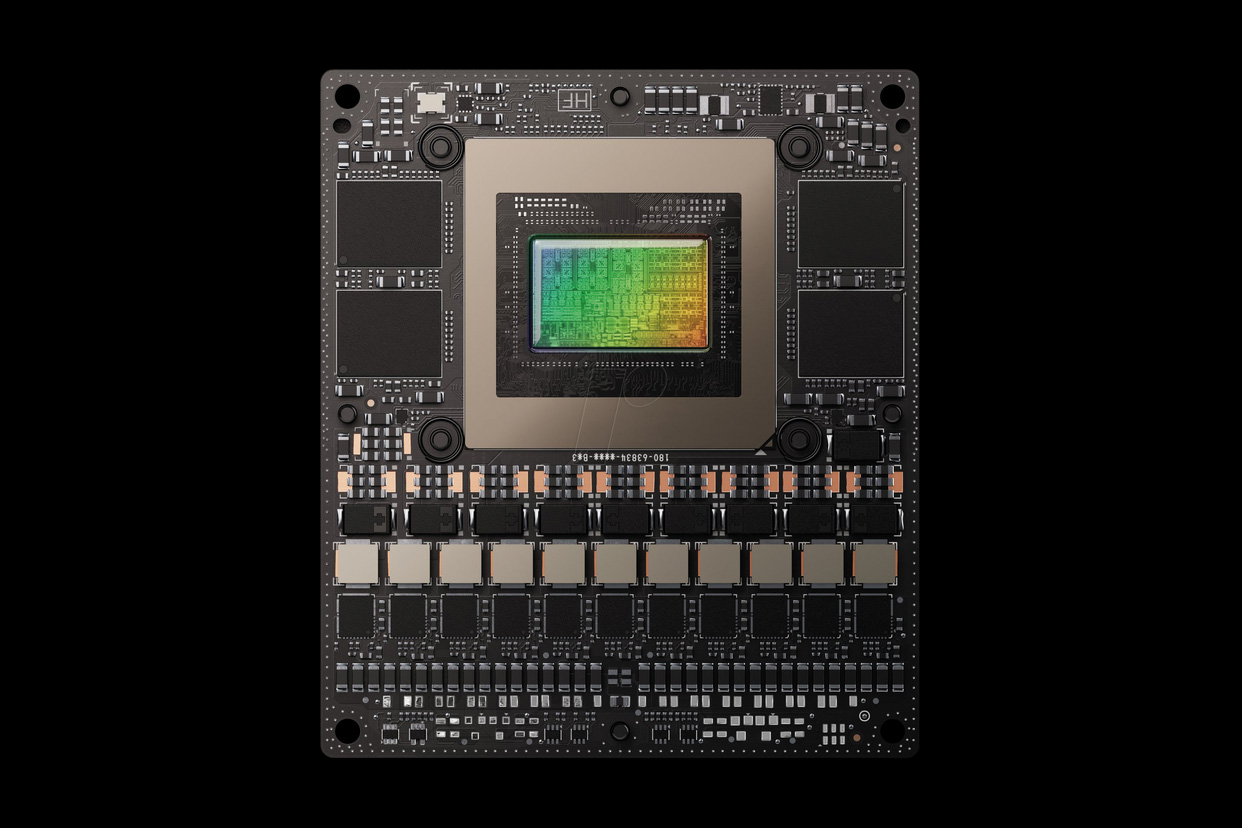
The T3000 uses the same Thor system-on-chip family as the existing Jetson Thor modules, according to ServeTheHome, but in a reduced configuration. It has eight Arm Neoverse V3AE CPU cores and a Blackwell integrated GPU with 1,536 CUDA cores.
Nvidia rates the T3000 at 865 TFLOPS of sparse FP4 performance. ServeTheHome calculated that as roughly 72% of the T4000’s GPU performance. Since the T3000 and T4000 are listed with the same CUDA core count, ServeTheHome said the gap appears to come from clock speeds rather than a smaller GPU block.
The T3000 carries 32GB of LPDDR5X-8500 memory, half the T4000’s capacity. ServeTheHome’s table lists the T3000 at 237GB/s of memory bandwidth, the same figure it gives for the T4000 and T5000. Its accompanying text describes the board as keeping the full Thor memory bandwidth, while giving a different 273GB/s number. Either way, Nvidia’s pitch depends on a familiar edge-AI tradeoff: some models care more about how fast memory can feed the chip than about total memory capacity.
Nvidia says the T3000 can offer similar inference performance to the T5000 for multimodal workloads, according to ServeTheHome. Treat that as a workload-specific claim, not a blanket benchmark. The T3000 is also expected to draw about 65W, about half the T5000’s listed 130W, and it keeps 25Gb Ethernet connectivity, though ServeTheHome said it is unclear how many controllers will be exposed. Nvidia also plans an IGX variant with functional safety support.
The T2000 is the harder cut
The T2000 drops further. ServeTheHome lists it with six Arm Neoverse V3AE CPU cores, 1,024 CUDA cores, 16GB of LPDDR5X memory, and 137GB/s of memory bandwidth. Nvidia rates it at 400 TFLOPS of sparse FP4 performance.
Networking also moves down: the T2000 gets 10GbE rather than 25GbE. Nvidia is positioning that module for lighter edge AI work, while the T3000 is aimed more directly at robotics systems that need Thor-class hardware without buying the largest memory configuration.
Nvidia is also trying to reduce the memory burden in software. In its announcement, the company said optimized agent skills can let customers run workloads in smaller memory configurations while keeping similar performance. ServeTheHome said Nvidia gave examples involving Orin-based robotics systems and one Jetson TX2 case where memory savings allowed added functionality.
This story draws on original reporting from ServeTheHome.