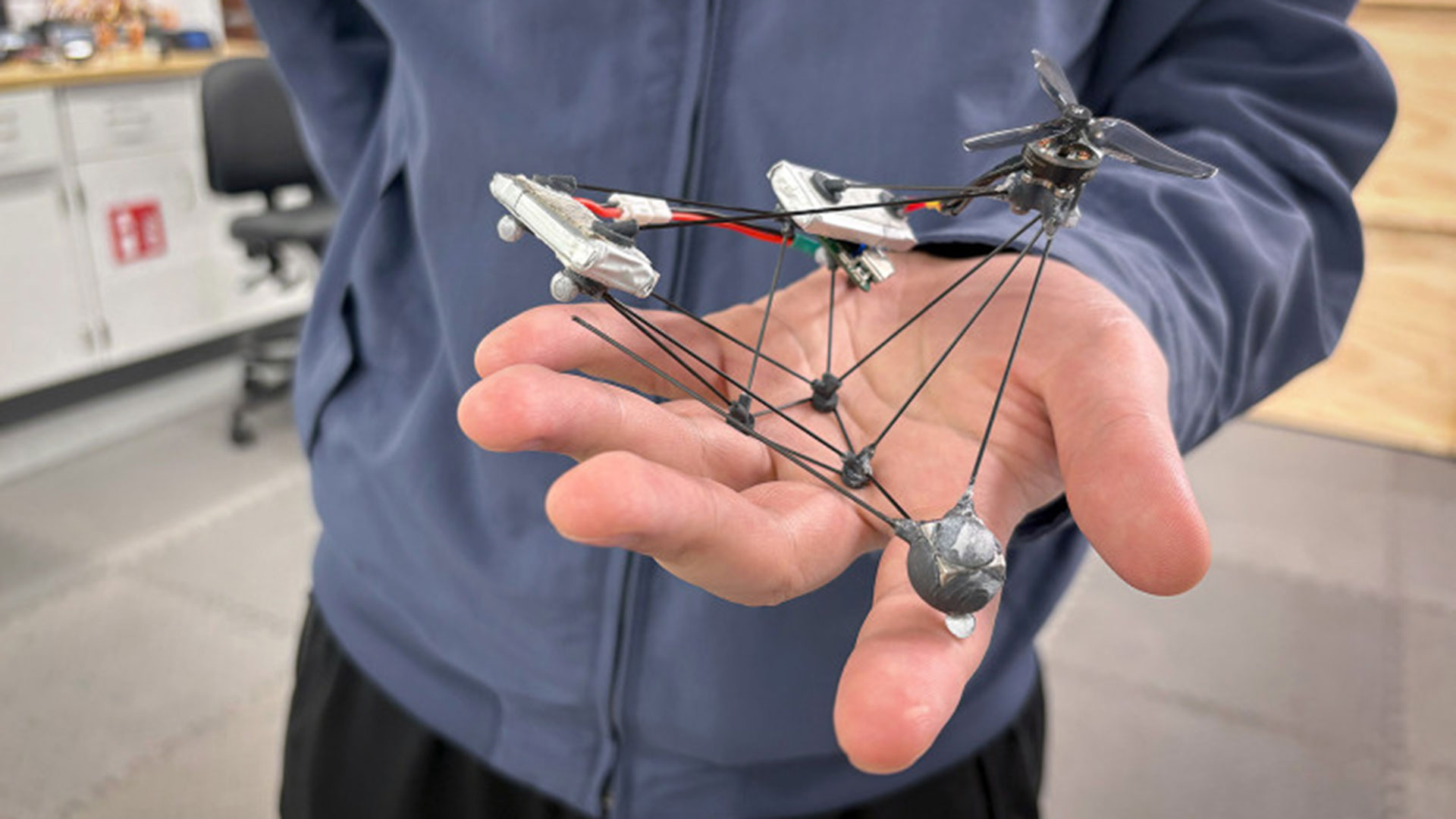
Northwestern University researchers have built a drone that makes itself harder to see by spinning its own body fast enough to exploit human motion perception. The aircraft, called Phantom Twist by the team, rotates at 25 RPM and appears to observers as a weak blur rather than a crisp flying object, according to Northwestern.
The work matters because the team is trying a different answer to a familiar drone problem. Many low-visibility designs focus on color, shape, camouflage or materials. Michael Rubenstein, who led the Northwestern project, said the group instead designed around how people perceive moving objects. In plain terms: the drone does not disappear. It smears itself across your visual system.
Northwestern showed the drone publicly during a Robotics: Science and Systems 2026 presentation on Thursday. Video released with the university’s announcement shows the aircraft blending into the air as a faint mark while flying. It also makes a noticeable high-pitched noise, a useful reminder that optical stealth and acoustic stealth are separate jobs.
How the drone blurs itself
Phantom Twist does not use a standard quadcopter layout. Northwestern describes a single-motor, single-propeller aircraft in which the propeller turns one way while the rest of the drone rotates in the opposite direction.
That counter-rotation is the trick. A stationary image of the device shows visible structure, including rods and wiring. In flight, the rotating body spreads those features over time in the viewer’s eye. Human vision integrates motion over short intervals, so a fast-moving object can look less distinct than the same object at rest. The team used that effect as a design constraint rather than treating it as an accident of camera footage.
Northwestern’s claim is specific to visual perception. The researchers said Phantom Twist measured as 10 times less visually perceptible than a conventional quadcopter under their visibility metrics. That is a metric from the research team, not a field guarantee that a person, camera or sensor will miss the drone in every setting.
Software helped choose the weird shape
The design process began with a computational model that generated about 20,000 drone configurations capable of stable flight, according to Northwestern. The researchers then used AI and other optimization methods to rearrange the main parts: motor, propeller, circuit board, counterweight and batteries.
After reducing the pool to roughly 500 candidate designs, the engineers placed simulated flying drones over 100 real-world backgrounds. A perception model scored how visible each design was. Rubenstein said the process was automated, and the team built a physical drone only after a candidate met its criteria.
The result is a drone that looks less like a tiny helicopter and more like a spinning perception exploit. The trade-offs are visible and audible. Northwestern said the team already knows the wires and support rods could be made less noticeable, and that the current propulsion system is noisy.
Future versions may use more transparent materials, quieter propulsion systems, or both, according to the university. Until then, Phantom Twist is less an invisible drone than a proof that hiding in motion can be engineered into the airframe itself. Annoying whine included.
This story draws on original reporting from Tom's Hardware.