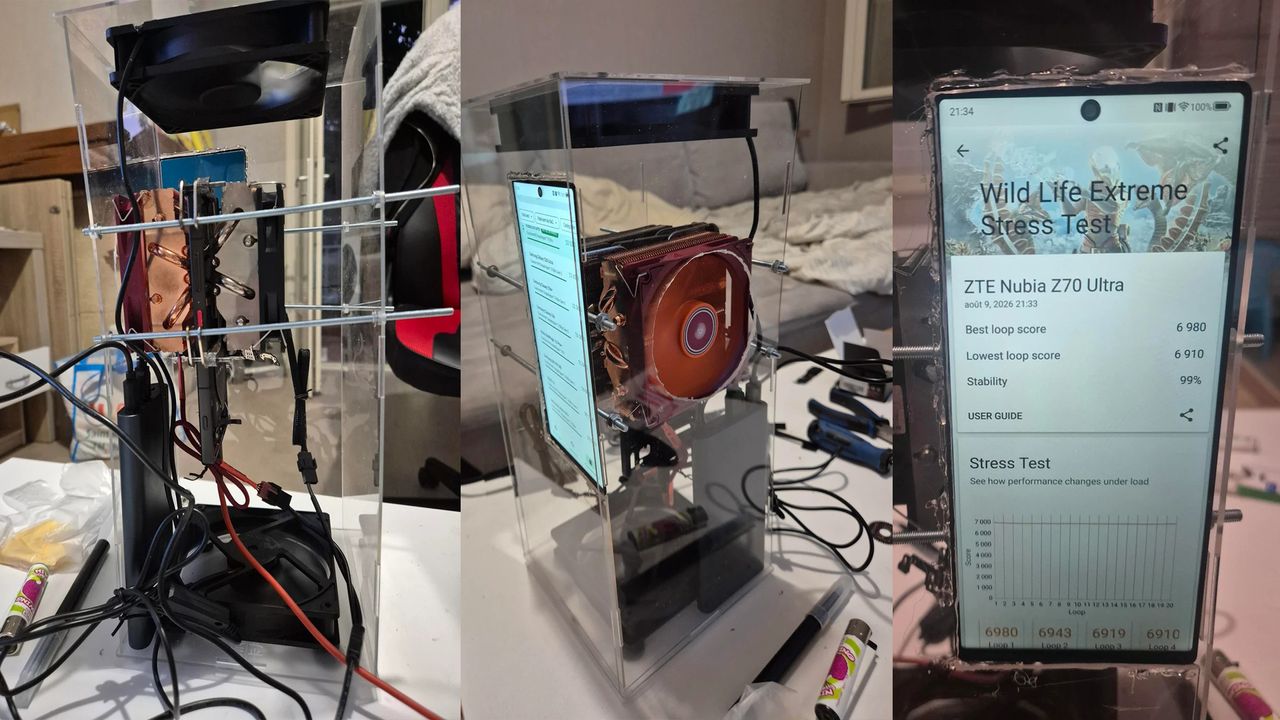
A hardware enthusiast has turned a Nubia Z70 Ultra desktop PC experiment into a small, impractical computer: the phone’s exposed core sits in a custom acrylic enclosure between two full-size desktop CPU heatsinks. The creator reported that the machine can run The Witcher 3 at 1080p on its Ultra preset, though at roughly 20 to 30 frames per second through a Linux-and-Windows compatibility stack. The claim has not been independently reproduced.
Tom’s Hardware, which spoke with the creator, reports that the project began with a ZTE Nubia Z70 Ultra carrying Qualcomm’s Snapdragon 8 Elite chip, 24GB of LPDDR5X memory and 1TB of UFS 4.0 storage. This is no longer a handset with an enthusiastic cooling accessory attached. The creator removed the camera hardware, mobile-network hardware and display from the phone core, then mounted the display inside the enclosure.
The two heatsinks were placed on opposite sides of the remaining hardware. Their contact plates cover the main components, according to Tom’s Hardware. The point was to give the Snapdragon chip more room to shed heat during sustained workloads, a constraint that pocket-sized phones usually handle by reducing clocks and power use.
How does the Nubia Z70 Ultra desktop PC mod run PC games?
Android remains the base operating system, but the creator built an XFCE4 desktop environment through Termux. The Adreno GPU uses Turnip for hardware-accelerated Vulkan. For Windows software, the setup combines adapted and recompiled versions of Wine, Box64 and Hangover with GameNative, according to Tom’s Hardware.
That combination matters. The Witcher 3 was not running as a native Windows installation on conventional PC hardware. The software layers translate between Windows applications, the Linux environment and Snapdragon’s Arm-based hardware. Wccftech separately reported the same claimed game result and said an external monitor, keyboard and mouse were used.
- Claimed game test: 1080p, Ultra preset, about 20–30 FPS. The creator reported about 99% GPU utilization, with some scenes exceeding 30 FPS.
- Reported stress test: 3DMark Wild Life Extreme recorded 99% stability across 20 loops, with scores from 6,910 to 6,980.
- What is established: the reported loops were tightly grouped, with a 70-point spread.
The stress-test figures come from the creator’s screenshots and demonstration, not a standardized independent comparison with an unmodified Z70 Ultra. They are consistent with the project’s aim of holding performance steadier under load, but they do not quantify a before-and-after gain from the cooling hardware.
The game result also does not make the assembly a replacement for a modern gaming PC. It depends on bulky external cooling and a translation-heavy software setup, and Tom’s Hardware describes the build as impractical. Still, it is a useful demonstration of the hardware left after a phone’s portability, cameras and cellular functions have been sacrificed to the heatsink gods.
This story draws on original reporting from Tom's Hardware.