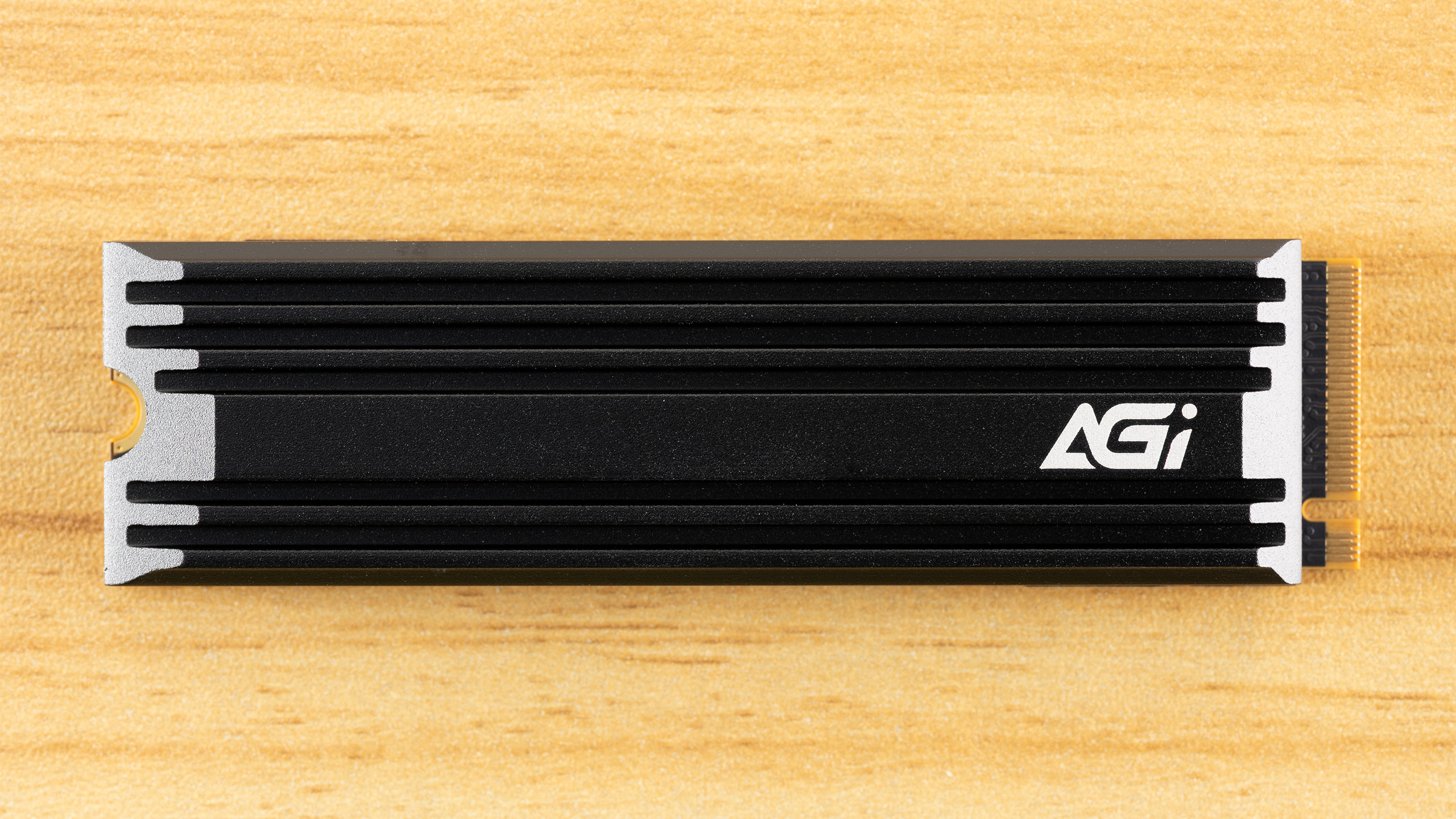
AGI’s AI828 is a budget-aimed PCIe 4.0 NVMe SSD with an included heatsink, broad capacity claims, and the usual catch for low-cost storage: the hardware inside may not be the same from one drive to the next.
Tom’s Hardware reviewed the drive and placed it between two earlier AGI models: the AI818, which it said performed poorly, and the AI858, which it found surprisingly competent. The AI828 is positioned for desktops, PlayStation 5 consoles, and laptops, although laptop use generally means leaving off the heatsink.
The practical verdict was narrow. Tom’s Hardware said the AI828 can beat some returning PCIe 3.0 drives and entry-level PCIe 4.0 models, including TeamGroup’s NV5000 and older MP44L, but it is not the reviewer’s first pick unless pricing drops below stronger alternatives.
What AGI is selling
AGI lists the AI828 in 512GB, 1TB, 2TB, 4TB, and 8TB capacities, all in the M.2 2280 form factor with PCIe 4.0 x4 and NVMe 1.4 support. Tom’s Hardware said only the 1TB and 2TB models were available at the time it checked retail channels, priced at $239.99 and $449.99. The review called those prices high, while noting that stock and pricing have been moving around.
AGI rates sequential reads as high as 7,400MB/s. Sequential writes vary by capacity, topping out at 6,700MB/s on the 2TB model. The company does not publish random IOPS figures for the drive, according to the review.
The AI828 carries a five-year warranty. AGI rates endurance at 750TB of writes per terabyte on the 1TB and larger models listed in the review, above the 600TB-per-terabyte level Tom’s Hardware described as common. The 512GB model is rated at 350TBW.
The hardware is the messy part
Tom’s Hardware found a single-sided board with a DRAM-less controller, two NAND packages, and a separate power-management chip. The drive uses host memory buffer rather than onboard DRAM, so it borrows a small amount of system memory to help manage flash mapping.
AGI lists both the controller and flash as variable. That matters. SSD vendors in this price tier often swap components based on supply and cost, which can make one retail unit behave differently from another. Tom’s Hardware could not identify the NAND directly and said examples it had seen used TLC flash, while also pointing out that similar controller-and-endurance combinations can appear with QLC NAND in other drives.
The heatsink was considered adequate in the review. The board layout puts the controller near the center, with room for four NAND packages. Tom’s Hardware said that arrangement may help spread heat through the heatsink and keep trace lengths to the flash more even, though it did not argue that buyers should choose the drive for that layout alone.
Performance: fine, with small-drive caveats
Tom’s Hardware’s benchmark discussion focused on 512GB and 1TB samples. In 3DMark’s gaming-oriented storage test, the AI828 landed near the bottom of the comparison group, although the review said the 1TB model’s roughly 50-microsecond latency was still acceptable for gaming. The 512GB model was hurt by capacity, because fewer NAND dies mean less parallelism.
PCMark 10 looked better. Both tested capacities hit around the 45-microsecond responsiveness target Tom’s Hardware uses for primary-drive behavior, and the review said the AI828 was fast enough to serve as a boot drive or the only SSD in a system.
On a PlayStation 5, Tom’s Hardware reported no issue with read tests or transfers from the M.2 SSD. The weak spot was writing to the 512GB model, where the drive appeared to run short of fast pseudo-SLC cache during a large transfer. That is the unglamorous physics of cheap SSDs: denser flash and fewer dies save money, then punish sustained writes.
File-copy testing showed the same pattern. Reads were solid, writes were more limited, and the 512GB model held about 1.1GB/s in the workload cited by the review. Tom’s Hardware said the result was not disastrous for that size, but the AI828 should be discounted accordingly.
This story draws on original reporting from Tom's Hardware.