Nvidia has released a Synthetic Video Detector, a microservice aimed at broadcasters, newsrooms and media companies that need to check whether incoming footage was generated by AI before it goes on air or into a feed.
The tool, which Nvidia calls SVD, is part of the company’s Nvidia Inference Microservice lineup and sits inside its AI for Media Private Access Program. That means it is not a normal consumer app. Nvidia has also posted a demo at build.nvidia.com, but the product is clearly built for production media workflows rather than casual “is this clip fake?” internet sleuthing.
Nvidia says SVD analyzes video frame by frame instead of judging a whole file as one blob. The system crops frames to 504 by 504 pixels, then sends them through two Meta vision transformer models, DINOv2 and DINOv3. Those models are designed to learn visual patterns without depending on manually labeled training data.
After that pass, SVD assigns each frame a score from 0 to 1. A score near 0 indicates the system sees the frame as real, while a score near 1 indicates it sees the frame as synthetic. Nvidia says the service averages those frame-level results into a percentage score for the video.
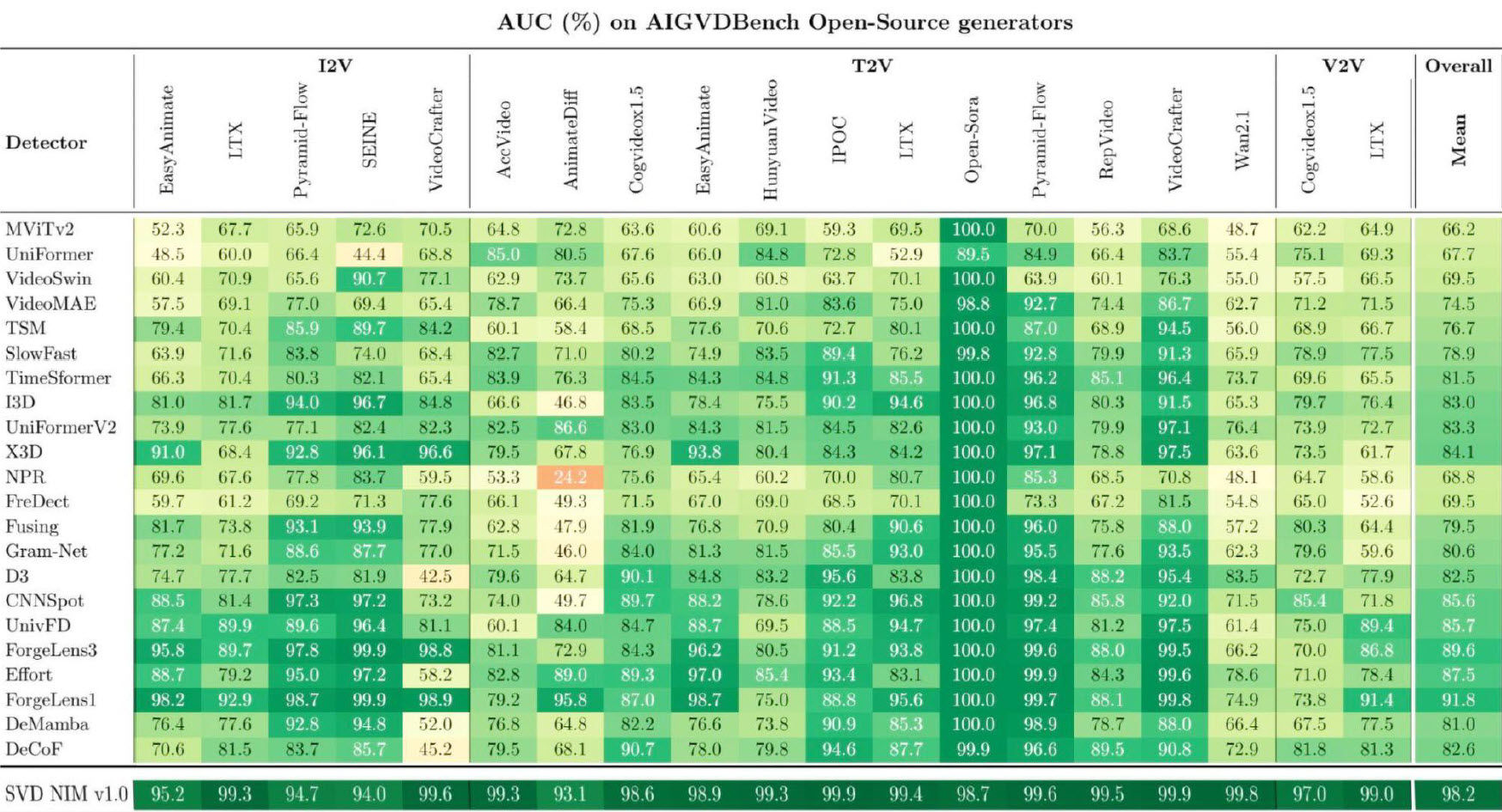
The company says the detector is based on research recognized at ICCV, the International Conference on Computer Vision. A related benchmark page is available on Hugging Face through the SAFE challenge.
Nvidia’s pitch is straightforward: generated footage is getting cleaner, social platforms compress and mangle files, and the old giveaways are less reliable. The company says SVD is designed to look for artifacts that remain useful even after social media compression hides obvious visual defects.
According to Nvidia’s AI GVD benchmark results, SVD reached 92% accuracy on uncompressed video. Nvidia reported 87% accuracy at 15% compression and 82% accuracy at 50% compression. Those are vendor-published benchmark numbers, so they should be treated as a claim about a test setup, not a universal guarantee for every clip a newsroom might receive.
Nvidia also claims low latency for the microservice. The company says SVD processes 1080p video in 22 milliseconds on Nvidia RTX GPUs and 30 milliseconds on Nvidia workstation models. That speed is the part broadcasters will care about if they want checks running close to live ingest rather than as a slow forensic step after publication.
There is a hardware catch. SVD requires Nvidia’s NVENC encoder, so Nvidia’s datacenter cards without that encoder, including B100, cannot run it natively. That is an odd but practical constraint for a tool aimed at high-throughput media operations.
Nvidia says it is working with Wowza to bring real-time synthetic video detection into livestreaming workflows. The demo currently accepts files up to 100MB and runs in the cloud, according to Nvidia’s demo page.
This story draws on original reporting from Tom's Hardware.