AMD used Nvidia Vera benchmarks as a springboard to argue that its upcoming Zen 6 “Venice” server CPUs are ahead in SPEC CPU 2026 integer tests, after Nvidia published Vera results in a white paper before AMD’s Advancing AI 2026 event.
Ravi Kuppuswany, AMD’s corporate vice president of compute and enterprise solutions, said he was “very happy” Nvidia released Vera performance figures because AMD could run its own tests using Nvidia’s disclosed configuration. Kuppuswany said AMD expected at least a 10% edge, but found a roughly 20% advantage before finishing its tuning.
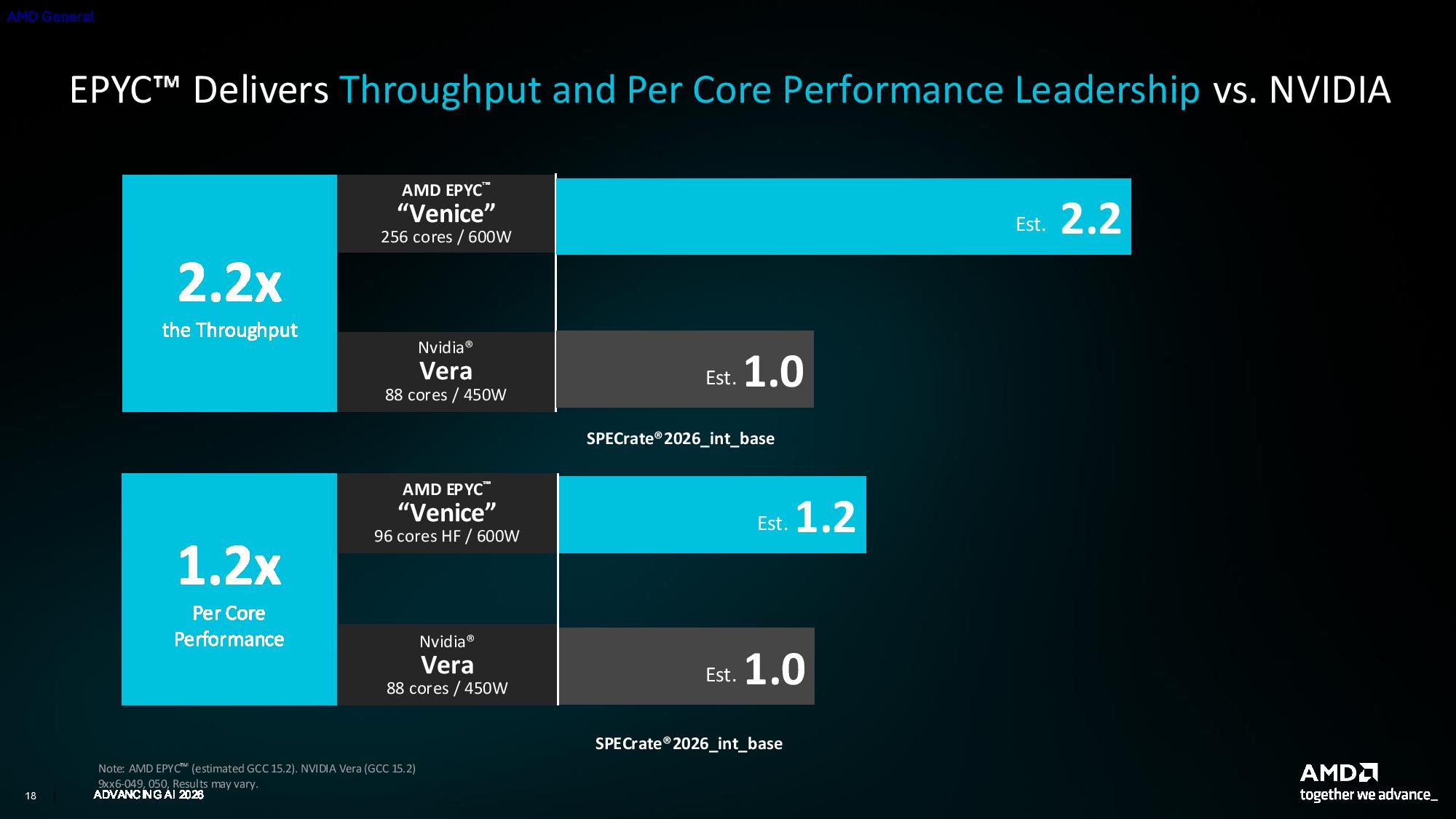
AMD’s slide claimed Venice delivered 2.2 times the throughput of Vera and 1.2 times the per-core performance. Those are AMD’s numbers, and they come with a large asterisk: the runs are labeled “estimated” because they have not been submitted to SPEC as official results under the group’s reporting rules.
How do Nvidia Vera benchmarks compare with AMD Venice?
The throughput comparison is the easiest to read and the easiest to abuse. AMD compared a 256-core, 600-watt Epyc 9996 Venice chip against Nvidia’s 88-core Vera, with both tested in two-socket systems. A processor with far more cores and higher power draw should post much higher throughput in a fully loaded benchmark.
AMD can say the matchup reflects the market reality that Nvidia is offering Vera as a single 88-core product. Nvidia, however, has described Vera as a CPU built for a particular role rather than a direct attempt to beat AMD’s highest-core-count Epyc parts across general server benchmarks.
The per-core claim is more useful, though still imperfect. SPECrate_int measures throughput by running many copies of workloads across threads and counting completed work over time. AMD derived its per-core figure by taking the overall SPECrate_int score and dividing it by core count, rather than using a separate single-application speed result.
Nvidia’s published Vera result showed an overall score of 925, according to the benchmark figures discussed by AMD. AMD said a 96-core high-frequency Epyc CPU scored 1,210. Dividing those totals by core counts in the two-socket systems gives about 6.3 per core for AMD and about 5.3 for Nvidia, which works out to roughly an 18.8% AMD lead. AMD rounded that into a 1.2 times claim.
There is one messy detail: the 96-core high-frequency chip cited by AMD does not line up cleanly with a known listed part in the way the slide presents it. AMD has a 96-core Epyc 9686F that boosts up to 5 GHz, but that part is rated at 500 watts, not 600 watts.
The larger Epyc 9996 tells a different story when normalized. AMD said that 256-core chip scored 2,070, which comes to about 4.04 per core in a two-socket setup. That is useful for seeing how the larger Venice part scales under load, rather than as a fair per-core contest with Vera.
The safe read is narrow: AMD says Venice leads Vera in unofficial integer SPEC CPU 2026 results using Nvidia’s published setup. Official SPEC submissions, compiler behavior and floating-point performance are still missing from the public comparison. AMD and Nvidia both used GCC 15.2, according to the benchmark discussion, but server chips do not live by one integer test alone.
This story draws on original reporting from Tom's Hardware.