Nvidia has filled in the missing pieces on Vera, its first data-center CPU built around an in-house core, and the sales target is obvious: AI infrastructure where the CPU spends its day feeding agents, sandboxes, databases and GPUs rather than winning old-school enterprise server bake-offs.
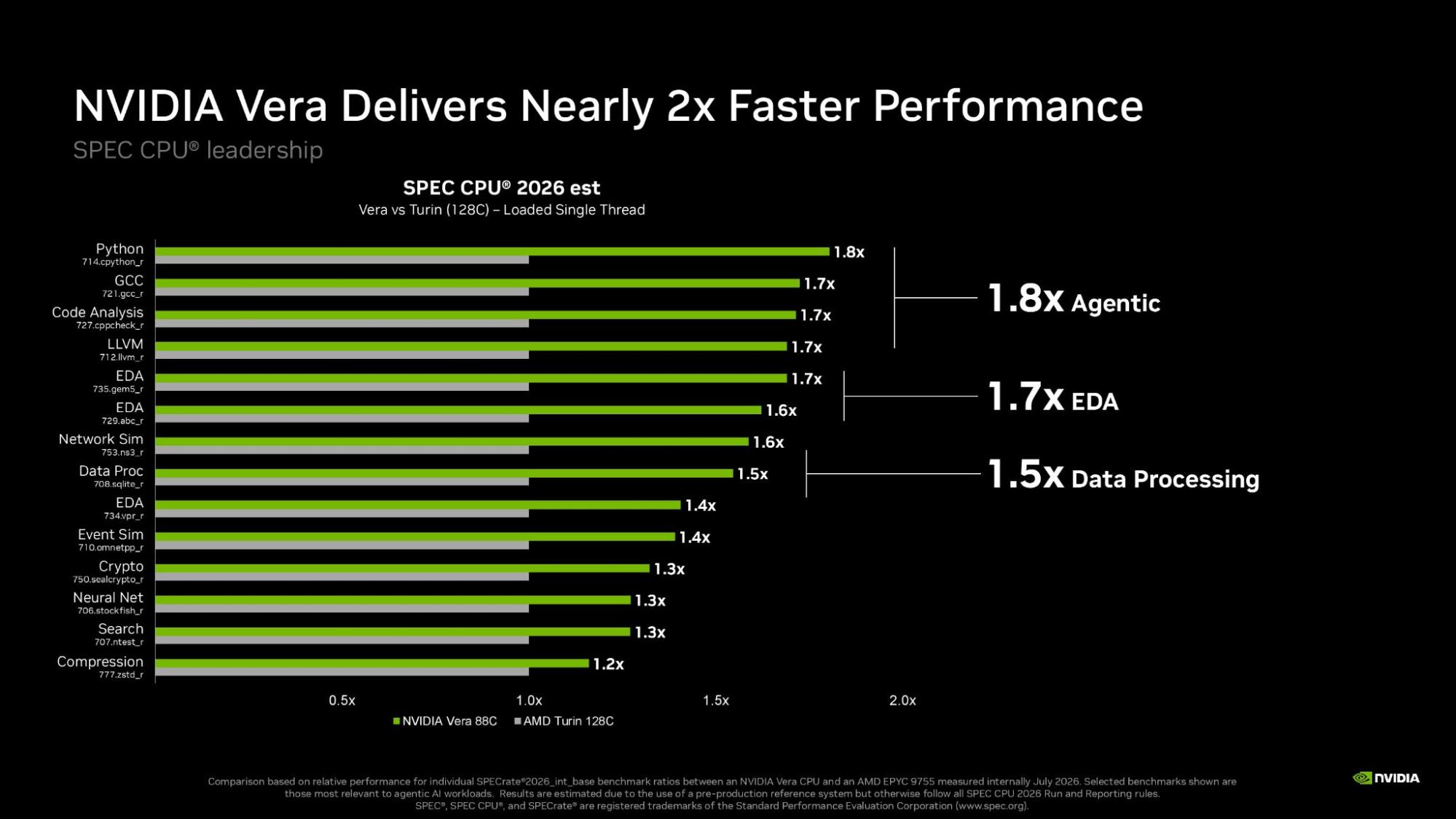
In a Vera white paper, Nvidia published unofficial SPEC CPU 2026 integer throughput results for a dual-socket Vera reference system against a dual-socket AMD Epyc 9755 system based on Turin. Nvidia reported an overall SPECrate integer base score of 925 for Vera and 898 for the Epyc 9755, putting Vera about 3 percent ahead in that test.
That number needs the boring caveat, because the boring caveat is doing work. Nvidia says the Vera system was a reference platform because the CPU is not broadly available yet. General availability is planned for the second half of the year, so the SPEC results are not official submissions. Nvidia also said both systems used GNU 15.2, which matters because SPEC CPU is compiled from source and compiler choices can swing results.
The benchmark claim
SPEC CPU 2026 includes several suites. Nvidia ran the SPECrate integer suite, which measures throughput by giving each thread a copy of the workload and timing completion. That structure naturally rewards chips with more cores and threads. Nvidia says Vera still led overall despite having fewer threads than AMD’s tested part.
Nvidia also presented normalized per-core comparisons that showed much larger Vera advantages. That is not the usual way SPECrate results are reported, and Nvidia did not publish the individual Epyc 9755 scores needed to reconstruct the comparison. Nvidia told Tom’s Hardware it normalized by physical core with simultaneous multithreading enabled on both systems because agentic AI and reinforcement-learning workloads run many sandboxes at once while individual agent steps remain sequential and latency-sensitive.
The workloads Nvidia emphasizes are code compilation, interpretation, exploratory data analysis and data processing such as SQLite. In Nvidia’s telling, those are the CPU-side chores around AI agents: checking repositories, resolving dependencies, building software and handling backend data work.
What Vera is
Vera uses Nvidia’s Olympus core, built on Arm v9.2-A. That is a shift from Grace, which used a stock Arm core design. Each Vera CPU has 88 Olympus cores on a monolithic die and supports 176 threads through spatial multithreading.
- 88 cores and 176 threads per CPU
- 2 MB of L2 cache per core
- 164 MB of L3 cache per CPU
- Up to 1.5 TB of SOCAMM2 LPDDR5X memory
- Memory speeds up to 9600 MT/s
- Up to 1.2 TB/s aggregate memory bandwidth
- Configurable TDP from 250 W to 450 W
- PCIe 6.4 support, with CXL 3.1
Nvidia says Vera improves instructions-per-cycle throughput by 1.5 times over Grace and claims 50 percent higher performance than x86 competitors, apparently in fully loaded per-thread comparisons. Its wider Olympus front end includes 10-wide decode, a neural branch predictor, 64 KB of L1 instruction cache and a 48-instruction decode queue. Nvidia says the branch predictor can handle two branches per cycle with no penalty.
The execution engine includes eight simple ALUs, two complex ALUs, four branch units, four load units and two store units. For vector work, Olympus includes Arm SVE support with six 128-bit vector units at FP8 precision, plus two crypto-capable vector units for algorithms including AES, SHA and SM3.
The design trade
Nvidia’s bigger bet is the memory and fabric design. Vera uses a second-generation Scalable Coherency Fabric to distribute last-level cache across a monolithic die. That avoids the cross-chiplet latency penalties that can show up in AMD’s chiplet architecture, though AMD’s approach favors core density.
Nvidia shared internal memory tests showing Vera with higher loaded memory bandwidth, more than four times the per-core bandwidth of the Epyc 9755 and more consistent core-to-core latency. Those tests came from Nvidia-developed tools, which it says are available on GitHub. They are architectural microbenchmarks, so they validate parts of the design more than they prove application performance.
Nvidia has not shared SPEC CPU floating-point results for Vera. That omission fits the product story: in a full Nvidia AI system, heavy vectorized work is meant to move to Rubin GPUs. It also leaves a gap. Vera’s memory subsystem looks built for demanding work, but public numbers so far mostly cover integer-heavy CPU tasks that Nvidia wants buyers to care about.
This story draws on original reporting from Tom's Hardware.