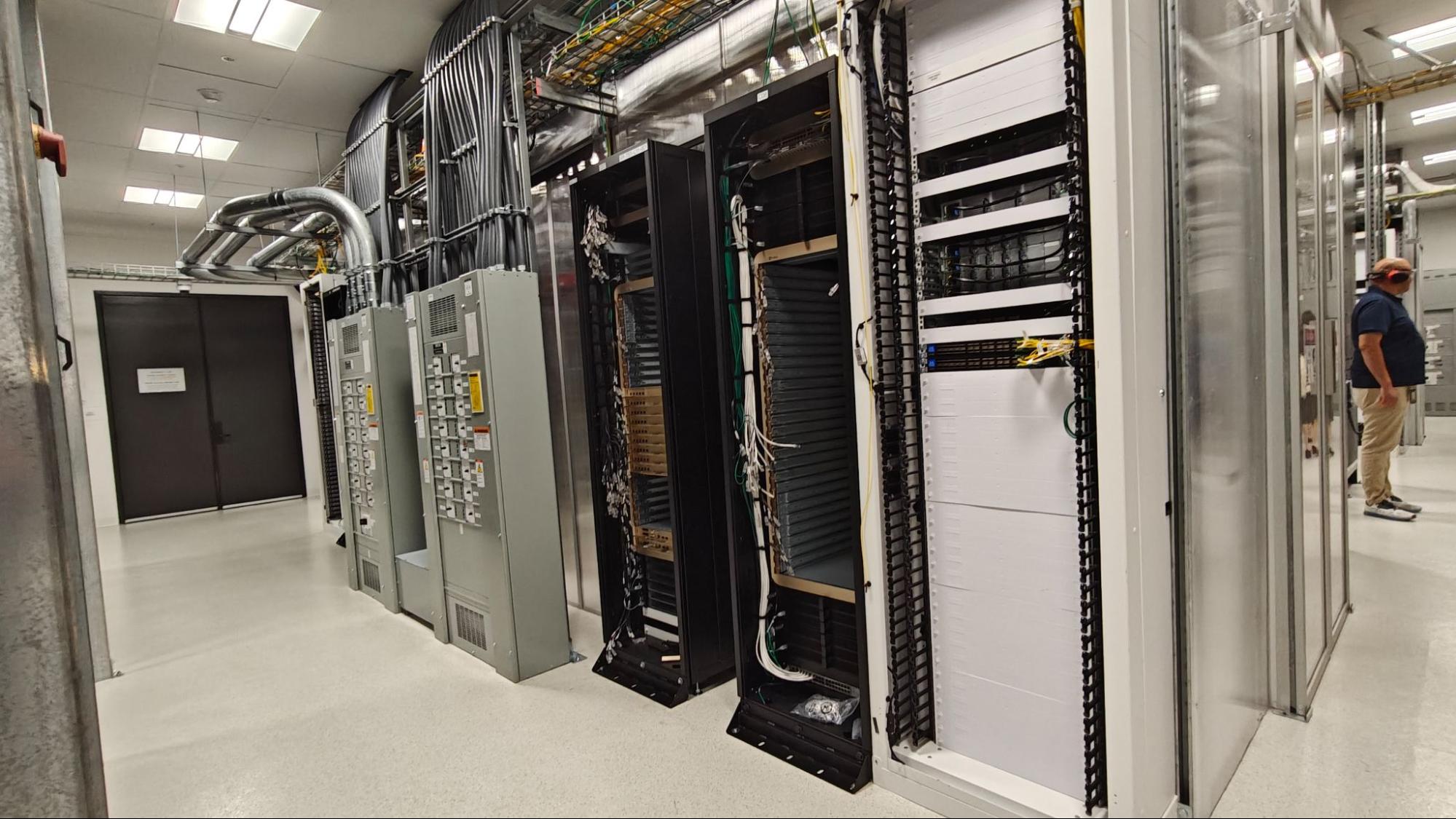
Nvidia has shown working Vera Rubin NVL72 racks inside its Engineering SuperLab near company headquarters, including systems the company said were running workloads for OpenAI. For buyers of AI infrastructure, the useful bit is not another keynote tray under stage lights. It is seeing the rack-level machine with power, cooling and networking attached, which is where most of the pain now lives.
Tom’s Hardware reported that Nvidia brought about a dozen journalists into one of four previously undisclosed engineering sites near its headquarters. Nvidia described the SuperLab as an engineering space rather than a polished production data center. The point, according to the company, is to let engineers install, replace and test racks quickly as new hardware comes online.
Vera Rubin as a rack, not a prop
The system on display was Nvidia’s Vera Rubin NVL72 rack. Nvidia said the racks in the lab were running OpenAI workloads, and Tom’s Hardware photographed trays labeled for OpenAI’s GPT-Rosalind model.
Each NVL72 rack contains 18 compute trays and 9 NVLink switch trays. Nvidia’s MGX NVL reference rack combines 72 Rubin GPUs with 36 Vera CPUs. The company also described an MGX ETL variant that swaps the NVLink spine for either a Spectrum-X Ethernet spine or a direct chip-to-chip spine, allowing scale-out configurations of up to 256 GPUs.
The front of each compute tray exposes two ConnectX-9 network interface cards and a BlueField-4 DPU. Around the rear, Nvidia’s NVLink spine ties the trays together through a dense copper interconnect. Nvidia says the sixth-generation NVLink implementation uses 5,000 copper cables totaling more than two miles, with up to 3.6 TB/s of bandwidth per GPU and 260 TB/s of scale-up bandwidth per rack.
Cooling is no side issue here. Nvidia’s earlier GB200 and GB300 NVL72 racks used hybrid cooling, according to Tom’s Hardware, while Vera Rubin trays are fully liquid cooled and have no fans. Nvidia said the design can use “dry cooling” if coolant enters at 45 degrees Celsius or below, using a heat exchanger rather than chillers. That claim would matter to operators because chillers consume space, power, water and money.
The rack takes coolant from large pipes at the top and sends warmed fluid out near the bottom. Tray connections hook into the loop automatically, leaving the main inlet and outlet connections at the rack level. Nvidia said it standardized the Vera Rubin NVL72 rack with the Open Compute Project, including shipping specifications, and claimed a rack can go from truck arrival to power-on in 47 minutes.
800VDC gets a live demo
Nvidia also demonstrated an 800VDC power sidecar feeding an NVL72 rack. A single Vera Rubin NVL72 rack can draw more than 200 kW, according to Tom’s Hardware, which makes conventional 48V or 54V DC distribution inside the rack increasingly awkward. Higher current means larger bus bars, more losses and more rack volume spent on power hardware instead of compute.
The sidecar Nvidia showed keeps 415V or 480V AC distribution in the facility, then rectifies that power to 800V DC in a separate rack filled with power equipment. That 800V DC feed then supplies adjacent compute racks. SemiAnalysis has described this kind of sidecar as a retrofit stage on the way toward broader 800VDC data center designs.
Nvidia is not alone in pushing the approach. Tom’s Hardware noted that Google, Meta and Microsoft have contributed to open sidecar designs such as the Mt. Diablo specification.
What was on the bench
Nvidia also laid out Vera Rubin components, including a compute tray next to a GB300 tray. The Vera Rubin tray uses two cables, no hoses and no fans, with retention arms that Nvidia demonstrated for sliding Super Chip boards in and out within seconds.
The company also showed a CPU-only tray with eight Vera chips, supporting up to 256 chips per rack. Tom’s Hardware photographed 128GB Micron SOCAMM2 LPDDR5X modules running at 6400 MT/s, with some slots unfilled. Nvidia is using SOCAMM2 to get modularity from a memory class that is often soldered down.
For scale-out networking, Nvidia showed ConnectX-9 in the trays and Spectrum-X co-packaged optics switch trays. Nvidia says Vera Rubin is in production, with rollout planned for the second half of 2026.
This story draws on original reporting from Tom's Hardware.