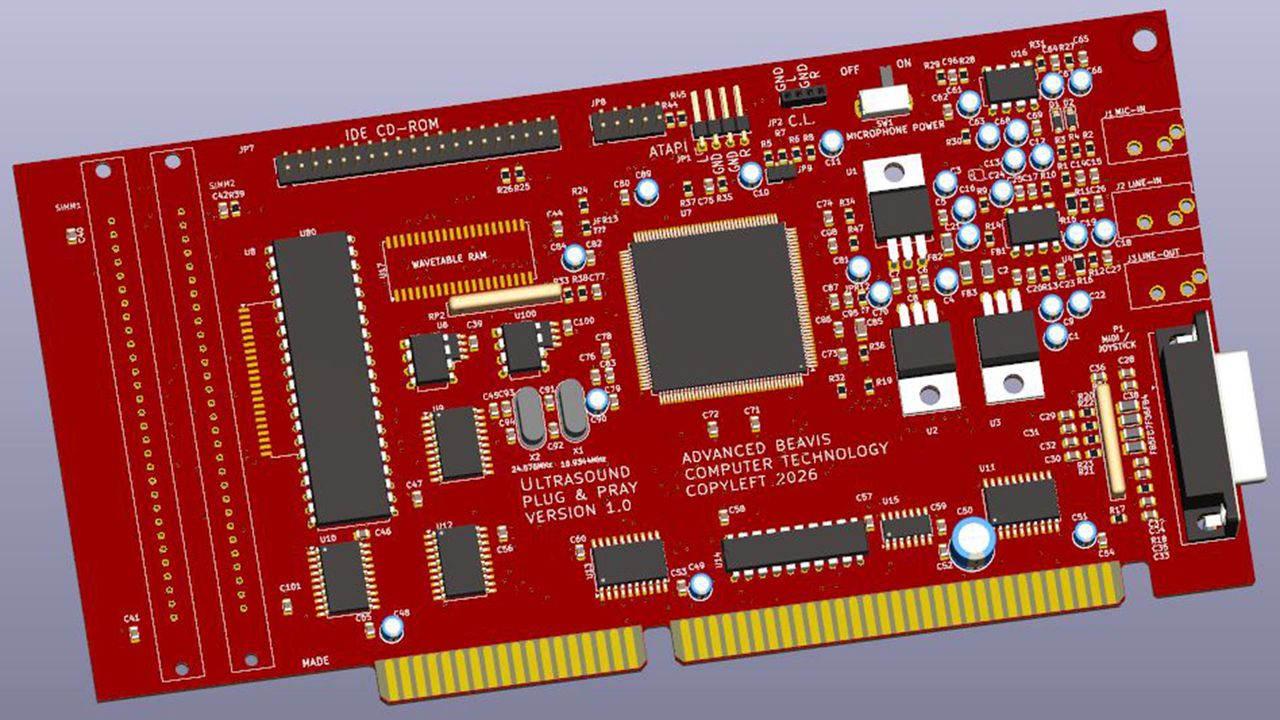
Developer schlae has published an open-source replica of the Gravis Ultrasound PnP ISA sound card, giving retro PC builders a full hardware design instead of another compatibility shim dressed up as preservation. The project, called Beavis Ultrasound, is available on GitHub and targets the later, more complex Plug and Play version of the Gravis Ultrasound rather than the earlier Classic or MAX cards.
The repository includes KiCad schematics, a PCB layout, a sample ROM, assembly notes and reverse-engineered GAL logic, according to schlae. That last part is the interesting bit for people who care about the hardware rather than the nostalgia fog. The GAL handles logic needed for an operational IDE CD-ROM interface, a feature present on original Gravis Ultrasound PnP cards.
Schlae describes the project as different from other clones because it includes both the full schematic and the reverse-engineered GAL source code. In practical terms, builders can inspect and reproduce the glue logic rather than treating part of the board as a black box. That is the difference between a clone you can audit and a clone you mostly have to trust.
The Beavis Ultrasound design also avoids the common modern shortcut of using a microcontroller to imitate vintage audio hardware. There is no software emulation standing in for the original card’s behavior, according to the project description. The board is meant as a hardware-level reproduction, including the IDE interface and associated logic rather than omitting awkward old parts because they are awkward.
The catch is the chip
The project still depends on one piece of old silicon: AMD’s AM78C201 InterWave chip. Anyone attempting a build has to find one. That is not a small caveat, since the InterWave is the sound engine at the center of the Gravis Ultrasound PnP design and is not a current commodity part you can toss into an online cart without thinking about provenance.
There is another catch, and it is the kind that should be printed in large type before anyone orders boards. Schlae says the Beavis Ultrasound PCB has not yet been fabricated and tested for functionality. The GitHub page tells builders to proceed at their own risk. Open source does not magically turn an untested board into a finished product, no matter how handsome the KiCad files look.
For purists, that uncertainty may be part of the appeal. The design exposes the schematics and the GAL logic, and it tries to reproduce the real PnP hardware rather than provide a close-enough audio path. For people who just want DOS games to make the right noises, that may be more archaeology than they signed up for.
Other routes to GUS-style audio
The Beavis Ultrasound sits beside other modern attempts to bring Gravis Ultrasound compatibility back to old PCs. The Orpheus II ISA sound card has returned as a commercial proprietary product and includes some GUS functionality, according to prior reporting cited in the project coverage. It is aimed at DOS and early Windows users, but it is not an open-source clone.
PicoGUS takes the opposite tradeoff. It is a DIY-friendly project built around the Raspberry Pi Pico’s RP2040 microcontroller and performs GUS-compatible playback in software. That avoids hunting for rare vintage parts such as the AMD InterWave, but it also means accepting emulation rather than a board built around the same kind of hardware used by the original Gravis Ultrasound PnP.
This story draws on original reporting from Tom's Hardware.