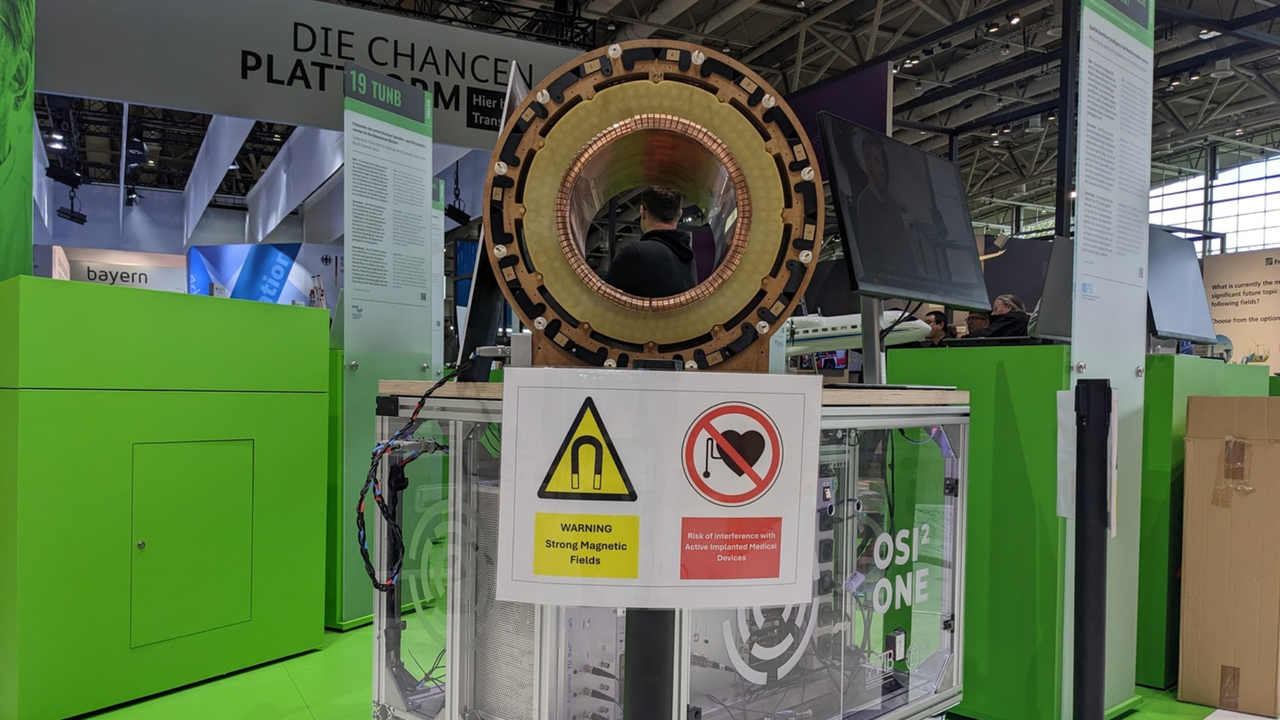
The open source MRI project known as OSI2 ONE has produced a portable scanner that can be built for under $70,000, according to the Open Source Imaging Initiative and comments cited from technology analyst Brian Roemmele. That is a very different price bracket from conventional MRI systems, which the project’s backers say start around $1.1 million for new machines and can run to several million dollars per unit.
The machine is not a like-for-like substitute for the scanners found in large hospitals. OSI2 ONE uses a 3D-printed core and operates at about 50 millitesla, far below the 1.5 tesla to 3 tesla field strengths common in full-sized clinical MRI systems. Lower field strength usually means lower spatial resolution and a weaker signal-to-noise ratio, which is exactly the trade-off that has kept low-field MRI from replacing higher-end machines.
What is the open source MRI?
OSI2 ONE is a portable MRI scanner from the Open Source Imaging Initiative, a group working on scanner designs that can be studied, modified and replicated. The project has already been copied multiple times in different countries, according to the initiative, which matters because MRI hardware is usually expensive, proprietary and tied to specialized installation requirements.
An MRI scanner uses magnetic fields and radiofrequency pulses to create images of tissue inside the body. In broad terms, stronger and more uniform magnetic fields make it easier to collect cleaner data. OSI2 ONE accepts weaker raw data in exchange for lower cost, portability and a design that researchers can inspect rather than treat as a sealed box.
Roemmele argued on X that modern AI reconstruction could help close part of the quality gap. He said models trained on high-field MRI data, or models that include the physics of the scanner, can denoise images, correct field inhomogeneity and improve apparent resolution from low-field acquisitions. He also described real-time adjustment of gradients and radiofrequency pulses as a possible way for software to respond to poor signal during a scan.
That claim should be read as a technical argument, not proof that a garage-built scanner is ready for hospital diagnosis. AI-assisted MRI reconstruction is an active research area, and the cited example of researchers training models on 1.6 million brain scans for dementia detection shows that medical imaging groups are already using large datasets. Whether a particular OSI2 ONE deployment can produce clinically reliable images would depend on validation, data quality, model design and the rules in the country where it is used.
Can a 3D-printed MRI replace a hospital scanner?
On the facts available, no serious case has been made that OSI2 ONE matches a full-sized, high-field MRI scanner. The better reading is that it targets places where the alternative may be no MRI access at all. Refurbished MRI units can still start around $100,000, and clinics also need money and space for the shielded, specialized rooms that conventional systems require.
That cost problem is the project’s strongest argument. A lower-resolution scan that has been carefully validated for limited uses could be useful in regions with poor access to imaging equipment. A low-cost scanner with unproven AI reconstruction could also be a regulatory and clinical headache. The hardware being open does not remove the need to prove that the images are good enough for the medical decisions people want to make from them.
Roemmele framed the project in blunt maker terms, saying on X that people cannot be stopped from building in garages. Hospitals, regulators and insurers may have other opinions. For now, OSI2 ONE is best understood as an open, low-field MRI platform that lowers the cost of experimentation and access, while leaving the hardest question unresolved: whether the images can be trusted in routine care.
This story draws on original reporting from Tom's Hardware.