PCIe Gen6 AI storage will start showing up with new server platforms in the second half of 2026, but ServeTheHome reports that PCIe Gen5 SSDs are not about to vanish from AI infrastructure. The reason is annoyingly practical: AI clusters need more bandwidth, while buyers still have to deal with budgets, existing platforms and tight component supply.
ServeTheHome framed the shift as a storage inflection point alongside the better-covered jumps in CPUs, GPUs and networking. The site disclosed that Silicon Motion advertises with it through an agency and said the analysis was sponsored. Silicon Motion makes SSD controllers used by many drive vendors, so its claims are useful, with the usual vendor-claim salt shaker nearby.
Why will PCIe Gen6 matter for AI storage?
PCIe Gen6 doubles the transfer rate per lane compared with PCIe Gen5, giving system designers either more bandwidth per device or the option to split lanes across more devices. ServeTheHome says that matters because AI storage is being pulled in several directions at once: high-capacity flash for training, fast local storage in GPU nodes, and shared storage for inference workloads such as KV cache and agentic AI.
A KV cache is saved model context used during LLM inference so a system can continue generating responses without recomputing earlier context. That is one reason storage and memory tiers are getting dragged into AI architecture discussions that used to focus mostly on accelerators. For background on the compute side of this, Kernel has an explainer on how LLMs work.
At data-center scale, ServeTheHome says a single PCIe Gen6 x16 slot can support 800Gbps of network bandwidth. It compares that to the throughput of about 32 PCIe Gen3 NVMe SSDs, or 128 PCIe Gen3 lanes, over one network link. The report says modern servers can carry eight to 10 of those links, and that individual GPUs may have 800Gbps or 1.2Tbps of network bandwidth available.
The server transition is expected to arrive with several new CPU platforms. ServeTheHome lists AMD EPYC Venice, Nvidia Vera, Arm AGI CPU and Intel Xeon 7 Diamond Rapids, with Diamond Rapids expected in 2027. The previous major server PCIe transition cited by the site was AMD EPYC 9004 Genoa bringing PCIe Gen5 to servers in 2022.
Why will PCIe Gen5 still matter?
ServeTheHome argues that Gen5 remains relevant because many AI deployments are constrained by cost, supply and installed hardware. Existing platforms still need storage upgrades, inference clusters need predictable throughput, and not every system will justify a first-wave Gen6 build.
The generational gap is still large. ServeTheHome says it can take roughly eight early-2021 PCIe Gen3 NVMe SSDs to match the throughput of a 2026 PCIe Gen6 SSD. That does not make every workload a Gen6 workload; it does explain why storage can become the boring bottleneck in systems sold as GPU miracles.
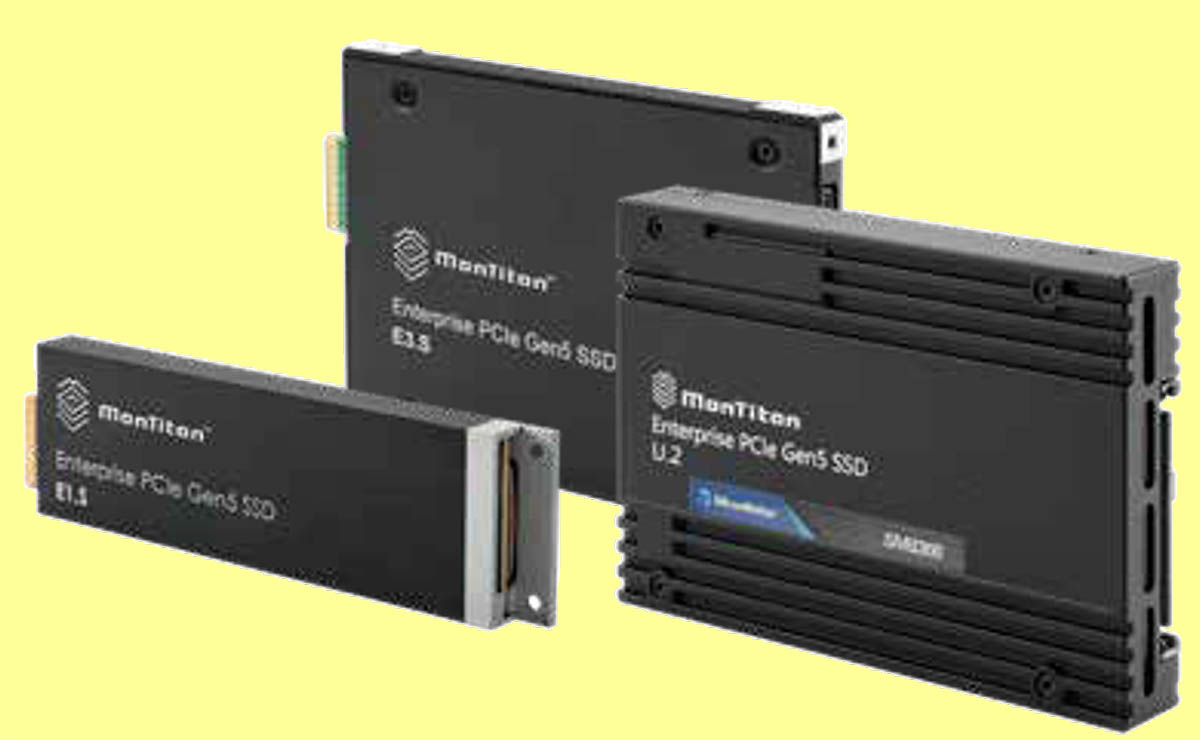
Silicon Motion points to its SM8466 controller as one Gen6 example. The company says the controller supports PCIe Gen6 x4, tops 28GB/s in sequential performance and exceeds 7 million random IOPS, about twice the company’s PCIe Gen5 SM8366. Silicon Motion also says the SM8466 targets Nvidia CMX, short for Context Memory eXtension, and KV-cache extension use cases.
The controller supports SR-IOV, Multi Physical Function isolation and NVMe 2.0 Flexible Data Placement, according to Silicon Motion. ServeTheHome says those features can help separate tenant workloads and improve data placement across AI jobs, although actual results depend on the finished SSD, firmware, host platform and software stack. The site also said it has not yet tested an SSD based on the SM8466.
This story draws on original reporting from ServeTheHome.