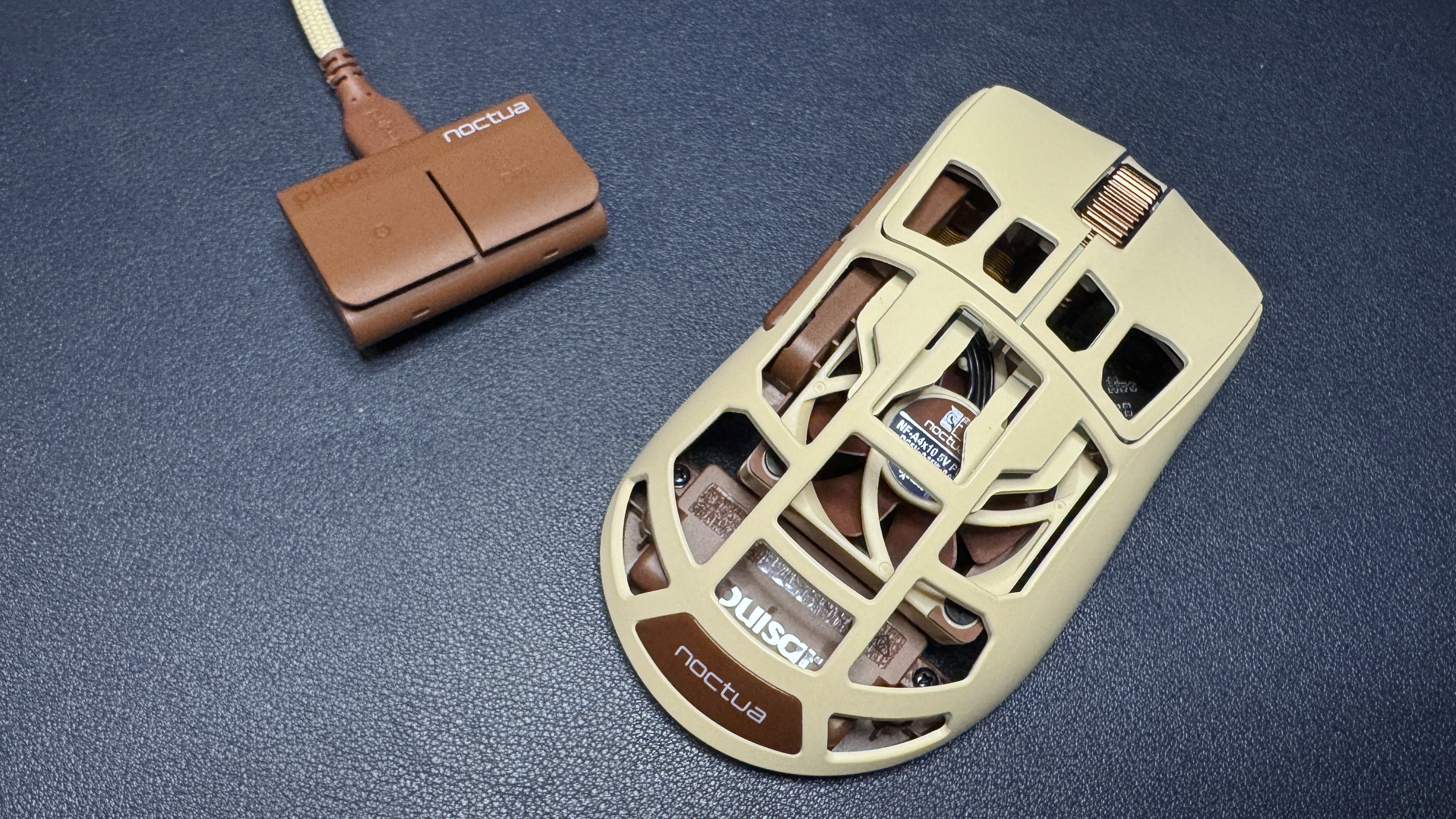
The Pulsar Feinmann F01 Noctua review comes down to a very specific trade: Pulsar put a 40mm Noctua fan inside a $179.95 right-handed gaming mouse, and reviewers say it can cool a user’s palm through the perforated shell. The cost is weight and, at the settings where the effect is clearest, battery drain. Pulsar’s release calendar lists the model as released on July 21, 2026.
This is active cooling for the hand, not for the mouse electronics. A Noctua NF-A4x10 fan sits under the carbon-composite chassis and pushes air upward through its cutouts. That makes the F01 Noctua Edition a narrowly targeted device for players concerned about palm heat or sweat, rather than a general performance upgrade disguised as beige hardware.
Does the Pulsar Feinmann F01 Noctua fan actually cool your hand?
In hands-on coverage, the answer is yes, with qualifications. Tom’s Hardware describes four fan settings, operated without software by holding both side buttons while moving the scroll wheel. Scrolling downward while holding those buttons switches the fan off; an LED on the left indicates the selected speed. Other reports say Pulsar’s browser-based driver can control it too.
Boardzy’s first-impressions video found a noticeable cooling sensation at maximum speed through the shell openings. Fresh Reviews similarly described the top setting as refreshing in hot, humid conditions, while calling speed three faint and speeds one and two barely perceptible. Those are individual experiences, not standardized airflow or skin-temperature tests, but they establish that the fan does more than decorate the spec sheet.
What buyers gain and give up
- Cooling: A 40mm Noctua fan directs air at the palm, with four speeds and an off setting.
- Weight: The Noctua Edition weighs 73g, versus 46g for the standard Feinmann F01. The fan adds 27g, about a 59% increase.
- Battery: Fresh Reviews reported losing about 15% charge in roughly 40 minutes of gaming with the fan at maximum and polling set to 4,000Hz. Boardzy also reported rapid drain when pairing high fan speed with high polling. Neither report is an official runtime figure.
- Price: The $179.95 launch and review price matches the regular F01’s reported price, according to The Gadgeteer and Tom’s Hardware.
The rest of the hardware is current flagship-mouse boilerplate, which is fine: Pulsar’s XS-2 sensor is rated for up to 42,000 DPI, 800 IPS tracking speed and 70G acceleration, with polling up to 8,000Hz. It supports 2.4GHz wireless through an included 8K dongle and wired USB-C use. Those maximum figures say little about a player’s results, but the reviewers cited no tracking failures in use.
Tom’s Hardware measured the mouse at 121.7 by 66.5 by 43.3mm and described its ergonomic, right-handed form as smaller than many mainstream gaming mice. Its reviewer found the carbon-composite shell sturdy and premium-feeling, but considered the unusually large side buttons mildly uncomfortable, particularly the rear one.
Buyers also get the full Noctua visual treatment: a beige-and-brown shell, color-matched 8K dongle and a 1.8-meter braided USB-C-to-USB-A cable. An aluminum-alloy scroll wheel and PTFE feet round out the package.
The F01 Noctua Edition earns its peculiar existence if palm airflow is a real priority and 73g is acceptable. People choosing a mouse chiefly for minimum weight or long wireless sessions should treat the fan as a compromise, not a free feature. The sensor upgrade is welcome; the tiny fan is the whole argument.
This story draws on original reporting from Tom's Hardware.