ASRock briefly listed the Radeon RX 9050 in 4GB and 8GB versions, giving the clearest vendor-level look yet at AMD’s unannounced entry-level RDNA 4 graphics card. AMD has not announced the GPU, and ASRock’s pages have since been removed, so pricing and launch timing remain unconfirmed.
The listings described ASRock Challenger cards using what appears to be a cut-down Navi 44 GPU, the same silicon family used in the Radeon RX 9060 series. According to the ASRock specifications, both RX 9050 versions carry 1,024 cores across 16 compute units, with a 1,920 MHz base clock and a 2,600 MHz boost clock.
That differs from earlier reports in May, which had claimed the entry-level RDNA 4 part would include 32 compute units. Vendor pages can still be wrong, especially when they appear ahead of an AMD announcement, but a live product listing is harder to hand-wave away than the usual forum smoke.
What are the Radeon RX 9050 specs?
ASRock’s listed split between the two cards is all about memory. The RX 9050 8GB uses GDDR6 on a 128-bit bus, with listed bandwidth of 288 GB/s. The RX 9050 4GB uses GDDR6 on a 64-bit bus, cutting listed bandwidth to 144 GB/s.
The listings also recommended a 450W power supply. That is below the 500W recommendation listed for the Radeon RX 9060, but the actual board power for the RX 9050 was not provided. The card images showed a single 8-pin PCIe power connector, two DisplayPort 2.1a outputs and one HDMI 2.1b port.
- GPU: Navi 44, according to the ASRock listing
- Cores: 1,024
- Compute units: 16
- RX 9050 8GB memory bus: 128-bit
- RX 9050 4GB memory bus: 64-bit
- Listed display outputs: two DisplayPort 2.1a, one HDMI 2.1b
The awkward part is the 4GB model. Recent desktop GPU releases have generally treated 8GB as the floor, even though 8GB cards still get criticized for struggling with newer games at higher settings. The last 4GB desktop GPUs cited in the report were Intel’s Arc A310 and Nvidia’s GeForce GTX 1630, both released in 2022.
A 4GB card in 2026 would likely target cheap prebuilt PCs and basic gaming systems rather than buyers chasing high settings. The 64-bit memory bus also means the 4GB RX 9050 would have half the listed memory bandwidth of the 8GB version, which can matter quickly once textures, resolution and ray tracing start asking for memory the card does not have.
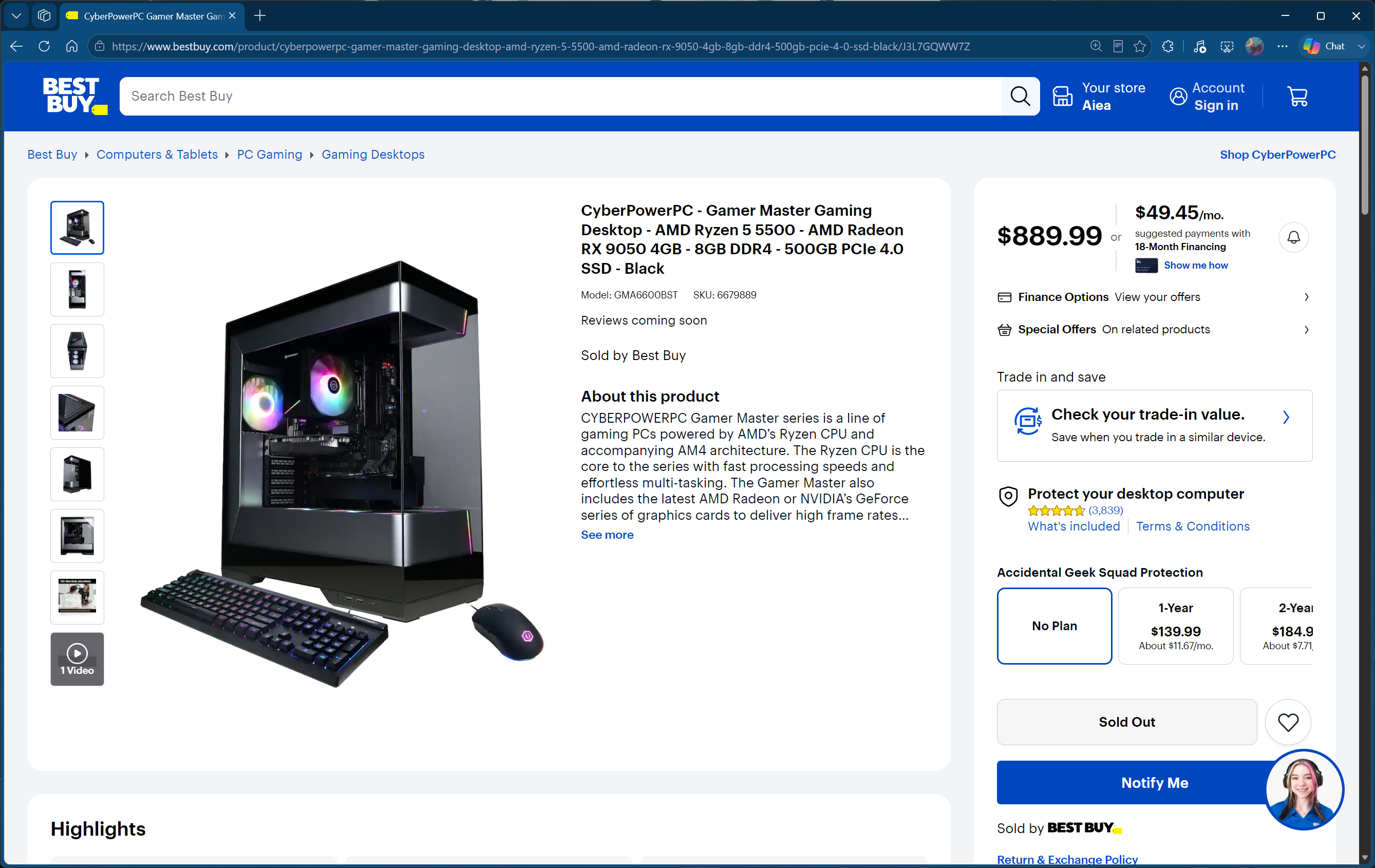
There is already one sign that the 4GB version may be aimed at system builders. A CyberPowerPC desktop listed at Best Buy includes an AMD Radeon RX 9050 4GB alongside a Ryzen 5 5500, 8GB of DDR4 memory and a 500GB PCIe 4.0 SSD, with the system shown at $900.
The 8GB model, if AMD and its partners sell it as a normal retail card, would be the less cramped version. Because the RX 9050 is listed as an RDNA 4 product, it should support the architecture’s newer ray tracing and upscaling features, including FSR 4. Performance claims beyond the listed specifications should wait for actual reviews, preferably with drivers AMD intended people to use.
This story draws on original reporting from Tom's Hardware.