Early Radeon RX 9050 benchmarks from Japanese outlet GDM put AMD’s newly launched budget RDNA 4 card well behind Nvidia’s GeForce RTX 5050 in many games, especially outside lighter esports workloads. The results are preliminary and come from one test setup, so they should be treated as an early read rather than the last word.
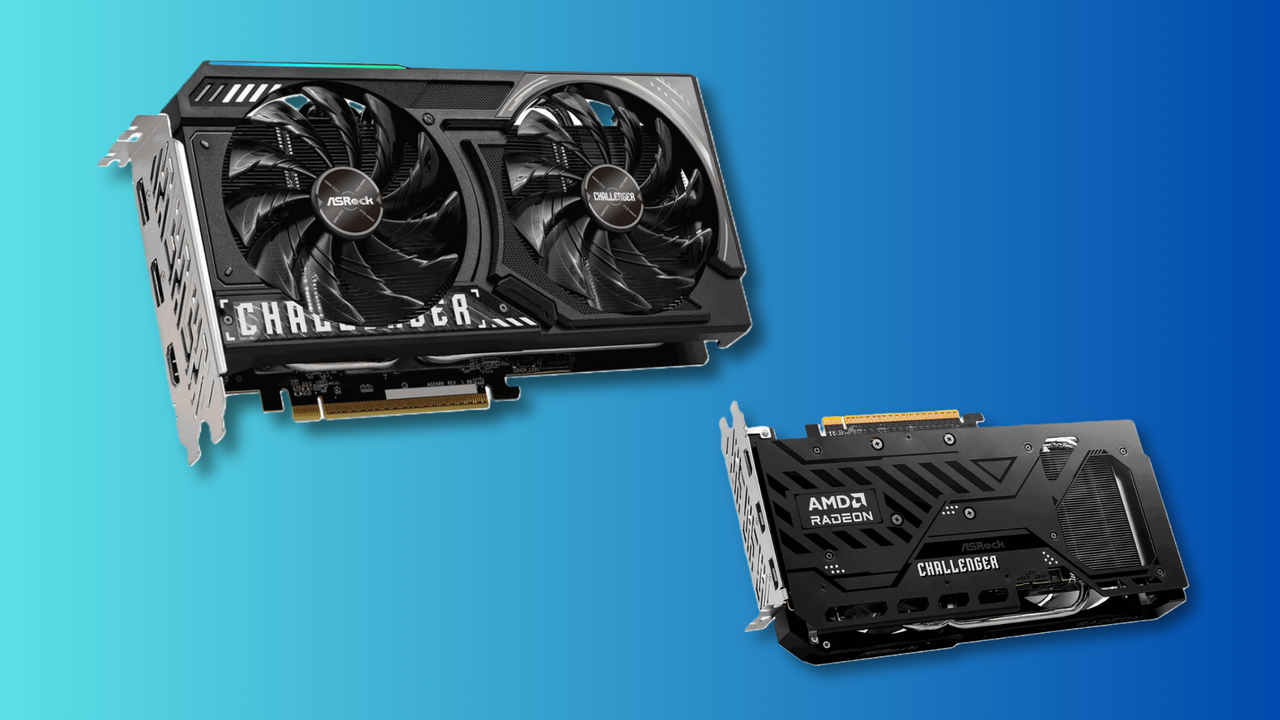
AMD launched the Radeon RX 9050 a few days ago as its lowest-cost RDNA 4 graphics card. GDM tested the ASRock Challenger version of the RX 9050 against Gigabyte’s Windforce OC version of the RTX 5050, using a system built around AMD’s Ryzen 7 9800X3D.
How fast is the Radeon RX 9050?
In GDM’s testing, the RX 9050 looks usable for 1080p gaming, but it generally loses to the RTX 5050. Across several titles cited in the results, the AMD card was roughly 30% slower on average, with wider gaps appearing at higher resolutions in some games.
The synthetic tests also favored Nvidia. In 3DMark, the RX 9050 was nearly 20% behind overall. The smallest gap came in Time Spy, where the two cards were separated by about 500 points: 9,441 for the RX 9050 and 10,571 for the RTX 5050. The ray tracing tests were less kind to AMD. In Port Royal, the RTX 5050 scored 6,181 while the RX 9050 reached 4,531. In Speed Way, the RX 9050 scored 1,873 against the RTX 5050’s 2,520.
Ray tracing benchmarks stress hardware used to calculate lighting, reflections and shadows in a more physically modeled way than standard rasterized rendering. That matters here because the RTX 5050’s lead grew in those tests, which is exactly where budget GPUs tend to show their compromises fastest.
Where did the RX 9050 hold up?
GDM’s esports results were less lopsided. In Apex Legends at maximum settings, the RX 9050 delivered 147.1 FPS at 1080p, compared with 192.4 FPS for the RTX 5050. At 4K, the gap narrowed sharply: 72.6 FPS for AMD and 74.8 FPS for Nvidia.
Rainbow Six Siege X also showed the RX 9050 staying in the fight. At medium settings, GDM measured 204 FPS at 1080p for the RX 9050 and 239 FPS for the RTX 5050. At Ultra+ settings in 4K, both cards landed at 64 FPS.
DOOM: The Dark Ages was the odd case in the data. GDM’s numbers showed the RTX 5050 far ahead at 1080p, but the RX 9050 winning at 1440p and 4K in the listed settings. The test also involved unequal frame-generation support: Nvidia’s card had multi-frame generation up to 6x, while AMD’s FSR frame generation was limited to 2x. Frame generation creates additional displayed frames between rendered ones, so comparing modes with different multipliers can make FPS results messy.
Where did Nvidia pull away?
Outside those exceptions, GDM’s results were rougher for AMD. In Final Fantasy XIV: Dawntrail, the RTX 5050 led by about 23% at 1080p in the standard benchmark. In Cyberpunk 2077, the Nvidia card was 42.4% faster at 1080p medium and 70.2% faster at 1080p ultra. In Onimusha: Way of the Sword, the RTX 5050’s lead ranged from 23.4% at 1080p medium to 72.8% at 4K ultra.
GDM’s averaged results for the remaining game group put the RX 9050 31% behind at 1080p, 34% behind at 1440p and 42% behind at 4K.
The RX 9050 did better on power. GDM measured it using about 8 watts less at idle and about 35 watts less under heavy load than the RTX 5050. The testing also described the AMD card as cool and quiet, with small-board potential for compact PCs.
The early verdict is narrow: AMD’s 8GB RX 9050 can run 1080p games, but GDM’s first numbers make the RTX 5050 look faster in most direct comparisons. The reported 4GB RX 9050 variant appears limited to OEM systems, according to the same reporting.
This story draws on original reporting from Tom's Hardware.