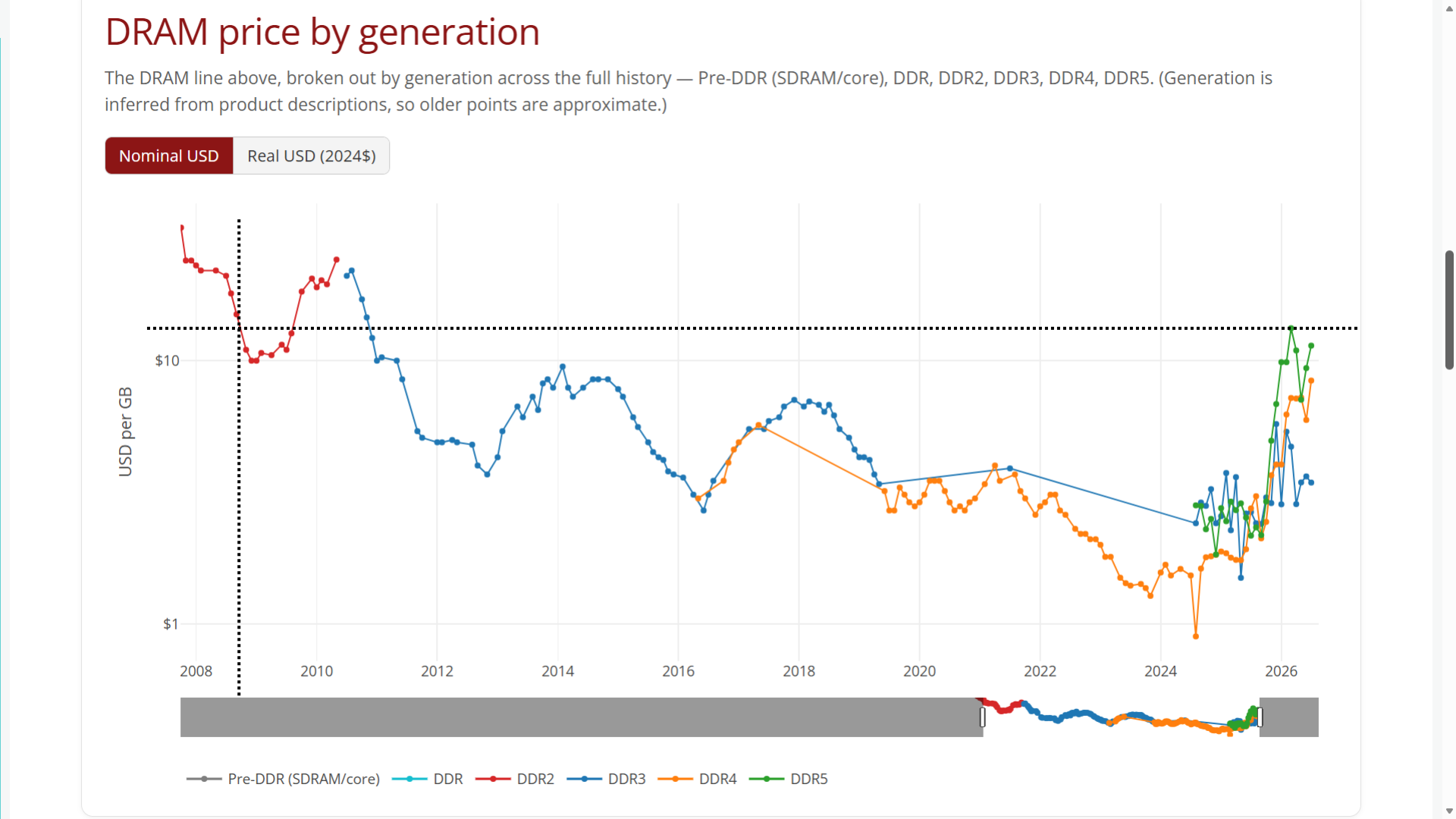
Daniel Lemire, a software-performance researcher and developer, says RAM prices 2007 levels is no longer a nostalgic PC-builder complaint but a defensible per-capacity comparison. In an Aug. 5 post, Lemire said decades of declining computer-memory costs had lost roughly 20 years of progress in a matter of months, leaving RAM about as expensive per unit as it was in 2007.
That is Lemire’s assessment, not a settled law of hardware economics. He called the reversal a historical anomaly to the best of his knowledge and said he could not name a comparable precedent. He also declined to forecast an end date, suggesting only that AI systems may need to use less memory or manufacturers may need to expand output much faster.
The distinction that prevents this comparison from turning into spreadsheet cosplay is the unit and the dollar basis. The claim concerns price per gigabyte, not the shelf price of a particular memory kit, and inflation changes the apparent historical match.
Are RAM prices really back at 2007 levels?
Tom’s Hardware reported that data compiled by David Shim for Stanford’s DAM Project put DDR5 at roughly $11.41 to $13.28 per GB. On a nominal-dollar basis, it said those levels resembled DDR2 pricing in 2008, when prices ranged around $11 to $15 per GB. After the publication’s stated adjustment using 2024 inflation, it placed the comparable point in 2011, when DDR3 cost about $11.85 per GB.
So “2007 levels” is a useful shorthand for Lemire’s per-unit, historical trend analysis, rather than an exact match that survives every choice of inflation measure and memory generation. The broader point is less delicate: the long-running decline in memory capacity costs has sharply reversed.
Why does AI demand affect ordinary RAM?
RAM is a computer’s temporary workspace for active programs and data, not its long-term file storage. Computer memory works differently from SSD storage, and AI servers consume far more of it than a typical consumer device.
The pinch is partly about what manufacturers choose to make. CNBC reported that Micron business chief Sumit Sadana said producing one bit of high-bandwidth memory, or HBM, requires the company to forgo three bits of conventional memory. HBM is the specialized, high-speed memory packaged alongside AI processors. That tradeoff does not prove HBM alone sets every consumer-RAM price, but it shows how AI-server demand can reduce supply available for PCs, phones and other products.
CNBC also reported that TrendForce expected average DRAM prices to rise 50% to 55% in a quarter compared with the fourth quarter of 2025. Separately, Northeastern University cited Counterpoint Technology Market Research’s estimate of an approximately 90% increase in memory prices in the first quarter of 2026 versus the same late-2025 baseline. Those are different measures from different firms, so they should not be stacked into one grand total.
Matteo Rinaldi, a Northeastern electrical and computer engineering professor, described the situation as an AI-driven memory-demand shock. His explanation is unglamorous but useful: Samsung, SK hynix and Micron have shifted more production toward high-bandwidth and high-capacity products for data centers, constraining general-purpose memory modules. The AI boom did not make ordinary RAM technologically worse. It made the industry’s limited output much more contested.
This story draws on original reporting from Tom's Hardware.