Hop Aero has put public numbers on the Rook cargo rocket, an autonomous vehicle the Orange, California startup says could deliver 550 pounds, or 250 kilograms, as far as 750 kilometers in about 15 minutes. The pitch is military logistics without airports: launch from a 40-foot shipping container, fly a space-skimming ballistic path, and touch down on rough ground near the customer.
The company is small, with six people listed by Y Combinator, and its public government support is modest by rocket standards. Hop Aero has a $1.25 million Air Force contract that runs until October. Its Y Combinator profile describes an Okinawa-to-Taiwan trip as the reference mission and frames Rook as a way to move groups of autonomous unmanned systems onto a battlefield. Hop Aero also says it has completed one tethered test of a small-scale prototype at the Oklahoma spaceport. Rook itself has not flown.
What is the Rook cargo rocket?
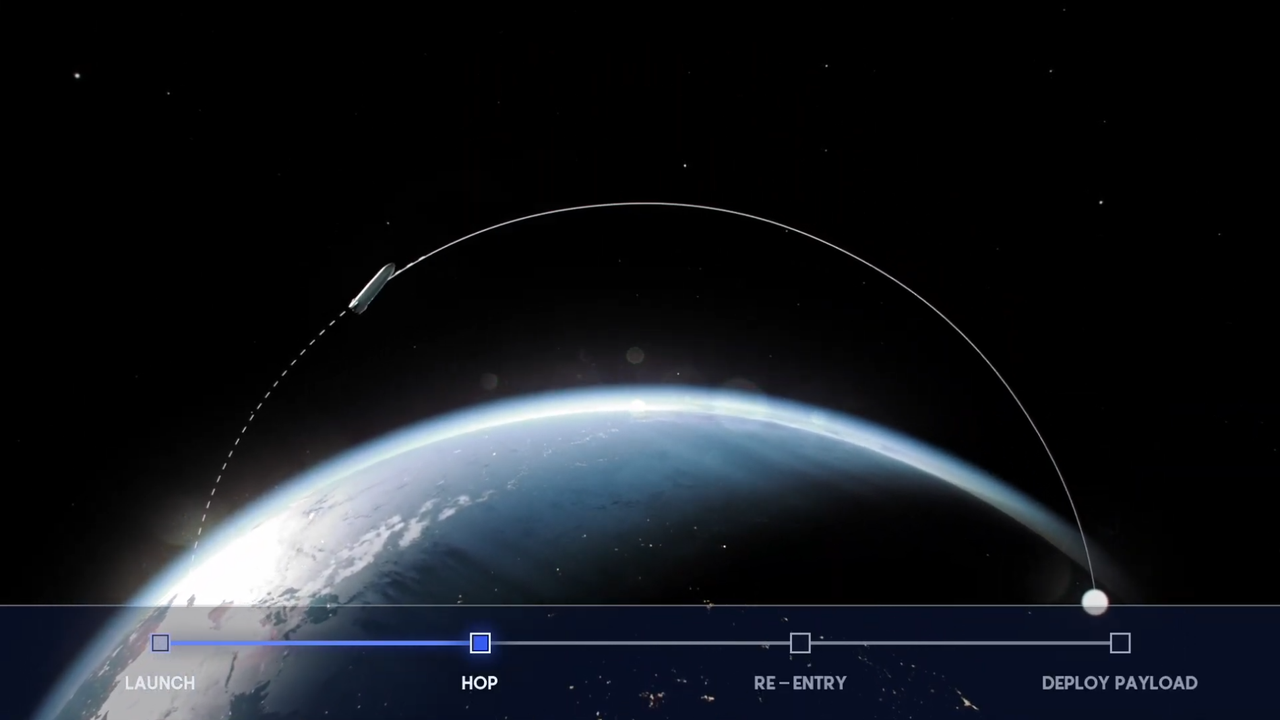
Rook is Hop Aero’s proposed point-to-point cargo rocket, meant to carry a small military payload over regional distances far faster than an aircraft or truck. Point-to-point delivery means the vehicle is not trying to stay in orbit; it launches, coasts along a ballistic arc, reenters, and lands at or near its destination.
The physics implied by Hop Aero’s claimed range is not gentle. A rough minimum-energy ballistic calculation for a 750-kilometer hop requires about 2.64 kilometers per second at burnout and would peak around 181 kilometers in altitude. That would carry the vehicle above the 100-kilometer Kármán line commonly used as the edge of space. The coast phase alone would take roughly six to seven minutes, leaving the rest of the claimed 15-minute trip for launch, reentry, and landing.
The shipping-container requirement also boxes in the design, in the literal engineering sense. A 40-foot ISO container has about 12.03 meters of internal length and 2.35 meters of internal width. For scale, Rocket Lab’s Electron is 18 meters tall and can put about 300 kilograms into low Earth orbit. Rook is not being sold as an orbital launcher, but those dimensions and velocities show why this is still a rocket problem rather than a drone problem with better marketing.
How does this fit with Air Force rocket cargo plans?
The Air Force Research Laboratory made Rocket Cargo a Vanguard program in June 2021. In January 2022, the Air Force awarded SpaceX $102 million to study the idea using Starship. Starship completed its 13th test flight on July 24, with the upper stage later splashing down in the Indian Ocean.
The Air Force later renamed the program Point-to-Point Delivery in its fiscal 2025 budget request and sought $4 million for it. Other pieces remain unfinished. A Johnston Atoll environmental review that covered as many as 10 reentry vehicle landings per year was suspended in July 2025. Rocket Lab’s AFRL reentry demonstration using Neutron has not flown.
Hop Aero’s technical lineage includes co-founder Jacob Balaj, who previously worked at Masten Space Systems. Masten spent 18 years flying vertical takeoff and landing vehicles more than 600 times and was developing Xogdor for point-to-point payload transport before filing for Chapter 11 in July 2022. Astrobotic bought Masten’s assets for $4.5 million that September.
Other startups have chased nearby territory with mixed results. Inversion Space, another Y Combinator company, raised $44 million in Series A funding and has about 60 employees, but its subscale Ray demonstrator failed to leave orbit in January last year after a short circuit prevented the deorbit engine from firing. No company has yet flown a licensed commercial point-to-point cargo delivery.
This story draws on original reporting from Tom's Hardware.