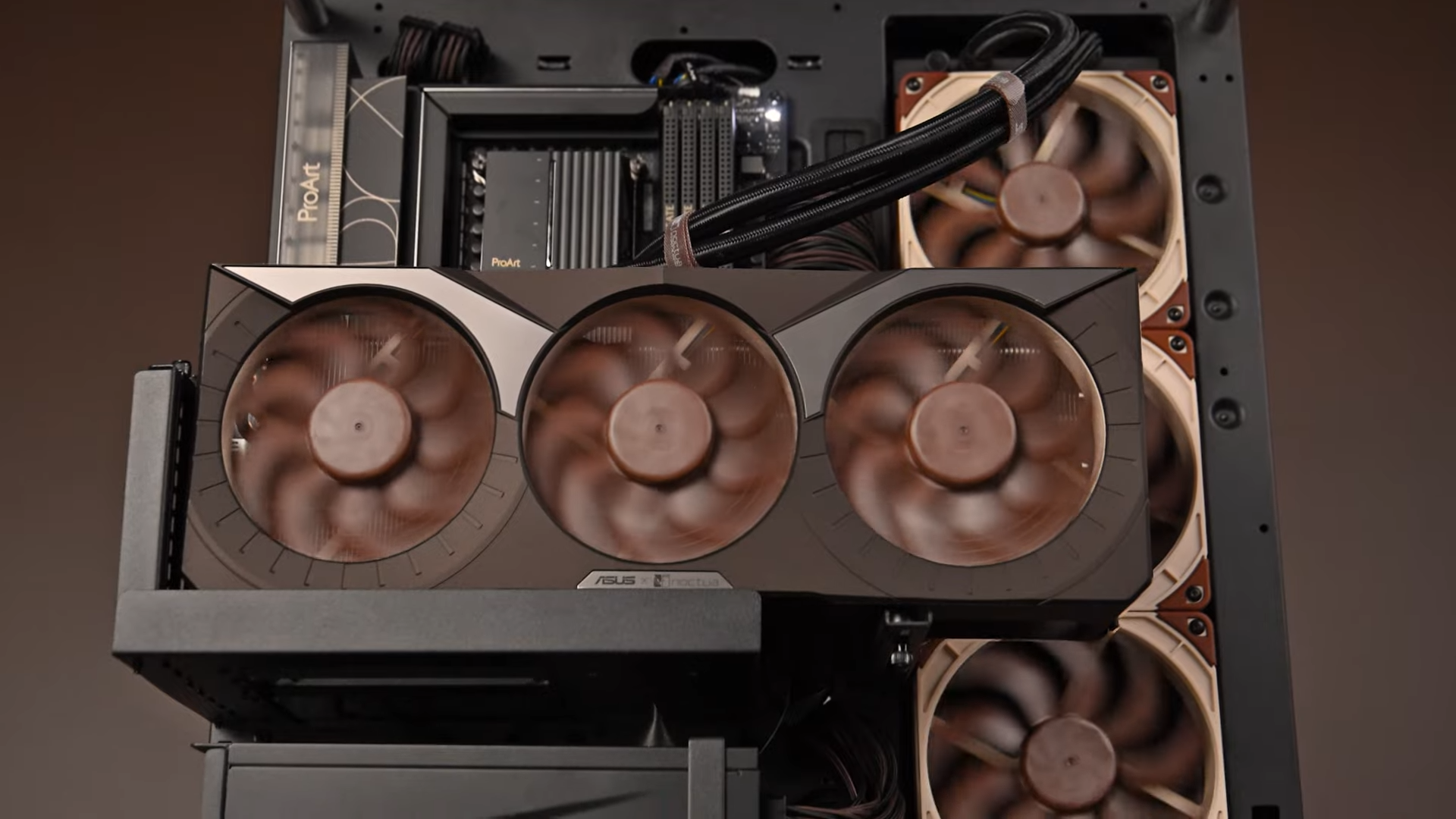
A rtx 3090 rtx 3050 lossless scaling setup has put an old high-end Ampere card back in the 4K conversation, at least according to one enthusiast’s report. Reddit user quziwuzzi said they used a Gainward GeForce RTX 3090 Phoenix to render games and an Asus Dual GeForce RTX 3050 OC Edition to handle frame generation through Lossless Scaling, reaching up to 144 FPS at 3840x2160.
The result comes with a large caveat: quziwuzzi did not name the games used for testing, and the numbers are a user report rather than a controlled benchmark. Still, the setup is a useful example of how a second, much weaker GPU can be used for a specific post-processing job instead of sitting in a drawer like a very expensive paperweight.
How does an RTX 3090 and RTX 3050 Lossless Scaling setup work?
In quziwuzzi’s configuration, the RTX 3090 remains the main graphics card. It runs the game and renders the base frames. Lossless Scaling then performs frame generation on the RTX 3050, so the RTX 3090 does not have to spend part of its own GPU budget generating additional frames.
Frame generation does not make the game engine render more original frames. It inserts generated frames between rendered ones, which can make motion look smoother and better match a high-refresh display. That distinction matters because the perceived frame rate can rise even when the underlying game simulation and input sampling are not increasing in the same way.
Quziwuzzi said the RTX 3090 alone produced up to 71 FPS at 4K. With the RTX 3050 assigned to Lossless Scaling frame generation, the reported output rose to 144 FPS at 4K. The goal, according to the Reddit post, was to feed a 42-inch LG C4 OLED television with a 144 Hz refresh rate.
Lossless Scaling is sold on Steam for $7 and provides upscaling and frame generation outside the usual game-specific support model. Unlike Nvidia DLSS, AMD FSR, or Intel XeSS, it is presented as working across games and video applications rather than depending on official integration in a given title.
What modes did the Reddit user say worked?
Lossless Scaling supports 2X, 3X, and 4X frame generation modes, which aim to double, triple, or quadruple the perceived frame rate. Quziwuzzi said 2X, 3X, and adaptive modes worked in the dual-GPU setup, and that the RTX 3050 was enough for frame generation at 4K.
The tool can also run on integrated GPUs, according to the report, though stronger hardware is still expected to produce better results. The same account said even older spare cards such as a GeForce GTX 750 Ti or Radeon RX 550 can be useful for improving a system’s gaming experience when used for this kind of workload.
The broader appeal is obvious: new graphics cards are expensive, and memory supply pressure has kept GPU pricing and availability uncomfortable for many PC gamers. A $7 utility plus a spare card is not the same as buying a new GPU, and generated frames are not a substitute for native rendering performance. For players trying to make existing hardware feel better on a high-refresh 4K display, quziwuzzi’s experiment shows one practical path.
This story draws on original reporting from Tom's Hardware.