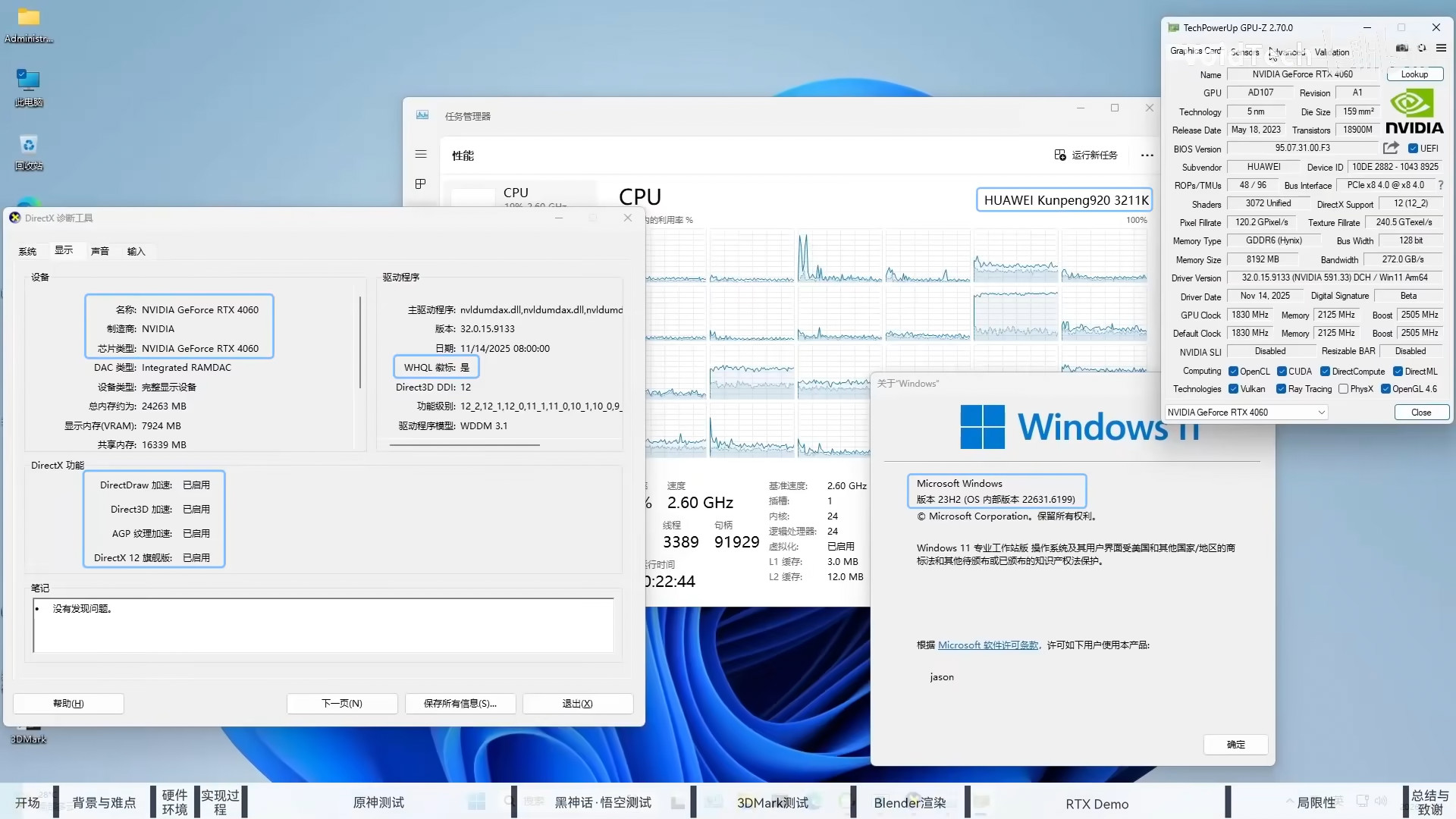
A Chinese hardware modder has shown an Nvidia GeForce RTX 4060 running under Windows 11 on an Arm workstation, a useful proof of life for a combination the PC industry keeps promising and rarely ships. According to WindowsLatest and a BiliBili video by the modder VoidTech, the setup used a modified Nvidia graphics driver associated with Nvidia’s RTX Spark platform.
The machine was not one of Qualcomm’s Snapdragon X laptops and did not use an Nvidia CPU. VoidTech installed the RTX 4060 8GB in a Huawei Qingyun W510 workstation built around Huawei’s HiSilicon Kunpeng 920. That chip was introduced in 2019 as a 7nm Arm server processor with configurations up to 80 cores. The W510 version used in the test has 24 cores.
The driver angle is the interesting part. Nvidia’s RTX Spark systems use Arm Windows 11 and include Nvidia graphics hardware derived from Blackwell technology, which means an Nvidia client graphics driver for Windows on Arm exists. VoidTech used that driver as the basis for getting a desktop GeForce card recognized on Huawei’s Arm workstation, according to the BiliBili demonstration.
The result was functional, in the cursed-lab-bench sense of the word. Windows 11 recognized the RTX 4060, and VoidTech ran games, 3DMark tests, Blender Cycles, and Nvidia RTX demos on it. The GPU was doing real work. The rest of the platform was less cooperative.
The Kunpeng 920’s many cores did not translate into good gaming performance. The report cites weak single-threaded speed, cache limitations, DDR4 memory tuned more for throughput than latency, and the extra cost of running x86 Windows games through Microsoft’s Prism translation layer.
- PassMark single-thread and multi-thread scores were listed as 733 and 9,496 for the Qingyun W510 with RTX 4060.
- A Ryzen 7 5800X system with the same GPU was listed at 3,448 and 27,671 in the same comparison.
- Genshin Impact at 1080p High ran at about 25 frames per second on the Huawei system, while the Ryzen comparison hit the 60 fps cap.
- Black Myth: Wukong at 1080p Medium ran at 21 fps on the Arm workstation, compared with 83 fps on the Ryzen machine.
- 3DMark Time Spy Graphics scored 6,369 on the Huawei system, versus 10,939 on the Ryzen system.
One game did not cooperate at all. Arknights: Endfield refused to launch. The report attributes the probable cause to a conflict between its Anti-Cheat Expert software and the Prism translation layer needed for x86 games on Windows Arm.
The biggest practical failure was display output. VoidTech said the RTX 4060 and monitor were detected, but the system would not send a working video signal through the card. The report suggests the RTX Spark driver may lack support for the HDMI and DisplayPort display engines on desktop GeForce cards.
VoidTech worked around that by running the Huawei machine headlessly with the Sunshine game-streaming server and connecting from another device with the Moonlight client. That let the RTX 4060 render frames without directly feeding a monitor.
The experiment also exposed the normal pain of forcing unsupported hardware into Windows. VoidTech showed trouble booting Windows 11 because of broken ACPI tables, and the workstation lacked Windows drivers for integrated hardware including the HiSilicon Network Subsystem and audio.
For future RTX Spark systems, the test cuts both ways. It suggests Nvidia’s Windows Arm graphics driver can run substantial DirectX workloads. It also shows how quickly compatibility gets messy once anti-cheat, display output, platform firmware, and x86 translation are dragged into the room.
This story draws on original reporting from Tom's Hardware.