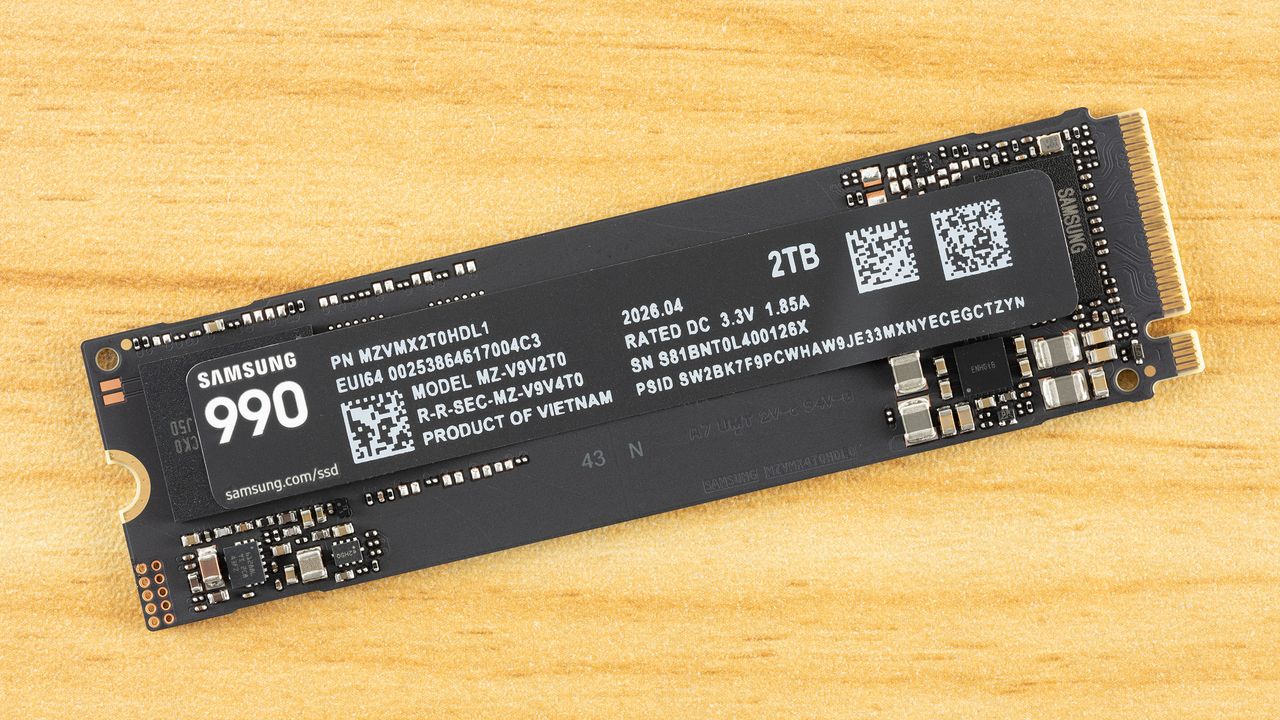
Samsung has put a new consumer SSD into the awkward middle of the storage market: the 990, a PCIe 4.0 NVMe drive built with QLC flash and aimed at buyers who want high sequential speeds without paying for a flagship.
According to Tom’s Hardware, which reviewed the 2TB model, the 990 should not be confused with Samsung’s Pro drives or its EVO line. It is closer in spirit to a budget QLC product, though Samsung has given it a plain 990 name rather than reviving the old QVO branding some watchers had expected.
The drive comes in only two capacities, 1TB and 2TB. Samsung lists MSRPs of $269.99 and $529.99, respectively, according to Tom’s Hardware. Those numbers are steep beside competing drives cited by the review, including Crucial’s P310 and WD’s TLC-based Black SN7100. Tom’s Hardware notes that Samsung often launches SSDs with high official pricing before retail prices fall, so the real test will be street price.
What Samsung actually built
The 990 uses Samsung’s PiccoloQ controller, a four-channel DRAM-less design that relies on host memory buffer rather than onboard DRAM. Tom’s Hardware identifies it as the QLC-oriented version of the Piccolo controller used in the TLC-based 990 EVO and 990 EVO Plus.
Samsung rates the 2TB model for up to 7,250 MB/s sequential reads and 6,450 MB/s sequential writes. Random performance is listed at up to 850,000 read IOPS and 1.2 million write IOPS. The 1TB model is slightly lower on reads and random I/O, with 7,150 MB/s sequential reads, 700,000 random read IOPS and 1.1 million random write IOPS.
The review says the 2TB drive uses a single package containing sixteen 1Tb dies, allowing enough parallelism across the controller’s four channels to hit Samsung’s top ratings. The single-package layout also keeps the M.2 2280 board single-sided, which helps fit laptops and other cramped systems.
- Interface: PCIe 4.0 x4, NVMe 2.0
- Flash: Samsung V9 QLC
- Controller: Samsung PiccoloQ
- DRAM: none, host memory buffer used instead
- Warranty: three years
- Endurance: 400 TBW for 1TB, 800 TBW for 2TB
- Security: TCG Opal 2.0
New NAND, familiar consumer payoff
The most interesting part is the flash, at least if you are the sort of person who reads NAND package markings for fun or self-defense. Tom’s Hardware says the 990 uses Samsung V9 QLC, a 286-layer part marketed as 280-layer after excluding non-data lines.
The review says Samsung’s new QLC improves density and includes design work meant to reduce the cost of protecting data during native QLC writes. In plain English: QLC stores four bits in each cell, which makes writing more delicate than TLC. Samsung’s method uses a parity-bit approach rather than a full backup of all four bits in pSLC, according to Tom’s Hardware, with claimed benefits for performance, endurance and density.
For buyers, the visible result is less exotic. Tom’s Hardware characterizes the 990 as competent rather than dominant, with technology that looks more ambitious than the consumer benchmark story. The review also notes that Samsung’s spec-sheet power figures around 4W are averages, while SMART data shows load power states can peak around 5.90W.
Samsung includes support through its Magician software, which Tom’s Hardware describes as a full SSD toolbox for health data, SMART reporting, firmware updates, benchmarking, encryption features and authenticity checks.
The short version: Samsung has a new QLC drive with modern NAND, full Gen 4 ratings and a clean single-sided layout. The less flattering version is that the 990 arrives late, with high launch MSRPs, into a market already full of fast cheap SSDs. The hardware is not the problem. The price probably is.
This story draws on original reporting from Tom's Hardware.