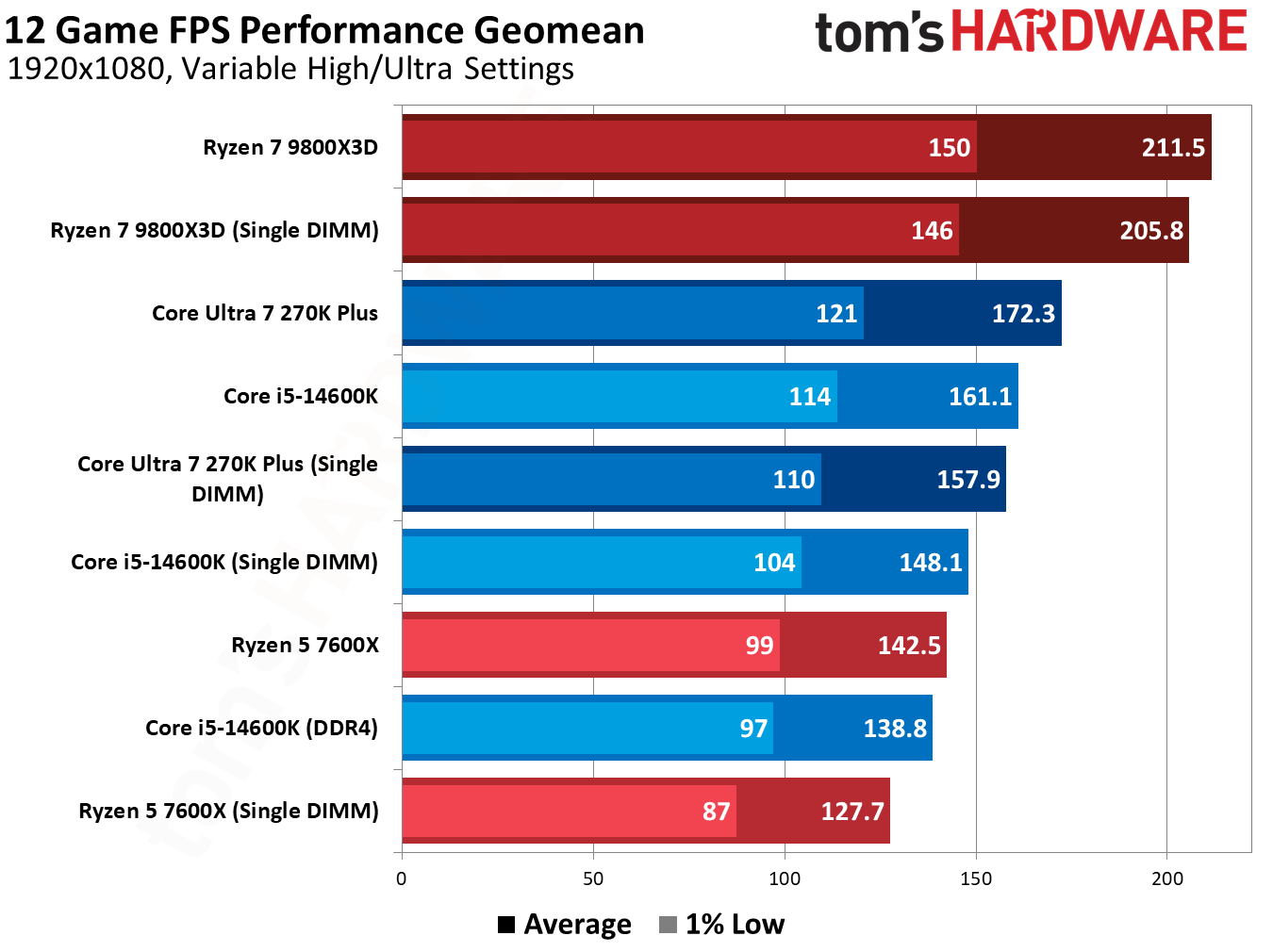
Single DIMM DDR5 gaming is less painful than old dual-channel habits suggest, according to new Tom's Hardware testing, which found that using one 16GB DDR5 stick instead of a 32GB two-stick kit cut average game performance by about 8% to 10% on most tested CPUs. AMD's Ryzen 7 9800X3D was the outlier, losing only 2.8% across a 13-game average.
The findings matter because rising DRAM prices have pushed some PC buyers and system builders toward one-stick DDR5 configurations as a cheaper way into a newer platform. AMD previously told Tom's Hardware that builders were considering the option, and Tom's Hardware said the pattern has appeared in many prebuilts.
A two-DIMM DDR5 setup still performed best. The useful surprise is that a single fast DDR5 DIMM often stayed ahead of dual-channel DDR4 on CPUs that can use either memory generation, according to Tom's Hardware's results. That is the sort of detail that gets lost when memory advice gets repeated from the DDR3 and DDR4 era without checking the current hardware.
Is one DDR5 stick enough for gaming?
For gaming alone, one DDR5 DIMM can be workable, though it is not the performance-optimal setup. Tom's Hardware tested at 1080p with High and Ultra settings and used an Nvidia GeForce RTX 5090 Founders Edition to reduce the chance that the graphics card, rather than memory, set the limit.
- The Ryzen 5 7600X lost 10.9% of average performance with one 16GB DDR5 DIMM across the 13-game geomean.
- The Intel Core Ultra 7 270K Plus fell 8.7%.
- The Intel Core i5-14600K dropped 8.3%.
- The Ryzen 7 9800X3D fell only 2.8%, helped by AMD's large 3D V-Cache.
Tom's Hardware also reported that 1% lows tended to fall in line with average frame rates, rather than collapsing separately. That matters because bad lows are what make a game feel choppy even when the average frame rate looks fine.
Individual games varied. In 007 First Light, the Core Ultra 7 270K Plus lost 8.9% and the Ryzen 7 9800X3D lost 6.5% with one DIMM. The Core i5-14600K dropped 7.9%, yet its single-DIMM DDR5 result still beat dual-channel DDR4 by 6.8%, according to Tom's Hardware.
Starfield punished the single-stick setup harder on Intel's Core i5-14600K, which lost 10.6% versus two DDR5 DIMMs. Even there, Tom's Hardware found one DDR5 DIMM was 6.9% faster than dual-channel DDR4, though it noted that slower DDR5 speeds would narrow that gap. In Starfield, the Ryzen 7 9800X3D lost only 1.6%.
Doom: The Dark Ages was another memory-sensitive case. Tom's Hardware measured a 17.3% drop on the Ryzen 5 7600X and a 14% drop on the Core Ultra 7 270K Plus, while the Ryzen 7 9800X3D lost 4.2%. In more GPU-heavy games, including The Last of Us Part One, the gap was smaller. Counter-Strike 2 also showed limited damage, with the Core i5-14600K down 5.9% despite running above 600 frames per second.
Why one DDR5 DIMM is not the same as old single-channel memory
A single DDR5 DIMM still has half the total bandwidth of two DDR5 DIMMs. The reason it does not behave as badly as older single-stick setups is that DDR5 changed the internal layout.
Tom's Hardware points to DDR5's two independent subchannels. DDR4 uses one 72-bit channel, with 64 bits carrying data and the rest used for ECC. DDR5 uses two 40-bit subchannels, with 32 data bits each, and each subchannel has its own command and address interface. DDR5 also increases prefetch size, bank groups and burst length. The practical result is that one DDR5 DIMM can perform two independent memory operations per cycle, while two DDR5 DIMMs can perform four.
Adding a second stick later has a catch
The upgrade path is the messy part. Tom's Hardware warns that buying one DDR5 DIMM now and a second one later can cause stability or performance problems if the sticks were not sold as a matched kit. Even two modules with the same brand and listed specs can differ internally if the vendor changes DRAM suppliers or timings.
Tom's Hardware recommends matching the brand and specifications if adding a second DIMM, then testing first at stock JEDEC settings without XMP or EXPO enabled. After checking normal games and applications, plus a memory test such as MemTest64, users can repeat the process with XMP or EXPO if the modules match. The boring answer remains the cleanest one: two matched DDR5 DIMMs are still better, but one fast DDR5 stick is not the disaster many buyers expect.
This story draws on original reporting from Tom's Hardware.